Published Date: January 7, 2026
Updated Date: January 7, 2026
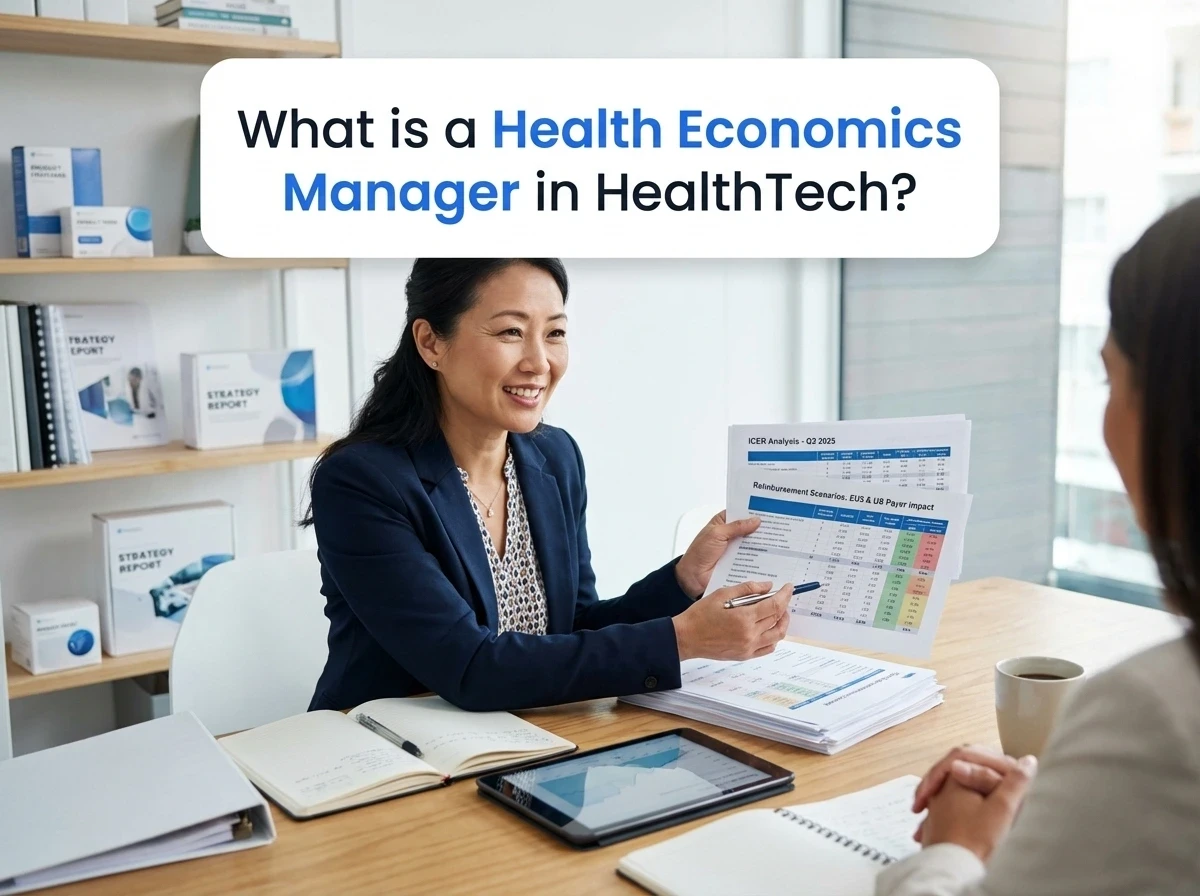
What is a Health Economics Manager in HealthTech?
A Health Economics Manager in HealthTech proves that a product creates value in real healthcare systems, not just in product demos. Their work translates clinical benefit and operational impact into the language that payers, providers, and procurement teams can act on: cost-effectiveness, budget impact, capacity implications, and the evidence plan needed to stand behind those claims.
This role exists because HealthTech adoption is rarely driven by users alone. It is driven by decision-makers who carry financial and clinical risk, who must justify spending, and who are held to standards about evidence quality. A Health Economics Manager owns the value story and the evidence strategy that makes a HealthTech product fundable, scalable, and resilient under scrutiny, especially when the product changes, data matures, or outcomes vary across settings.
More than a modelling role, it is an accountability role. The Health Economics Manager is responsible for deciding what value means for a specific buyer, what evidence is sufficient, what is too risky to claim, and what trade-offs are acceptable when timelines, data, and regulatory expectations collide.
🔍 How this role differs in HealthTech
In many tech sectors, the business case can lean heavily on productivity, conversion, retention, and willingness to pay. In HealthTech, the bar is different: value must survive clinical scrutiny, budget constraints, and procurement rules, and it often must be expressed in outcomes that aren't directly controlled by the vendor.
HealthTech also changes the data and risk landscape. Evidence frequently depends on sensitive health data, messy operational workflows, and real-world variation between sites. The Health Economics Manager must anticipate what happens when a product moves from a pilot to scaled deployment, when patient populations differ, and when operational constraints limit the ideal pathway assumptions.
Finally, the real-world impact is unusually tangible. If the value case is overstated, the consequences can include failed implementations, loss of trust, contractual disputes, or reputational risk with clinical stakeholders. The role therefore tends to be closer to decision-making (about what can be claimed, what must be tested, and what must be explicitly caveated) than equivalent economics or analytics roles in other industries.
🎯 Core responsibilities in HealthTech
Day to day, a Health Economics Manager operates as the internal owner of the product's economic truth. They work with product and clinical teams to define the target use case precisely, because economic value collapses when the use case is vague. They make judgement calls about comparators, pathways, and endpoints, balancing what is methodologically best with what is feasible given available data, customer timelines, and how care is actually delivered.
A large part of the work is navigating constraints. The data may be incomplete, heterogeneous, or biased towards early adopters; stakeholders may want bold claims that outpace evidence; the commercial team may need a usable value narrative before a full study is finished. The Health Economics Manager owns these tensions and resolves them by setting evidence standards, designing pragmatic evaluation approaches, and putting governance around what is communicated externally.
They also typically sit at the intersection of market access-style thinking and HealthTech go-to-market execution: shaping value propositions, supporting procurement responses, aligning economic assumptions to contracts, and ensuring the organisation can defend its claims when challenged. In more mature organisations, they may also lead or matrix-lead external partners (e.g., consultants, academic collaborators) and implement internal review processes that prevent value drift as the product evolves.
🧩 Skills and competencies for HealthTech
Core Skill | HealthTech specific requirement | Reason or Impact |
|---|---|---|
Value ownership | Ability to define and defend what value means for a specific HealthTech use case across different care settings | Prevents generic ROI claims and forces clarity on outcomes, comparators, and who benefits financially and clinically |
Economic judgement under uncertainty | Comfort making conservative, defensible assumptions when evidence is early, messy, or operationally confounded | Reduces the risk of over-claiming and builds credibility with buyers who scrutinise assumptions |
Stakeholder-grade communication | Translating economic evidence into procurement-ready and clinician-sensible narratives without diluting accuracy | Improves adoption by aligning decision-makers on what is proven, what is expected, and what remains unknown |
Evaluation strategy | Designing pragmatic study approaches that fit real service constraints, data availability, and implementation timelines | Enables evidence generation that is feasible in live environments and still persuasive to decision-makers |
Cross-functional influence | Steering product, clinical, and commercial teams towards claims and roadmaps that are evidence-aligned | Avoids misalignment where product promises outpace evidence, creating downstream delivery and reputational risk |
Governance and risk management | Setting review standards for external value materials and establishing claim control as the product changes | Keeps the value case stable over time and defensible when challenged by sophisticated buyers |
Systems thinking | Understanding patient pathways, operational bottlenecks, and capacity effects rather than isolated feature impact | Captures the real mechanisms that drive cost, wait times, and clinical outcomes in HealthTech deployments |
💷 Salary ranges in UK HealthTech
Pay in this role is primarily a function of how much risk you carry and how close you are to funding decisions. Scope matters (single product vs portfolio; pilot support vs national-scale procurement), as does criticality (whether economics is central to revenue), and whether the role is expected to lead submissions-grade work, govern external claims, or manage vendors and teams. Location influences ranges, but variation is also driven by seniority of decision-making, commercial exposure, and the complexity of evidence required.
Experience level | Estimated annual salary range | What drives compensation |
Junior | London & South East: £40,000–£55,000 | Usually supports modelling, evidence synthesis, and value materials under close supervision; lower accountability for external-facing claims |
Mid-level | London & South East: £55,000–£75,000 | Owns defined workstreams (e.g., budget impact, evaluation plans) and begins influencing go-to-market claims; compensation rises with autonomy and stakeholder exposure |
Senior | London & South East: £75,000–£95,000 | Accountable for the full value story for a product or segment, including assumption governance and cross-functional alignment; higher pay where the role is tightly linked to revenue outcomes |
Lead | London & South East: £95,000–£115,000 | Leads multiple products or a major evidence programme, mentors others, and becomes the internal standard-setter for claim quality and defensibility |
Head / Director | London & South East: £115,000–£150,000 | Portfolio ownership, leadership accountability, external credibility, and responsibility for governance, strategy, and resourcing; highest variance based on scale, buyer sophistication, and commercial impact |
Typical add-ons beyond base include performance bonus, pension and benefits, and (more commonly in venture-backed HealthTech) equity or options. On-call allowances are not typical for this role, but total compensation can still swing meaningfully based on bonus targets, equity value, whether the position is revenue-critical (e.g., tied to procurement wins), and whether the role includes people leadership and heavy external stakeholder responsibility.
🚀 Career pathways
Common entry points include health economics, outcomes research, public health, epidemiology, consulting, or analyst roles in life sciences, medtech, or healthcare strategy, often with early exposure to evaluation, modelling, or evidence synthesis. In HealthTech, a strong route in is through real-world evaluation work where you learn how implementation constraints and data quality shape what you can credibly claim.
Progression tends to come from expanding ownership: first owning analyses, then owning the assumptions and the story, then owning the evidence plan and governance. Over time, the role broadens from producing economics to setting standards for what the company will claim, how it will prove it, and how it will adapt the value case as the product evolves and scales. Senior progression is typically earned by being trusted to protect credibility whilst still enabling growth, especially when commercial pressure pushes for certainty that the data cannot yet support.
❓ FAQ
Do I need previous HTA-style submission experience to be credible in HealthTech?
It helps, but it isn't always required. What matters most is whether you can build a defensible value case, understand decision-maker expectations, and design evidence plans that fit real deployment constraints. If you don't have submission experience, be ready to demonstrate rigour, assumption governance, and an ability to communicate uncertainty clearly.
How is my performance evaluated if HealthTech evidence takes time to mature?
You're often assessed on decision quality and credibility, not just outputs. That includes whether stakeholders trust your assumptions, whether value materials withstand scrutiny, whether evaluation plans are feasible and executed, and whether the company avoids over-claiming. Strong performance usually looks like fewer rework cycles and a value story that stays stable as data evolves.
Will I be expected to be commercial, and what does that mean in practice?
Yes. Commercial in this context usually means prioritising what evidence will unlock adoption and structuring the value case to match buyer incentives, without compromising defensibility. You'll need to influence pricing logic, procurement narratives, and roadmap trade-offs, whilst staying clear on what is proven versus hypothesised. The best Health Economics Managers can support growth whilst actively preventing credibility risks.
🔎 Find your next role
If you're looking for your next Health Economics Manager role in HealthTech, search on Meeveem and compare opportunities by scope, evidence expectations, and ownership.
You might also like