Published Date: December 18, 2025
Updated Date: December 18, 2025
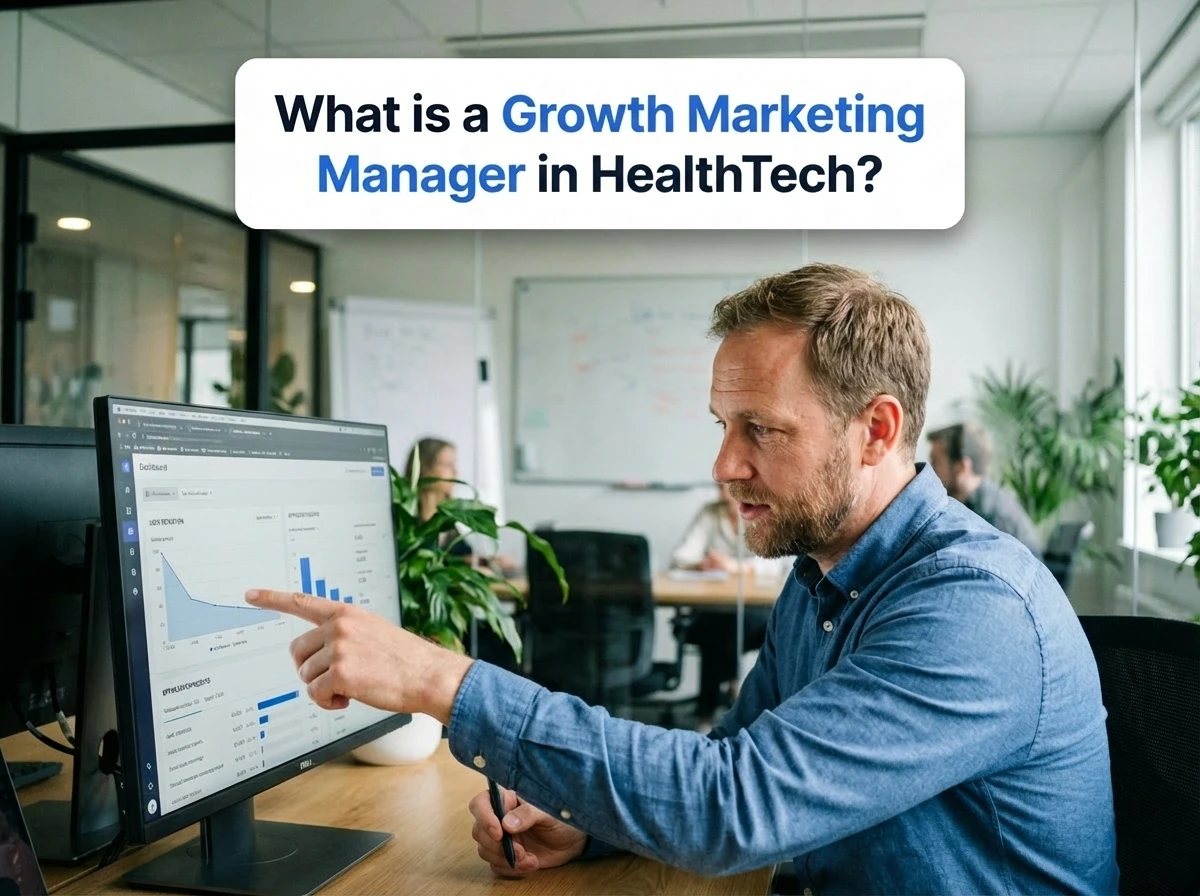
What is a Growth Marketing Manager in HealthTech?
A Growth Marketing Manager in HealthTech is accountable for turning a health product's value into measurable, repeatable adoption without compromising trust, safety, or compliance. They own outcomes like qualified demand, activation, retention, and revenue contribution, and they achieve this by shaping how the organisation acquires and keeps the right users (patients, clinicians, carers, payers, or employers) through the full funnel.
This role exists because HealthTech growth rarely comes from "more spend" alone. It comes from making careful decisions about who you target, what claims you can responsibly make, what data you can use, how you measure impact, and how you remove friction from onboarding and ongoing use. A Growth Marketing Manager provides a single point of ownership for growth performance across channels and lifecycle. They coordinate teams, prioritise experiments, and make trade-offs when speed conflicts with risk, evidence, or operational reality.
Above all, this role is about responsibility: being answerable for growth results, for the integrity of how those results are achieved, and for aligning marketing with product, clinical, and operational constraints.
🔍 How this role differs in HealthTech
In many SaaS or consumer tech businesses, growth marketing can move fast with broad targeting, aggressive iteration, and instrumentation that assumes plentiful behavioural data. In HealthTech, the same playbook has to be reshaped around higher stakes and tighter constraints. Messages influence real-world decisions, user journeys can involve vulnerability, and data is often more sensitive, more regulated, and harder to use for experimentation.
HealthTech growth work tends to be more cross-functional by default. A Growth Marketing Manager may need to align campaigns with clinical review, information governance, security, customer success, and sometimes procurement processes, particularly where clinicians or institutional buyers are involved. Even when regulation isn't front and centre day to day, the expectation of caution and evidence usually is. You are not only optimising conversion, you are defending trust.
The result is a role with heavier accountability. Success is defined not just by growth rate, but by the quality of users acquired, the downstream outcomes they experience, and the reputational risk avoided while scaling.
🎯 Core responsibilities in HealthTech
Day to day, a Growth Marketing Manager in HealthTech runs the growth agenda like an operator: setting targets, selecting the few bets that matter most, and ensuring the organisation can execute without breaking what makes the product safe and credible. They look across acquisition, activation, and retention as one connected system. In HealthTech, a "win" at the top of the funnel can become a failure later if onboarding is confusing, if expectations are mis-set, or if support teams can't handle the demand.
They spend time translating strategy into decisions under constraint: which segments are appropriate to target, what evidence is needed to support claims, how to balance reach with sensitivity, and which data can be used to personalise journeys. They partner closely with Product and Analytics to make measurement meaningful (often with imperfect data), and with Clinical or Compliance stakeholders to keep messaging accurate and defensible.
Trade-offs are constant. Faster experimentation may be slowed by approvals, higher-intent targeting may reduce volume, and privacy-preserving measurement may reduce attribution precision. The Growth Marketing Manager is accountable for making those calls, documenting them, and still delivering progress, often by designing smarter tests, improving onboarding, tightening segmentation, and focusing on retention and referral loops that build durable growth.
🧩 Skills and competencies for HealthTech
Core Skill | HealthTech specific requirement | Reason or Impact |
|---|---|---|
Outcome ownership | Ability to own growth targets whilst respecting clinical, safety, and governance boundaries | Prevents "growth at any cost" decisions and ensures scale does not erode trust or patient safety |
Judgement under constraint | Comfort making decisions with partial attribution, limited tracking, and stricter data-use rules | Keeps the team moving and prioritised when perfect measurement is not feasible |
Cross-functional leadership | Capability to align Product, Data, Compliance/IG, and Commercial teams around one growth plan | Reduces bottlenecks and ensures the funnel works end to end, not just at acquisition |
Evidence-led messaging | Discipline to shape claims, positioning, and creative around what is supportable | Lowers reputational and regulatory risk whilst improving credibility with cautious users and buyers |
Lifecycle thinking | Skill in designing journeys that minimise drop-off after sign-up and support sustained usage | Improves retention and real-world impact, which is often the true constraint on scaling |
Segmentation and targeting strategy | Understanding how to define "right-fit" users (patients, clinicians, carers, employers) without overstepping data boundaries | Increases conversion quality and reduces downstream harm from mis-targeted acquisition |
Stakeholder management | Ability to manage approvals and objections without losing momentum | Speeds delivery by building predictable review paths and avoiding last-minute rework |
Commercial acumen | Understanding unit economics, payback, and how growth affects operations and service delivery | Aligns marketing investment with sustainable scaling, especially where support capacity is a limiting factor |
💷 Salary ranges in UK HealthTech
Pay for Growth Marketing Managers in UK HealthTech is shaped less by channel expertise and more by scope and accountability: how directly the role owns revenue or patient/user growth, whether it manages a budget and a team, how regulated or sensitive the product context is, and how much cross-functional leadership is expected. Location remains a major driver, and compensation can also rise where growth is business-critical (for example, a single product line carries the plan) or where measurement is difficult and the role is expected to deliver despite that.
Experience level | Estimated annual salary range | What drives compensation |
Junior | London & South East: £35,000–£45,000 | Usually execution-heavy with limited ownership; higher pay when hiring expects autonomy, fast learning, and responsibility for a measurable funnel stage |
Mid-level | London & South East: £45,000–£60,000 | Responsibility for a defined funnel area (e.g., acquisition + activation) and meaningful budget; higher ranges where the role owns targets and works across Product/Data |
Senior | London & South East: £60,000–£80,000 | End-to-end funnel accountability, stronger strategic remit, and higher-risk decision-making in sensitive contexts; compensation increases with clear revenue contribution and complexity |
Lead | London & South East: £75,000–£95,000 | Leading growth strategy and execution across channels/lifecycle, often managing a small team; higher pay when the role is the primary owner of growth performance |
Head / Director | London & South East: £95,000–£130,000 | Multi-team leadership, ownership of growth forecasting and budgets, and accountability to exec stakeholders; higher ranges where growth is board-level critical and spans multiple products/markets |
Beyond base salary, typical add-ons include performance bonus (often tied to revenue, pipeline quality, or activation/retention goals), equity in venture-backed businesses, and enhanced pension contributions in some organisations. On-call allowance is not usually standard for marketing roles, but total compensation can increase where growth leaders are expected to support incident-sensitive comms, high-stakes launches, or time-critical operational escalations. The biggest drivers of total comp variation are ownership (targets and budget), team scope, how regulated/sensitive the product context is, and whether the company is scaling aggressively or optimising efficiently.
🚀 Career pathways
Most Growth Marketing Managers in HealthTech enter from adjacent routes: performance marketing, lifecycle/CRM, content-led demand generation, product marketing with a strong analytics orientation, or commercial roles that have owned pipeline and conversion. What matters more than the entry title is proof of owning a measurable outcome: something you can define, improve, and defend.
As responsibility expands, the role moves from running campaigns to running a growth system: setting targets, shaping positioning, aligning Product and Data work to unblock the funnel, and building operating rhythms (experimentation, reporting, forecasting, learning loops). Progression is typically earned through broader ownership: moving from a channel to a funnel stage, then to the full funnel, then to leading a team and budget across multiple segments or products.
At the most senior levels, the pathway becomes less about marketing execution and more about general growth leadership: resource allocation, cross-functional prioritisation, and setting the rules for how the organisation grows without compromising trust and safety.
❓ FAQ
Do I need prior healthcare experience to be credible as a Growth Marketing Manager in HealthTech?
Not always, but you do need to show you can operate carefully with sensitive user contexts and higher-stakes messaging. Hiring teams often look for evidence of good judgement, cross-functional working, and a bias towards measurable outcomes rather than "viral" tactics. Demonstrating how you learn regulated constraints quickly can offset limited domain experience.
What will interviews test that's different from other growth marketing roles?
Expect deeper questioning on how you make trade-offs: what you would measure if tracking is limited, how you'd validate claims, and how you'd respond when growth goals conflict with patient or clinician trust. You may be assessed on stakeholder handling: how you work with Product, Data, and governance functions to ship improvements, not just campaigns.
Will I ever be on-call in this role?
It's uncommon for marketing to have formal on-call rotations, but some HealthTech companies expect senior growth marketers to be reachable for high-impact launches, urgent comms, or escalations where user trust is at stake. If a role implies out-of-hours responsibility, clarify expectations early and ask how it's recognised in workload planning and compensation.
🔎 Find your next role
If you're ready to own growth outcomes in a mission-led environment, search Growth Marketing Manager roles on Meeveem and compare scope, constraints, and progression potential before you apply.
You might also like