Published Date: January 7, 2026
Updated Date: January 7, 2026
What is a Full Stack Engineer in HealthTech?
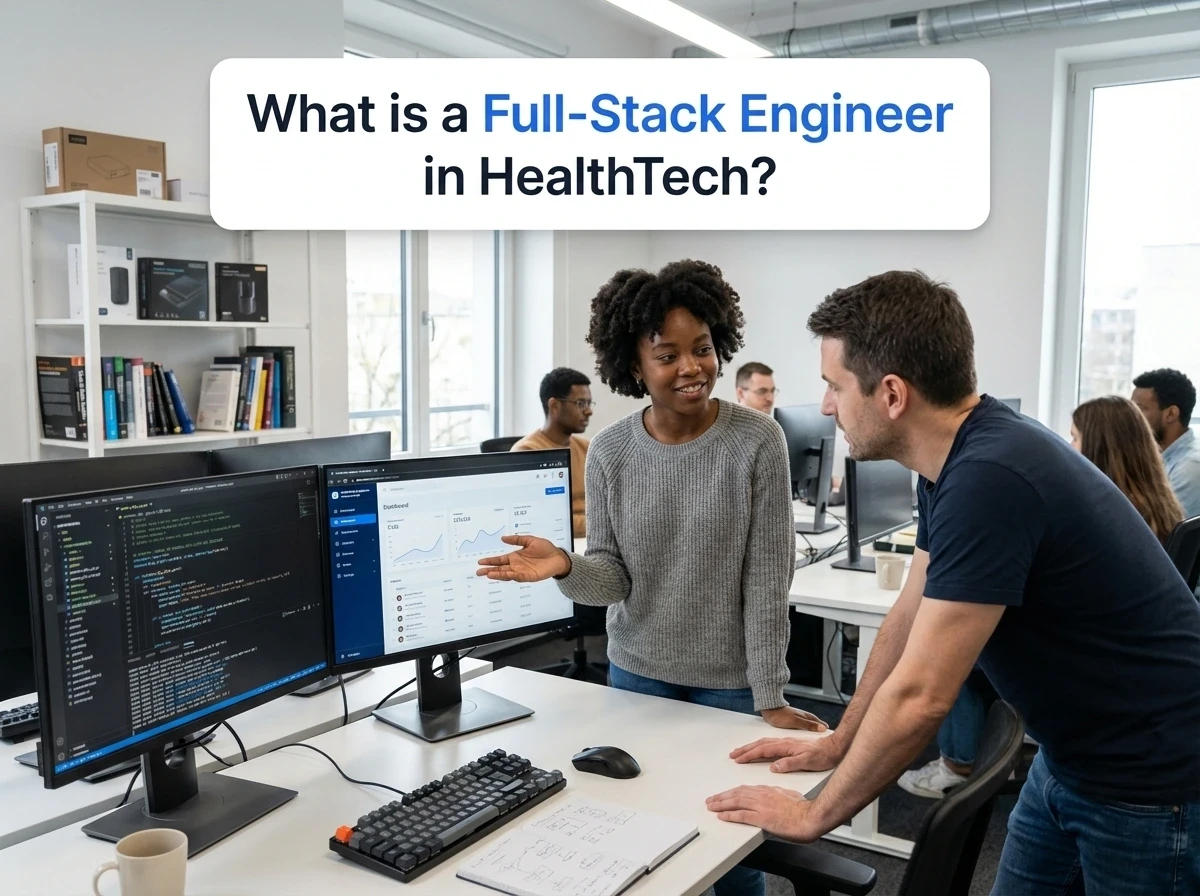
A Full Stack Engineer in HealthTech is a software engineer who takes complete ownership of patient or clinician-facing digital products from start to finish: the user experience, backend services, data flows, and how everything behaves in production. "Full stack" in this context is less about mastering every technology and more about being accountable for outcomes across the entire product, particularly where errors could impact care pathways, safety, access, or trust.
This role exists because HealthTech products require close coordination between what users see (triage, booking, care plans, results, messaging) and what the system guarantees behind the scenes (identity, audit trails, integrations, permissions, data quality, uptime). A Full Stack Engineer typically bridges these areas and makes clear, risk-aware decisions that maintain momentum without compromising safety, privacy, or resilience.
In practice, the job centres on ownership: shipping changes that are safe to use, measurable, supportable by the organisation, and appropriate for the context in which the product operates.
🔍 How this role differs in HealthTech
In most industries, full stack engineers can optimise mainly for speed, conversion, and iteration. In HealthTech, the context shifts what "done" actually means. Risk is higher, user journeys can have clinical consequences, and the data is usually sensitive. Decisions that might be acceptable elsewhere (lightweight logging, vague error states, unclear identity flows, "we'll fix it later" releases) can cause real harm or create unacceptable operational exposure here.
HealthTech also brings more constraints into engineering conversations: evidence requirements, safety assurance expectations where applicable, strict access control, auditability, and deeper integration with external systems. Even when a product isn't a regulated medical device, it may still exist in environments where adopters expect structured risk thinking, clear operational controls, and strong data governance.
This means the role often sits closer to product and delivery decisions than in other sectors. Full Stack Engineers in HealthTech are frequently expected to challenge requirements, clarify clinical or operational intent, and shape what should be built (not just how it's built) because ambiguity itself is a risk.
🎯 Core responsibilities in HealthTech
Day to day, a Full Stack Engineer in HealthTech is accountable for translating real service needs into working software that behaves predictably under pressure. You'll move between shaping user journeys with design and product, defining backend behaviour and data handling, and ensuring the system can be operated safely after release. The work typically involves navigating imperfect inputs (partial requirements, evolving clinical or operational workflows, integration constraints) and turning them into decisions the team can stand behind.
A large part of the role involves trade-offs: deciding when to simplify, when to add safeguards, and when to slow down because the failure mode is unacceptable. That could mean building strong permissioning before adding features, designing safer defaults, adding audit trails early, or pushing for clearer validation and monitoring because "silent failure" isn't an option in care-adjacent products.
You're also expected to own production reality. In HealthTech, incidents can be more than downtime. They can disrupt services, create backlogs, or undermine confidence from clinical and operational stakeholders. Full Stack Engineers are often directly involved in diagnosing issues, improving observability, reducing alert noise, and making the product easier to support through careful design and operational discipline.
🧩 Skills and competencies for HealthTech
Core Skill | HealthTech specific requirement | Reason or Impact |
|---|---|---|
End-to-end product ownership | Ability to carry a feature from user need through data handling to operational support, with clear acceptance criteria and measurable outcomes | HealthTech products fail when ownership is fragmented; end-to-end accountability reduces safety, privacy, and service risks |
Risk-aware decision making | Comfort making trade-offs explicitly, documenting rationale, and designing for safer failure modes | In care-adjacent systems, "edge cases" can become high-impact incidents; good judgement prevents avoidable harm |
Data protection and access control | Treat health data as highly sensitive, design least-privilege access, and ensure auditability is intentional | Poor access design can create serious privacy breaches and erode trust with users and adopters |
Operational reliability mindset | Design for monitoring, incident response, and supportability as first-class requirements | Services often run continuously; reliability and observability protect patient and clinician workflows from disruption |
Integration and interoperability thinking | Ability to reason about upstream/downstream dependencies, data contracts, and the operational realities of third-party systems | HealthTech commonly depends on external systems; integration fragility becomes product fragility without careful engineering |
Stakeholder communication under constraints | Clear communication with product, clinical, operational, and security stakeholders; ability to say "no" with evidence | HealthTech delivery involves competing priorities; alignment reduces rework and prevents unsafe or non-viable releases |
Quality and change control discipline | Strong testing strategy, careful rollout planning, and a bias toward reversible changes where possible | The cost of defects is higher; controlled change reduces incidents and supports safer iteration |
💷 Salary ranges in UK HealthTech
Salary in UK HealthTech tends to track the level of ownership more than the label "full stack". The biggest drivers are: how critical the product is (care delivery versus internal tooling), exposure to sensitive data, the expected independence in decision-making, the complexity of integrations, and operational expectations such as on-call. Location still matters, but the gap narrows when roles are remote-first and the scope is high.
Experience level | Estimated annual salary range | What drives compensation |
Junior | London & South East: £35,000–£50,000 | Supervision level, breadth across the stack, and whether the role is delivery-focused versus support-heavy |
Mid-level | London & South East: £50,000–£70,000 | Independent delivery, ability to own features end-to-end, and confidence working with sensitive data and integrations |
Senior | London & South East: £70,000–£100,000 | System design ownership, incident leadership, risk trade-offs, and responsibility for reliability and quality |
Lead | London & South East: £95,000–£125,000 | Cross-team influence, technical direction, delivery accountability, and raising engineering standards in regulated or high-trust environments |
Head / Director | London & South East: £120,000–£170,000 | Organisational accountability (people, budget, delivery), risk ownership, governance, and operating maturity for high-stakes systems |
Typical add-ons vary by employer type. Many HealthTech roles include pension and standard benefits; beyond that, compensation may include a performance bonus, equity (more common in venture-backed companies), and an on-call or incident allowance where the service demands it. Total compensation moves most with scope (product criticality and operational responsibility), the intensity and frequency of on-call, and whether you're expected to own platform-level decisions rather than just feature delivery.
🚀 Career pathways
Entry points are often either through generalist product engineering (web, platform, or full stack) or through adjacent domains like data-heavy systems, identity and access, or integration engineering. HealthTech tends to reward engineers who can learn the domain quickly and who are comfortable asking clarifying questions about real workflows instead of treating requirements as abstract tickets.
Progression usually expands along ownership. At mid-level, you're trusted to deliver complete slices of value safely and predictably. At senior, you're expected to define the right solution under constraints, anticipate failure modes, and lead the response when systems misbehave. At lead, the role becomes more about setting direction (how teams build, release, measure, and operate) so that safety, privacy, and reliability are systemic rather than heroic. Head/Director progression is marked by accountable leadership: building teams and processes that can sustain delivery in a high-trust environment, whilst managing risk, stakeholder expectations, and operational maturity.
❓ FAQ
Do HealthTech full stack interviews test domain knowledge, or can I learn the healthcare context on the job?
Most teams don't expect you to arrive as a healthcare expert, but they do expect strong judgement with sensitive data and a willingness to learn workflows quickly. You'll be evaluated on how you handle ambiguity, how you reason about risk, and whether you ask the questions that prevent unsafe assumptions.
How is "full stack" defined when the product integrates with external health systems?
In HealthTech, full stack often means owning the user journey and the service behaviour that makes it trustworthy: permissions, auditability, data correctness, and integration resilience. You may not own every external dependency, but you're expected to design your part so failures are detectable, recoverable, and clearly communicated.
Should I expect on-call as a Full Stack Engineer in HealthTech?
It depends on the service model. If the product supports live operations, clinical services, or time-sensitive workflows, on-call is more likely and the expectations can be stricter than in lower-stakes industries. Clarify frequency, incident ownership, and whether the organisation has mature monitoring and escalation before accepting an offer.
🔎 Find your next role
If you're ready to take ownership of real-world systems in UK HealthTech, search for Full Stack Engineer roles on Meeveem.
You might also like