Published Date: January 7, 2026
Updated Date: January 7, 2026
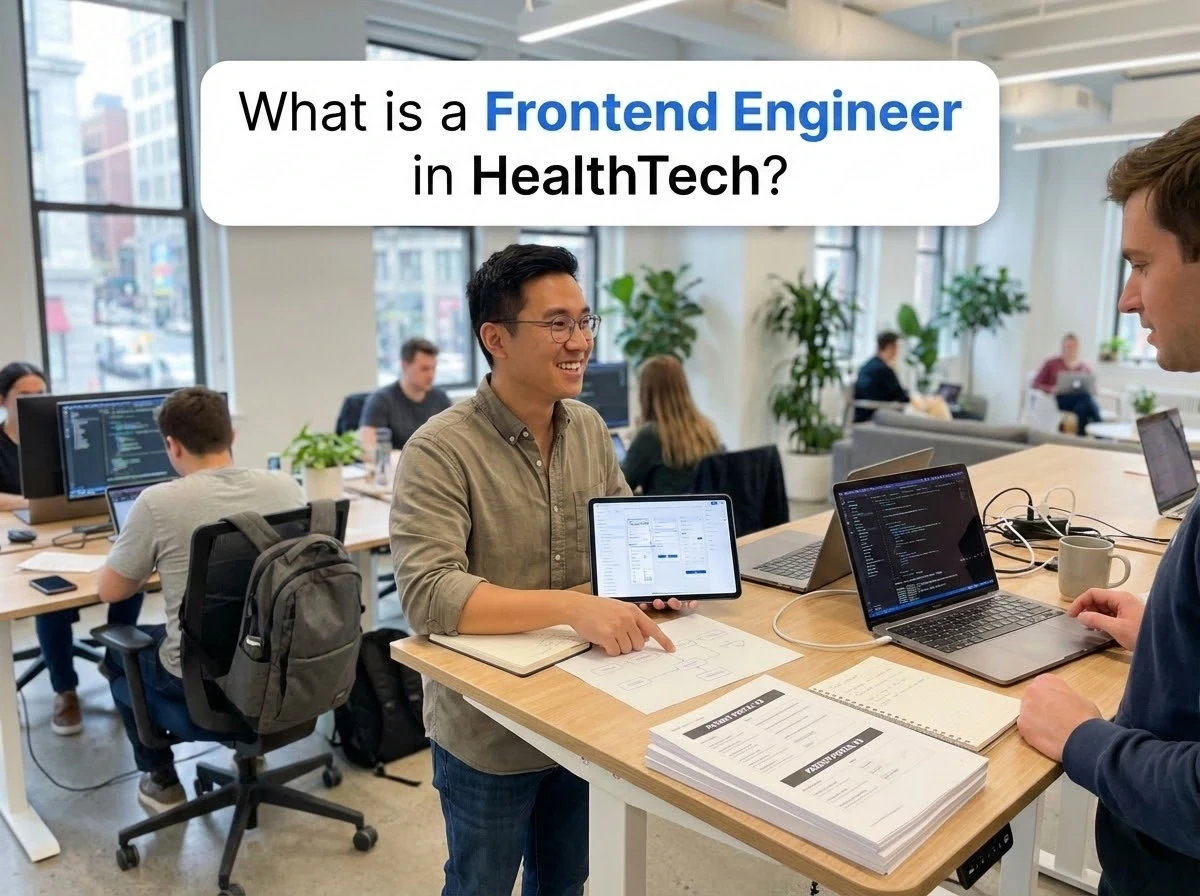
What is a Frontend Engineer in HealthTech?
A Frontend Engineer in HealthTech builds the part of a healthcare product that users actually see and interact with. This often includes clinicians, care teams, operational staff, and patients. They're responsible for the safety, clarity, and reliability of user journeys where mistakes can have real consequences: a misunderstood dosage, a missed alert, an inaccessible form, or a confusing workflow that delays care.
This role exists because healthcare is information-dense and time-sensitive. People make decisions from screens, sometimes under pressure, sometimes with incomplete context, and often with users who have varying abilities, devices, and environments. A Frontend Engineer translates complex clinical or operational intent into interfaces that are accurate, auditable, accessible, and resilient.
In many HealthTech organisations, the role sits inside a product engineering team and works closely with product, design, backend/data engineers, QA, security, and domain experts. The defining feature is ownership: you're accountable for how the product behaves at the point of care, how it guides decisions, prevents errors, and stays trustworthy when the system or the user is under strain.
🔍 How this role differs in HealthTech
In other industries, frontend work is often judged primarily on conversion, engagement, performance, and brand experience. In HealthTech, those still matter, but they're constrained by risk, sensitive data, and real-world outcomes. The "best" UI isn't just the slickest one. It's the one that reduces ambiguity, makes the correct action the easiest action, and stands up to scrutiny when something goes wrong.
HealthTech changes everyday engineering decisions because the data is highly sensitive and the workflows can be safety-critical. You may need to design for strict access control, minimise data exposure in the browser, and be disciplined about what is stored, cached, logged, or displayed. You also tend to operate in environments where compliance, auditability, and accessibility expectations are non-negotiable, and where user groups may include people with disabilities, older devices, or limited connectivity.
The result is a role that feels less like "building pages" and more like "building decision surfaces." You're balancing usability with governance, speed of delivery with clinical safety, and innovation with the operational reality of healthcare settings.
🎯 Core responsibilities in HealthTech
Day to day, a Frontend Engineer in HealthTech is accountable for delivering user experiences that help people do the right thing quickly and consistently. That can mean building flows where the interface must surface the most relevant information without overwhelming the user, where defaults are chosen carefully, and where error states are designed as first-class features rather than afterthoughts.
A large part of the work is decision-making under constraints. You'll constantly choose what to show, when to interrupt, and how to prevent risky actions without blocking legitimate work. You'll design interactions that cope with partial data, slow networks, and backend inconsistencies. You'll also spend time aligning with domain experts to translate ambiguous, real-world scenarios into clear interface rules, then making those rules observable and testable.
In many teams, you'll be expected to influence standards: accessibility quality, design system integrity, analytics instrumentation (done responsibly), and patterns for handling sensitive data in the client. As you become more senior, your accountability expands from "my feature works" to "our product experience is safe, coherent, and maintainable across multiple teams and releases."
🧩 Skills and competencies for HealthTech
Core Skill | HealthTech specific requirement | Reason or Impact |
|---|---|---|
Product judgement | Make UI decisions that reduce clinical/operational risk, not just complexity | Prevents ambiguous interactions and avoids designs that increase error likelihood under pressure |
Accessibility ownership | Treat accessibility as a release constraint, not an enhancement | Ensures services remain usable for disabled users and reduces legal and operational risk from inaccessible journeys |
Security and privacy instincts | Assume the browser is a sensitive environment and design to minimise exposure | Reduces the chance of leaking patient or clinically sensitive information through UI, logs, caching, or inadvertent display |
Workflow thinking | Model end-to-end tasks across roles, handovers, and interruptions | Produces interfaces that fit real care delivery patterns, not idealised linear flows |
Clarity in high-stakes UX | Write and structure UI so actions, status, and consequences are unmistakable | Lowers cognitive load and reduces the chance of misinterpretation in time-critical situations |
Resilience mindset | Design graceful failure, offline/poor-network behaviours, and safe defaults | Keeps users productive and avoids risky workarounds when systems degrade |
Collaboration with domain experts | Turn clinical or regulated requirements into precise, testable UI behaviour | Prevents "requirements drift" and builds shared accountability for what the product enables or blocks |
Quality discipline | Prioritise correctness, traceability, and regression prevention over rapid iteration alone | Protects safety-critical flows and reduces the cost of incidents in production |
System-level thinking | Understand how frontend choices affect backend load, data integrity, and audit trails | Avoids fragile implementations and supports reliable, inspectable operation across services |
💷 Salary ranges in UK HealthTech
Compensation for Frontend Engineers in UK HealthTech typically reflects more than coding ability. The biggest drivers are scope of ownership (single feature vs platform-wide UI), risk and criticality (patient-facing, clinician-facing, or operational tooling), the cost of mistakes, expectations around accessibility and governance, and how much autonomy you have to make product and architectural decisions. Location still matters, but seniority and responsibility often matter more, especially when the role carries incident accountability or shared on-call expectations.
Experience level | Estimated annual salary range | What drives compensation |
Junior | London & South East: £35,000–£48,000 | Supervision level, ability to deliver safely within established patterns, quality discipline, and exposure to regulated or sensitive-data products |
Mid-level | London & South East: £50,000–£70,000 | Ownership of features end-to-end, reliability in complex workflows, collaboration with product/design/clinical stakeholders, and ability to prevent regressions |
Senior | London & South East: £75,000–£105,000 | Leading UI architecture decisions, reducing risk through design and implementation choices, mentoring, and responsibility for critical journeys and cross-team standards |
Lead | London & South East: £90,000–£125,000 | Accountability for frontend direction across squads, design system governance, cross-cutting quality/security/accessibility decisions, and incident-level ownership where applicable |
Head / Director | London & South East: £110,000–£160,000 | Org-level accountability, hiring and team design, delivery risk management, stakeholder leadership, and responsibility for product quality in regulated, high-impact environments |
Beyond base salary, total compensation commonly includes performance-related bonus (often tied to company and team outcomes), equity (more common in venture-backed HealthTech), and broader benefits such as private medical cover and enhanced pension contributions. On-call allowances can apply when frontend engineers share responsibility for production incidents, particularly if the product is used continuously or supports time-critical workflows. Where on-call exists, intensity and incident frequency are major drivers of total pay variation.
🚀 Career pathways
Entry into HealthTech frontend roles often comes from general product engineering, agency work, public-sector digital teams, or adjacent industries where accessibility and reliability matter. What usually matters most is evidence that you can own user-facing outcomes, not just implement tickets, especially where correctness and clarity are core to the product's value.
As you progress, responsibility expands from building components to shaping how the product behaves under real-world constraints. Mid-level engineers typically move from execution to ownership: defining edge cases, improving resilience, and collaborating closely with domain experts. Senior engineers take responsibility for the quality bar across journeys, establish patterns that reduce risk, and create leverage through design systems, shared libraries, and observability.
Lead and Head/Director pathways diverge by focus. Some engineers deepen technical and product ownership across multiple teams (architecture, standards, incident readiness), whilst others broaden into people leadership and organisational accountability: hiring, delivery governance, and ensuring that the product experience remains safe and coherent as the company scales.
❓ FAQ
Do I need prior healthcare experience to be hired as a Frontend Engineer in HealthTech? Not always, but you do need to show you can learn domain complexity quickly and work responsibly with sensitive data. Hiring teams typically look for evidence of careful judgement, strong collaboration, and a track record of building reliable interfaces under constraints.
How will interviews test "HealthTech readiness" for a frontend role? Expect questions and exercises that probe how you handle ambiguity, edge cases, and risk: accessibility trade-offs, error states, and safe UI defaults. Strong candidates explain how they would prevent user mistakes and how they would validate behaviour with stakeholders, not just how they would implement it.
Will I be on-call as a Frontend Engineer in HealthTech? It depends on the company and the product's operational model. Some teams include frontend engineers in incident response because UI issues can block care workflows or access. Others route support through platform or SRE teams. Clarify expectations early: frequency, escalation paths, and whether you're responsible for out-of-hours fixes.
You might also like