Published Date: January 7, 2026
Updated Date: January 7, 2026
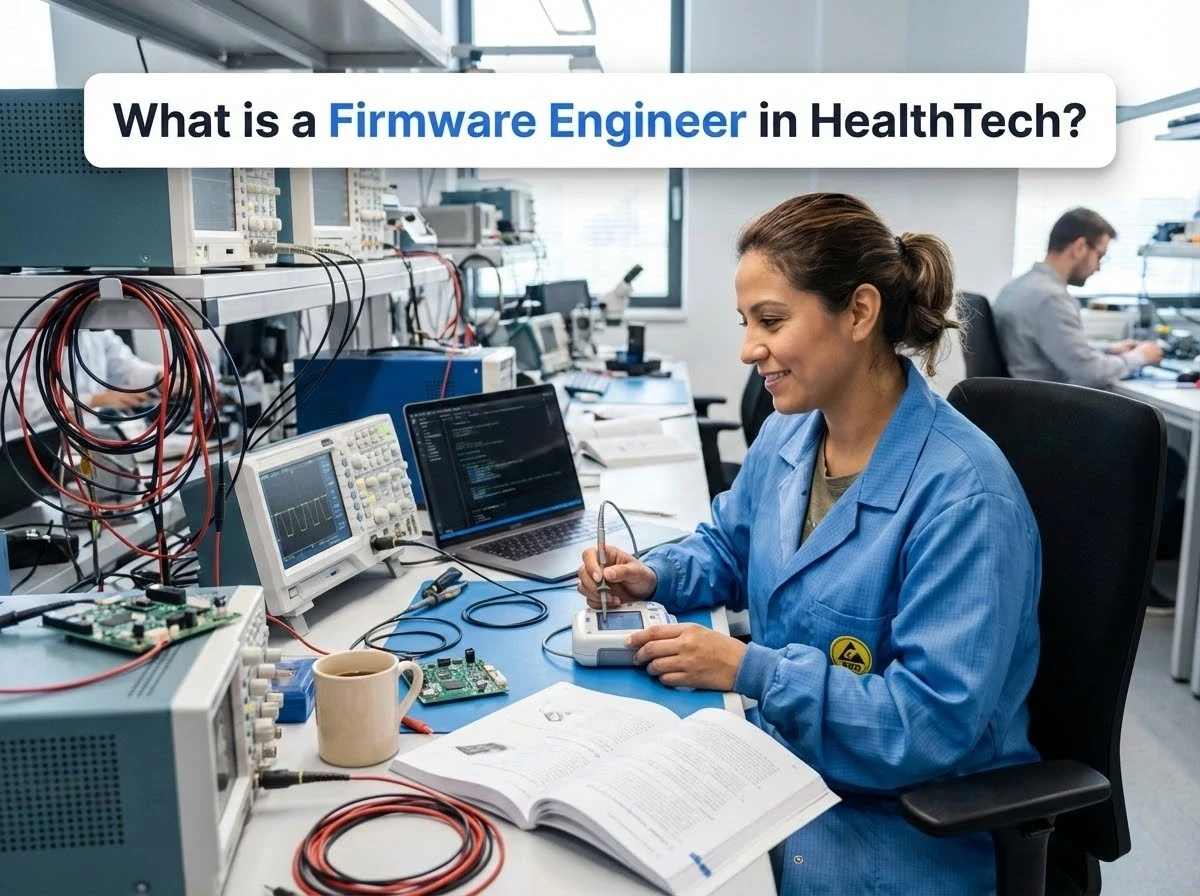
What is a Firmware Engineer in HealthTech?
A Firmware Engineer in HealthTech is the engineer responsible for the low-level software that makes medical hardware behave safely and predictably: the code that runs on microcontrollers, sensors, and real-time processors inside a device, plus the supporting software layers that turn electronics into a reliable clinical product.
This role exists because many health technologies are not "just software". They are physical systems that measure, stimulate, pump, image, dispense, or monitor, and the firmware is the part that must translate messy real-world signals into trustworthy device behaviour under tight constraints (power, memory, timing, fault tolerance). When something goes wrong, it's rarely abstract: it can affect a patient, a clinician's decision, or a regulated product in the field.
Ownership comes first. A Firmware Engineer is typically responsible for a defined subsystem's behaviour and safety characteristics, for proving (not just claiming) that it meets requirements, and for supporting it throughout its lifecycle, including investigation and fixes when issues are found after release.
🔍 How this role differs in HealthTech
In many tech sectors, you can optimise primarily for speed of delivery and user engagement, then iterate quickly in production. In HealthTech, the centre of gravity shifts towards safety, traceability, and controlled change. You still ship improvements, but you do it in a way that stands up to audits, clinical risk review, and long product lifecycles.
Because HealthTech systems often interact with the body or inform clinical decisions, failure modes matter more. A subtle timing edge case, an intermittent sensor fault, or an unexpected reset isn't just a bug. It can become a safety risk, a field action, or a formal incident investigation. That reality changes everyday engineering decisions: how you handle fault detection, watchdog behaviour, data integrity, and backwards compatibility with hardware revisions already deployed.
Data sensitivity also looks different. Even when firmware isn't directly storing identifiable data, it can influence how measurements are captured, timestamped, encrypted, transmitted, and validated end to end. That makes collaboration with systems, cybersecurity, QA/RA, and clinical stakeholders more central than in most consumer device teams.
🎯 Core responsibilities in HealthTech
Day to day, a Firmware Engineer in HealthTech is accountable for turning product intent into behaviour that is repeatable, testable, and defensible. That means working from requirements that may be written in safety and clinical language, translating them into implementation decisions, and maintaining traceability so the team can show what was built, why it was built that way, and how it was verified.
They spend significant time making trade-offs under constraints: selecting approaches that fit limited compute and memory while still being robust; designing state machines and failure handling that degrade safely; deciding what must be deterministic and what can be best-effort; and balancing performance against diagnosability in the field. A strong firmware engineer is also comfortable with the uncomfortable parts: ambiguous hardware behaviour, noisy signals, manufacturing variability, and the reality that "works on my bench" isn't a release criterion.
In regulated product environments, accountability extends beyond implementation. Firmware Engineers are expected to contribute to risk controls, verification strategy, and investigation work when something unexpected happens. When a device is in use, the job includes supporting root-cause analysis, producing fixes that minimise regression risk, and helping teams make careful decisions about update mechanisms, release gating, and post-release monitoring.
🧩 Skills and competencies for HealthTech
Core Skill | HealthTech specific requirement | Reason or Impact |
|---|---|---|
Safety-first engineering judgement | Ability to think in failure modes, define safe states, and prioritise harm reduction over elegance | Prevents firmware from becoming a single point of failure in clinically meaningful scenarios |
Requirements interpretation and traceability | Comfort translating clinical/safety intent into verifiable device behaviour and maintaining evidence links | Enables confident release decisions and reduces rework during audits, reviews, and incident investigations |
Verification mindset | Designing code so it can be proven, tested, and debugged across edge cases and hardware variance | Increases confidence that behaviour will hold under real-world conditions, not just ideal lab setups |
Risk-based trade-off making | Selecting architectures and mitigations proportional to patient impact and device criticality | Keeps delivery pragmatic while protecting safety and reducing regulatory and field risk |
Systems collaboration | Working effectively with hardware, systems, QA/RA, manufacturing, and clinical stakeholders | Aligns firmware decisions with device-level hazards, usability realities, and production constraints |
Field support and incident resilience | Ability to investigate, triage, and implement safe fixes without destabilising released products | Reduces downtime, speeds containment, and avoids "fixes" that introduce new safety issues |
Configuration and change discipline | Treating changes as controlled interventions with clear rationale, testing, and release gates | Protects long-lived products where uncontrolled drift can create compliance and safety exposure |
💷 Salary ranges in UK HealthTech
Salary in UK HealthTech firmware roles tends to follow responsibility more than title alone. The biggest drivers are: whether the firmware is safety-critical, how close the role is to regulated release decisions, how much device lifecycle ownership you carry (from concept through post-market), and whether you're expected to support escalations or out-of-hours incidents. Location still matters, but the largest jumps typically come from scope (single module vs platform ownership), severity of failure modes, and leadership expectations (technical authority, mentoring, cross-functional decision-making).
Experience level | Estimated annual salary range | What drives compensation |
Junior | London & South East: £35,000–£45,000 | Supervised delivery on well-defined components, limited release accountability, learning regulated documentation and verification expectations |
Mid-level | London & South East: £45,000–£60,000 | Owning subsystems end to end, contributing to risk controls and verification, handling more complex debugging and hardware interaction |
Senior | London & South East: £60,000–£85,000 | Technical ownership of critical pathways, shaping verification strategy, leading investigations, mentoring, and making risk-weighted design trade-offs |
Lead | London & South East: £85,000–£115,000 | Platform-level responsibility, cross-team technical leadership, release and quality influence, higher expectation to unblock systemic issues and manage risk |
Head / Director | London & South East: £110,000–£160,000 | Organisational accountability (roadmap, staffing, quality posture), governance over safety and delivery, stakeholder management, and high-impact decision-making |
Beyond base salary, total compensation often includes a discretionary bonus, employer pension contributions, and (more commonly in venture-backed HealthTech) equity or options. On-call is less universal than in pure software operations, but where devices are deployed clinically or connected systems require rapid response, an on-call rota may exist and can add an allowance or uplift. The intensity and responsibility of escalation (advice-only vs hands-on incident leadership) is what typically drives meaningful variation in total pay.
🚀 Career pathways
Entry points are usually through embedded systems, electronics/software engineering, or adjacent safety-critical domains where disciplined verification is already expected. Some people move in from consumer embedded roles, but the transition often hinges on demonstrating comfort with controlled change, documentation, and risk-aware decision-making rather than just shipping features.
As responsibility expands, progression tends to look like deeper ownership: first a component, then a subsystem with defined safety behaviours, then a broader platform with shared libraries, bootloaders, update paths, and verification approaches used across products. The seniority inflection point usually comes when you're trusted not only to write firmware, but to define how the team proves it is safe, how it is maintained in the field, and how engineering trade-offs are made under clinical and regulatory constraints.
At the highest levels, growth is less about writing the hardest code personally and more about shaping the operating system of the organisation: technical standards, risk governance, hiring and mentoring, release discipline, and cross-functional decision-making that protects patients whilst enabling product evolution.
❓ FAQ
Do I need prior medical device experience to get hired as a Firmware Engineer in HealthTech?
Not always. Many teams value strong embedded fundamentals and evidence of disciplined engineering from other safety-critical sectors. What you'll need to show is that you can work with requirements, testing evidence, and careful change control without treating them as "paperwork".
What will I be assessed on in interviews beyond embedded coding?
Expect evaluation of how you debug under uncertainty, how you reason about failure modes, and how you communicate trade-offs to non-firmware stakeholders. Good candidates can explain what they would do when hardware signals are noisy, requirements are ambiguous, or a fix risks regressions in released devices.
Is on-call common for Firmware Engineers in HealthTech, and what does it look like?
It varies by product and deployment model. Some roles have no rota at all; others involve supporting incident triage, urgent defect investigation, or release hotfix decisions when devices are used in time-sensitive environments. When it exists, clarity on escalation expectations and decision authority matters more than the rota frequency alone.
🔎 Find your next role
Ready to take ownership of safety-critical systems? Search Firmware Engineer roles on Meeveem and find HealthTech teams building real-world products that matter.
You might also like