Published Date: January 7, 2026
Updated Date: January 7, 2026
What is a Field Service Engineer in HealthTech?
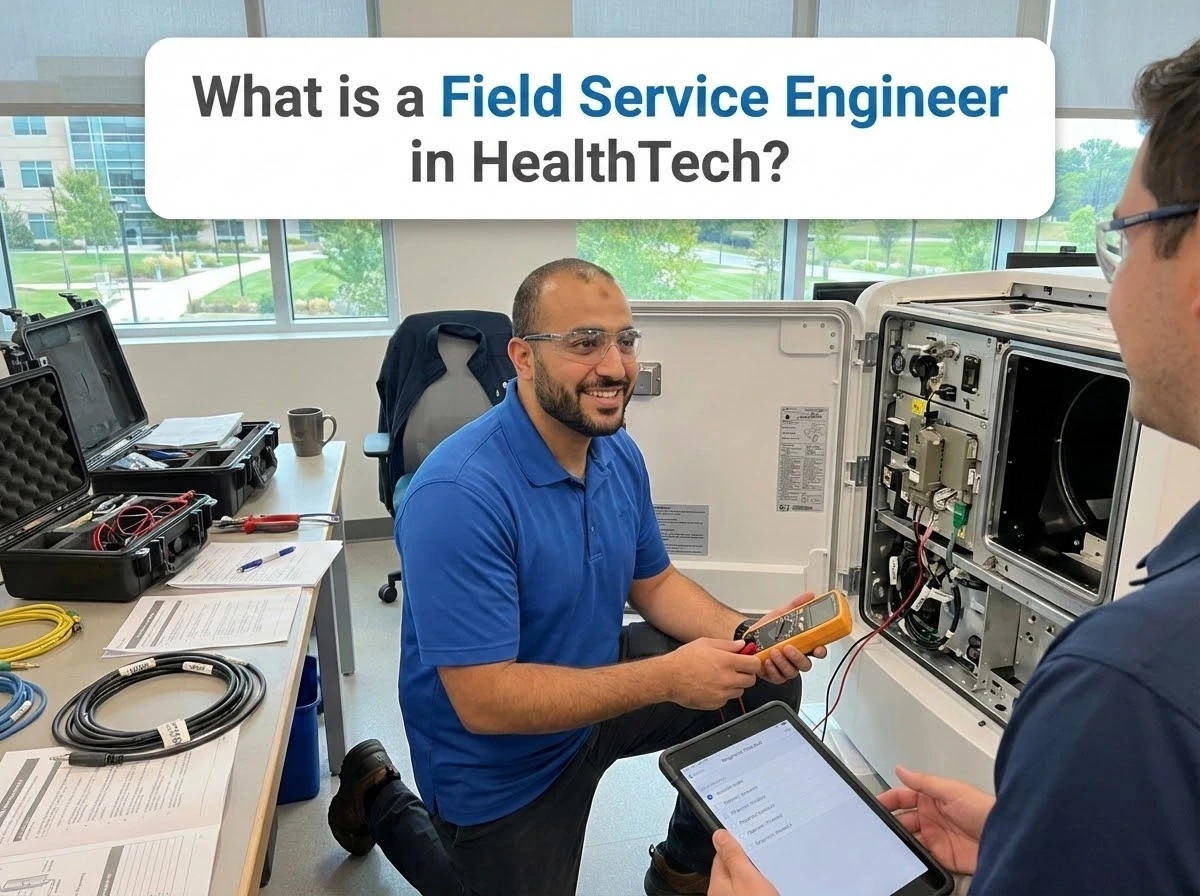
A Field Service Engineer in HealthTech is the person accountable for keeping clinical and care-critical technology working safely in the real world at hospitals, clinics, laboratories, care homes, and community settings. They install, commission, maintain, repair, and verify equipment and connected systems so they remain fit for clinical use, and they do it in environments where downtime has consequences that go beyond customer inconvenience.
This role exists because healthcare technology does not "just run" once it ships. Devices age, configurations drift, sites differ, users need guidance, consumables and parts fail, and software and connectivity changes can break otherwise stable workflows. A Field Service Engineer owns the outcome: equipment availability, safe operation, compliant documentation, and clear escalation when risk or uncertainty appears. Methods vary by product, but responsibility is consistent. Restore service without creating new clinical risk.
🔍 How this role differs in HealthTech
In many industries, field engineering is about uptime, customer satisfaction, and cost-to-serve. In HealthTech, those goals still matter, but they are constrained by patient safety, traceability, and the operational realities of clinical environments.
Instead of optimising for speed alone, HealthTech field service decisions are shaped by risk: what the device is used for, what happens if it behaves incorrectly, and what must be documented to demonstrate control. Work often sits inside a quality management approach where change control, complaint handling, and disciplined record-keeping are part of the job, not "admin." The same is true for data-handling and connectivity: even when you're not a security specialist, your actions can affect how systems interact with clinical networks and sensitive information, and you're expected to work within site rules rather than bypass them.
The result is a role that looks hands-on but is fundamentally judgement-heavy: knowing when a workaround is acceptable, when it is not, and how to return a system to a verified, supportable state.
🎯 Core responsibilities in HealthTech
Day to day, a Field Service Engineer is accountable for restoring and sustaining safe clinical operation. That might start with a scheduled visit (preventive maintenance, calibration checks, safety inspections, or software updates) but it can shift quickly into reactive work when a system fails mid-clinic or a lab instrument is producing questionable results. The key responsibility is not simply "fixing things," but deciding what "fixed" means in a regulated, safety-focused environment: the issue is resolved, the root cause is understood enough to prevent recurrence, and the system's status is clear to both the customer and your internal teams.
They operate under constraints that are specific to healthcare: limited access windows, infection control requirements, noisy stakeholders, procurement and service-contract boundaries, and the reality that clinical staff need equipment back quickly but also need confidence that it is safe. They make trade-offs constantly (repair now versus swap-out, temporary mitigation versus full remediation, escalating to product or quality teams versus containing locally) and they are expected to choose the option that best protects patients and preserves evidence of control.
Just as importantly, they are a feedback loop for the organisation. Field patterns become product improvements, service bulletins, training changes, and spare-part strategy. In many HealthTech businesses, field service is where product promises meet operational truth.
🧩 Skills and competencies for HealthTech
Core Skill | HealthTech specific requirement | Reason or Impact |
|---|---|---|
Accountability for safe outcomes | Treat "device back in service" as a safety decision, not a mechanical endpoint | Reduces the risk of returning equipment to use with hidden faults or unverified performance |
Structured troubleshooting judgement | Diagnose under time pressure while respecting site rules, clinical schedules, and escalation thresholds | Prevents repeated visits, limits downtime, and avoids unsafe "quick fixes" that create downstream incidents |
Quality-minded documentation | Produce service records that stand up to internal review, customer scrutiny, and audit expectations | Protects patients and the business by making work reproducible, traceable, and defensible |
Communication in clinical settings | Explain constraints, risks, and next steps to non-engineers without overpromising | Builds trust and reduces operational disruption when equipment issues affect patient flow |
Change control discipline | Treat configuration changes, updates, and substitutions as controlled interventions | Avoids introducing new failures, incompatibilities, or compliance gaps through informal changes |
Customer boundary management | Navigate what is included in contract scope while still acting as a responsible partner | Balances service economics with patient-impact realities and protects long-term relationships |
Escalation and incident thinking | Recognise when a field fault is a wider product issue and route it appropriately | Improves product reliability over time and reduces repeat failures across the installed base |
Site-readiness and workflow awareness | Understand the physical, network, and operational conditions required for installation and commissioning | Prevents failed installs and ensures systems are usable in real clinical workflows from day one |
💷 Salary ranges in UK HealthTech
Compensation for Field Service Engineers in UK HealthTech depends less on job title and more on what you're trusted to handle: how critical the device is, how much independence you need on site, how complex installation and verification are, and whether you're on call for urgent breakdowns. Location plays a role (particularly in London and the South East), but so do travel expectations, door-to-door arrangements, and whether you troubleshoot hardware, software, and networks. The biggest pay increases usually happen when you become the go-to person for challenging installations, high-risk escalations, or service performance leadership.
Experience level | Estimated annual salary range | What drives compensation |
Junior | London & South East: £28,000 to £36,000 | Level of supervision, product complexity, and whether you handle commissioning tasks or primarily maintenance under guidance |
Mid-level | London & South East: £36,000 to £45,000 | Ability to work independently, breadth of device coverage, customer-facing confidence, and readiness to take escalations without constant support |
Senior | London & South East: £45,000 to £58,000 | Ownership of complex installs, high-criticality environments (labs, diagnostics, acute care), stronger fault isolation, and influence on service standards |
Lead | London & South East: £58,000 to £72,000 | Regional or product-line leadership, coaching and technical authority, service quality ownership, and responsibility for escalations and customer outcomes |
Head / Director | London & South East: £80,000 to £120,000 | Accountability for service strategy, budget, performance metrics, compliance posture, commercial outcomes, and leadership across teams and partners |
Beyond base salary, typical add-ons include overtime (often a major driver of total earnings), on-call allowance where rota coverage is required, and a bonus that may be company-wide or tied to service KPIs (response times, uptime, customer satisfaction, quality targets). A car allowance or company vehicle is common, and some roles add "door-to-door" travel pay, expenses floats, or enhanced pension/health benefits. Total compensation varies most with on-call intensity, travel footprint, and the criticality/complexity of the devices you support.
🚀 Career pathways
Many Field Service Engineers enter HealthTech from apprenticeships, HNC/HND routes, military engineering backgrounds, or adjacent industries such as industrial automation, imaging support, or laboratory instrumentation. Others move in from in-house biomedical engineering roles where they've learned clinical environments and safety discipline, then specialise into OEM or vendor-supported equipment.
Progression typically follows ownership rather than title. Early on, you build credibility by restoring service reliably and documenting work cleanly. As you gain trust, you take on commissioning, complex troubleshooting, and customer-facing planning, becoming the person who can walk into a difficult site and leave it stable. From there, pathways branch: some engineers become technical specialists for a modality or product line; others move into team leadership and performance management; and some transition into quality, training, service operations, or product roles because they understand how devices behave at scale in real care settings.
❓ FAQ
Do I need medical device experience to get hired, or will strong engineering fundamentals be enough?
Many employers will consider strong electromechanical troubleshooting, disciplined working habits, and solid customer skills, even if your background is not directly in healthcare. What they will probe is whether you can work within stricter documentation and safety expectations. Demonstrating comfort with procedures, traceability, and escalation is often the difference.
How much on-call should I expect in HealthTech field service roles?
It varies by product criticality and service model: some roles are strictly business-hours with planned maintenance, whilst others include weekend or rota-based coverage for urgent failures. Ask specifically about frequency, response expectations, what counts as a call-out, and whether time off in lieu is provided. On-call intensity is one of the biggest factors in overall earnings and work-life predictability.
What gets assessed in interviews beyond technical troubleshooting?
Expect scenario questions about prioritisation under constraints: what you do when you can't access a site, when the "quick fix" conflicts with procedure, or when a fault might be broader than one device. Interviewers will also look for judgement in communication: how you set expectations with clinical staff and how you document and escalate without creating unnecessary alarm.
You might also like