Published Date: December 18, 2025
Updated Date: December 18, 2025
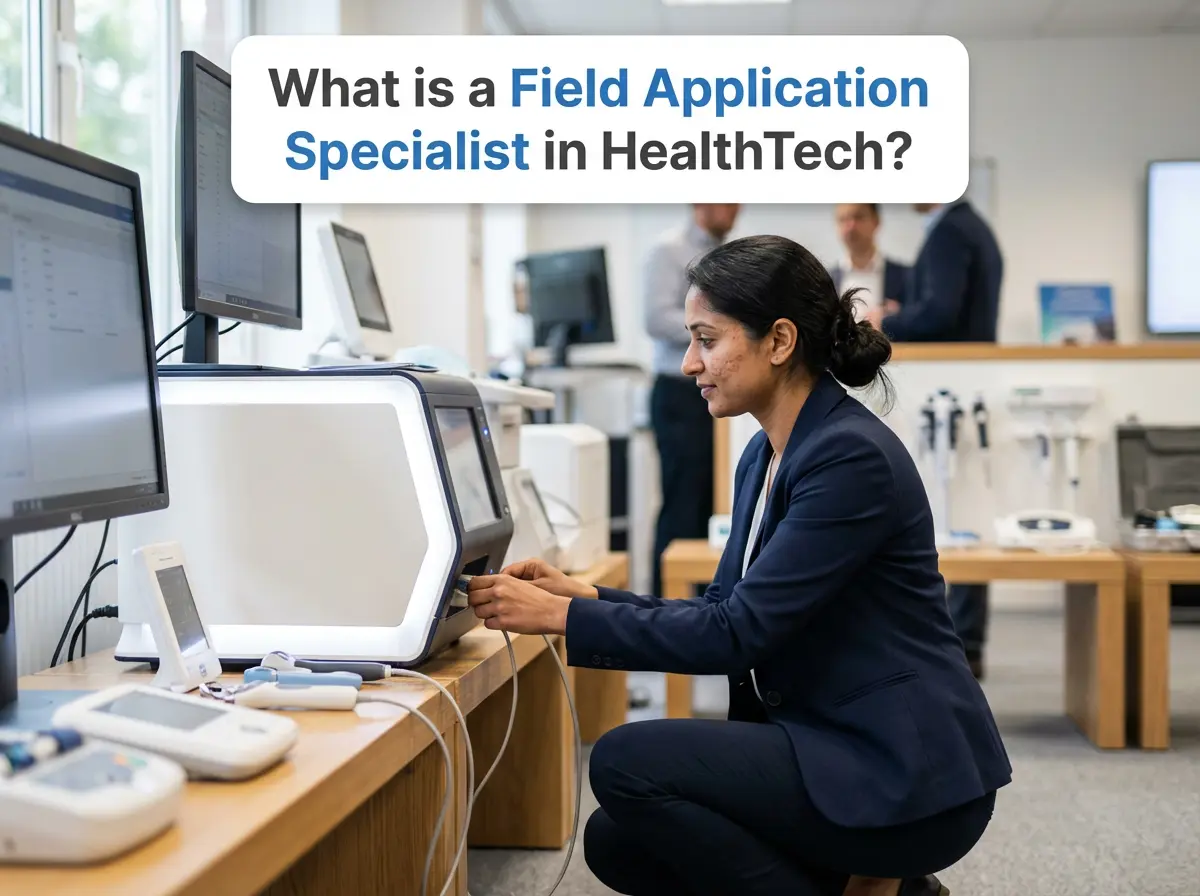
What is a Field Application Specialist in HealthTech?
A Field Application Specialist in HealthTech is the person responsible for making clinical or care-facing technology work in the real world: inside hospitals, clinics, labs, or community settings. Their job is to ensure it delivers safe, reliable outcomes for end users and patients. They sit at the intersection of product, customer operations, and clinical workflows, taking ownership of deployment success, adoption quality, and technical credibility at the point of care.
This role exists because HealthTech products don't "ship and forget". Even when the core software or device is stable, the environment is variable: different workflows, infrastructure constraints, data handling practices, and risk tolerances. A Field Application Specialist reduces that variability by owning how the product is understood, configured, used, and supported, especially in the moments where a customer's confidence can be won or lost.
The job is less about being a travelling trainer and more about being the accountable operator for customer outcomes: translating product intent into safe use, preventing avoidable incidents, and ensuring escalations are handled with urgency and discipline when clinical services depend on the technology.
🔍 How this role differs in HealthTech
In other tech sectors, "field" roles often focus on speed: rapid onboarding, fast enablement, and optimising usage to hit commercial goals. In HealthTech, the same activities happen (training, workflow guidance, adoption support), but decisions are shaped by higher consequence and lower tolerance for ambiguity.
Health data sensitivity changes the default approach to troubleshooting and analytics. You may not be able to "just pull logs" or replicate issues casually, and you often need to work through access controls, governance requirements, and operational approvals. That pushes the role towards careful evidence gathering, documented decision-making, and measured communication.
Real-world impact also changes trade-offs. A workaround that would be acceptable in consumer tech can be inappropriate in a clinical setting if it increases clinical risk, compromises data integrity, or creates hidden operational burden. Field Application Specialists in HealthTech are expected to carry that judgement, protecting patient safety and service continuity while still enabling progress.
🎯 Core responsibilities in HealthTech
Day to day, a Field Application Specialist is accountable for customer-facing technical and clinical success across the lifecycle: from early evaluation through go-live to stabilisation and ongoing optimisation. They arrive in environments where the "product" is only one component of the outcome; the rest is people, workflows, local policy, infrastructure, and time pressure. Their responsibility is to navigate those constraints and still deliver a safe, repeatable way of working.
They make judgement calls constantly: when to pause a rollout to prevent risk, when to proceed with mitigations, when to escalate to engineering or clinical safety, and when to push back on a customer request that could create unsafe use or non-compliant practice. The role also carries accountability for technical credibility in front of senior clinical and operational stakeholders: explaining what is known, what is uncertain, and what will happen next in a way that sustains trust.
In many HealthTech businesses (especially diagnostics, imaging, or workflow-critical platforms), Field Application Specialists also become the "signal amplifier" for the product organisation: identifying patterns across sites, translating real-world failure modes into actionable product improvements, and ensuring the next deployment is safer and smoother than the last.
🧩 Skills and competencies for HealthTech
Core Skill | HealthTech specific requirement | Reason or Impact |
|---|---|---|
Clinical workflow judgement | Understand how the technology interacts with real clinical or lab processes, including handoffs, exceptions, and time-critical moments | Prevents "technically correct" setups that create unsafe practice or hidden workload, protecting outcomes and adoption |
Risk-based decision-making | Prioritise actions based on patient impact, service continuity, and data integrity, not just customer urgency | Keeps escalations and mitigations aligned to real-world consequence, reducing avoidable incidents |
Stakeholder communication under pressure | Communicate clearly with clinical, operational, and technical audiences when incidents, delays, or constraints occur | Maintains trust and enables faster resolution by aligning expectations and responsibilities across teams |
Problem framing and evidence discipline | Gather reproducible evidence while working within access restrictions, governance boundaries, and partial observability | Improves speed-to-fix without breaching sensitive environments, and supports robust product and safety decisions |
Implementation ownership | Drive end-to-end readiness, including training quality, workflow fit, and support pathways through go-live | Reduces go-live risk and ensures the customer can operate independently after deployment |
Escalation leadership | Know when and how to involve engineering, clinical safety, security, or service teams, and how to stay accountable during handoffs | Prevents "dropped balls" during incidents and ensures the customer experiences a single, responsible owner |
Change management pragmatism | Adapt rollouts to local realities while keeping standardisation where it matters for safety and maintainability | Balances scalability with site-specific needs, lowering long-term support burden and improving outcomes |
💷 Salary ranges in UK HealthTech
Compensation is usually driven less by the job title and more by the criticality of the product in live clinical operations, the depth of domain expertise required (e.g. diagnostics workflows vs. general software enablement), and the level of accountability carried during go-lives and incidents. Location still matters (particularly for London and South East), but in HealthTech, travel intensity, customer complexity, regulated environments, and on-call expectations can shift pay materially even outside major hubs.
Experience level | Estimated annual salary range | What drives compensation |
|---|---|---|
Junior | London & South East: £32,000–£42,000 | Entry route from clinical/lab backgrounds or early-career technical roles; narrower ownership, more supervised delivery, lower incident accountability |
Mid-level | London & South East: £42,000–£55,000 | Independent site ownership, stronger troubleshooting, confident stakeholder management, and responsibility for stabilisation after go-live |
Senior | London & South East: £55,000–£70,000 | High-stakes deployments, complex environments, deeper domain expertise, and leadership during escalations; higher travel and customer-criticality exposure |
Lead | London & South East: £70,000–£90,000 | Multi-site or regional accountability, mentoring and standard-setting, ownership of playbooks and quality bar, and acting as the escalation "closer" |
Head / Director | London & South East: £90,000–£125,000 | Org-level accountability for field outcomes, support strategy, delivery quality, cross-functional governance, and performance against reliability/adoption goals |
Beyond base salary, total compensation commonly includes a performance bonus, pension and benefits, and travel-related support (often including a company car or car allowance for field-heavy roles). On-call allowance may apply where the product is operationally critical and rapid response is expected outside working hours; this increases with incident intensity, customer coverage model, and the maturity of the company's support organisation. Equity is more common in scaling HealthTech vendors than in established corporates, and tends to vary with seniority and how close the role sits to business-critical delivery outcomes.
🚀 Career pathways
Most people enter this role from one of three directions: a clinical or laboratory background moving into vendor-facing applications work; a customer support or implementation route where they've proven they can own outcomes in high-pressure environments; or a product-facing technical role where they want closer proximity to real-world use.
Progression is primarily about expanding ownership. Early on, success looks like running strong training and stabilising a single site with structured support. As you grow, you take responsibility for harder environments, lead go-lives where time and risk are real constraints, and become trusted to make calls that balance safety, service continuity, and delivery. The next step is owning a region or programme: standardising what "good" looks like, coaching other specialists, and shaping product and support strategy based on field evidence.
From there, pathways branch into Field Leadership, Implementation/Customer Success leadership, Product (especially workflow, clinical, or platform reliability), or specialised roles in clinical safety, solutions, or operational excellence, depending on whether your strength is execution, strategy, or deep domain expertise.
❓ FAQ
Do I need a clinical background to become a Field Application Specialist in HealthTech?
Not always, but it helps when the product directly touches clinical or lab workflows. Candidates without a clinical background tend to succeed when they can demonstrate strong operational judgement, evidence-based troubleshooting, and the ability to learn workflows quickly without overstepping governance boundaries.
How will I be assessed in interviews for this role beyond "can you train customers"?
Expect evaluation on ownership: how you handle escalations, how you communicate uncertainty, and how you protect safety and service continuity under pressure. Interviewers often look for structured problem framing, disciplined incident handling, and examples where you improved outcomes across multiple sites, not just delivered a single go-live.
Is on-call common for Field Application Specialists, and what should I clarify before accepting an offer?
It depends on how critical the product is in day-to-day care and how the company runs support coverage. Clarify whether on-call is expected, how often, what "response" means in practice, what escalation paths exist, and whether there's an allowance or time back, because this can materially change the real workload.
🔎 Find your next role
If you're ready to own customer outcomes where technology meets care delivery, search Field Application Specialist roles on Meeveem.
You might also like