Published Date: January 2, 2026
Updated Date: January 2, 2026
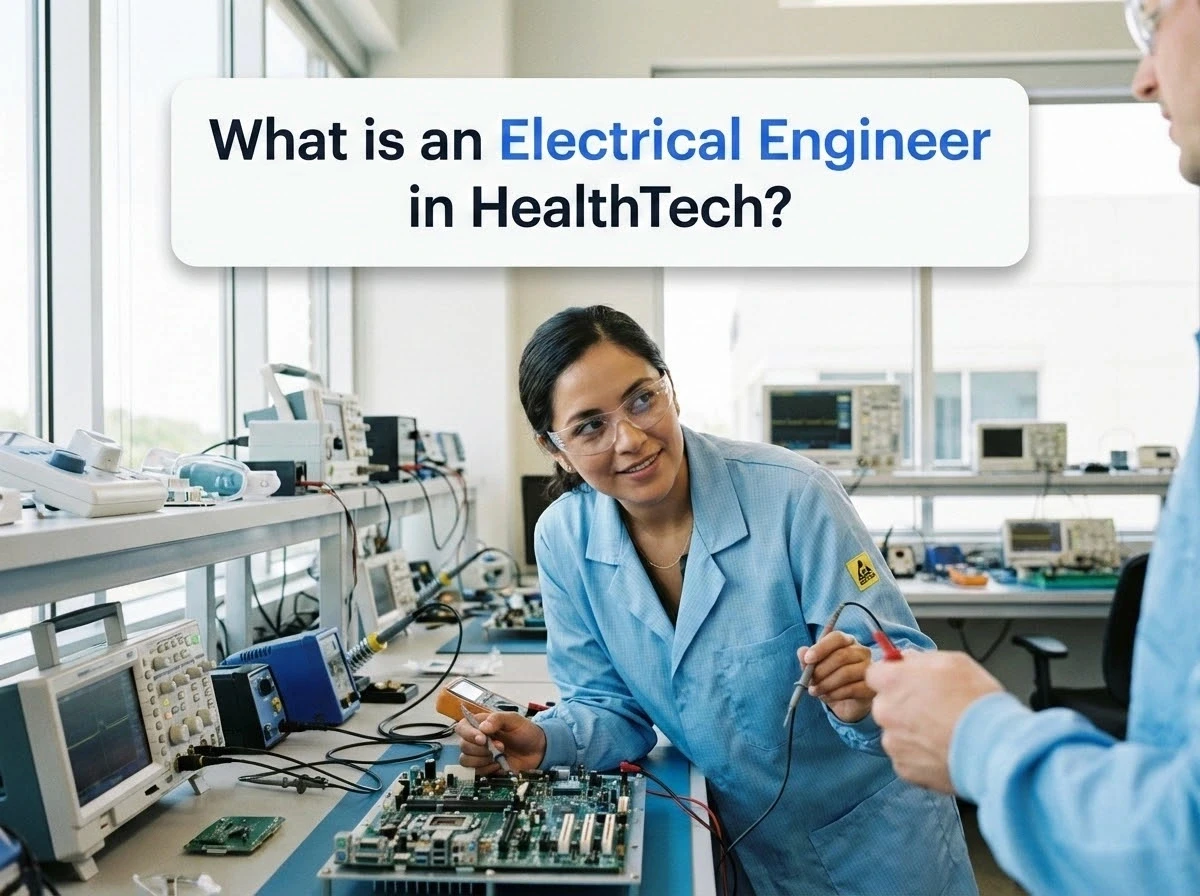
What is an Electrical Engineer in HealthTech?
An Electrical Engineer in HealthTech is accountable for the electrical integrity, safety, and performance of technology that interacts with clinical environments, patients, or regulated healthcare operations. In practice, this might involve designing the electronics inside a medical device, ensuring a diagnostic system's power architecture behaves safely under fault conditions, or owning electrical verification evidence that supports approvals and safe deployment.
This role exists because healthcare hardware is judged less on features and more on consequences. Electrical decisions can become patient safety decisions, service continuity decisions, and regulatory risk decisions. HealthTech organisations need someone who can take ownership of how electricity flows through a product or system (normal operation, misuse, component failure, environmental stress) and who is willing to accept the uncomfortable reality that "it mostly works" is not an acceptable definition of done.
The core of the job is responsibility: for safety margins, for test coverage that stands up to scrutiny, for decisions that balance speed and rigour, and for ensuring the organisation can explain, document, and defend what it shipped.
🔍 How this role differs in HealthTech
In many tech sectors, engineering trade-offs are dominated by customer experience, time to market, and scalability. In HealthTech, trade-offs are dominated by risk, traceability, and real-world impact. An Electrical Engineer isn't only optimising a circuit; they're shaping how a system behaves in edge conditions that are common in healthcare: cleaning regimes, continuous operation, shared wards, mixed equipment, constrained installation spaces, and non-expert users under pressure.
The tolerance for ambiguity is lower. Decisions need to be reproducible and explainable, not just "best practice." Documentation and evidence become part of the deliverable, because safety and regulatory expectations often require a clear chain from requirement to design decision to verification result to release rationale.
Finally, HealthTech frequently changes how success is measured. A technically clever solution that complicates maintenance, calibration, or fault isolation may be rejected because it increases downtime risk or makes safe field servicing harder. Electrical engineering here is inseparable from lifecycle thinking.
🎯 Core responsibilities in HealthTech
Day to day, an Electrical Engineer in HealthTech is accountable for making sure electrical design choices hold up under clinical reality. They translate product intent into electrical requirements that are specific enough to test, then make design decisions that manage safety, reliability, manufacturability, and serviceability at the same time. Much of the work is judgement under constraints: what to simplify, where to add redundancy, how to control energy pathways, and how to prove that the system fails safely.
They spend significant time aligning stakeholders around what "safe" and "acceptable risk" means in a given context. That may involve working with quality and regulatory colleagues to ensure evidence is structured properly, partnering with software and systems engineers so that electrical behaviours are correctly monitored and controlled, and supporting manufacturing so that the product built is the product that was verified.
In organisations that run installed hardware, the role often extends into operational accountability: understanding failure patterns from the field, deciding whether an issue is a design defect or a process drift, and leading the engineering response so fixes are effective without creating new risk. Where service continuity matters, they may also contribute to out-of-hours support or escalation pathways, because electrical faults can be safety critical and time sensitive.
🧩 Skills and competencies for HealthTech
Core Skill | HealthTech specific requirement | Reason or Impact |
|---|---|---|
Safety-first engineering judgement | Ability to reason about fault conditions, misuse, and degraded modes, not just nominal performance | Prevents "works in the lab" designs that become unsafe or unreliable in clinical use |
Requirements discipline | Turning clinical and system needs into testable electrical requirements with clear acceptance criteria | Enables defensible verification and reduces ambiguity during audits, incidents, or change reviews |
Verification ownership | Owning the electrical test strategy, coverage, and evidence quality end to end | Builds confidence that safety claims are supported by results, not assumptions |
Risk-based trade-off decision-making | Prioritising mitigations by severity, detectability, and likelihood rather than engineering preference | Keeps effort focused on what truly changes patient or service risk |
Cross-functional leadership | Aligning hardware, software, QA/RA, manufacturing, and service around a single safety and release narrative | Reduces late-stage rework and prevents gaps between design intent and operational reality |
Lifecycle and serviceability thinking | Designing with maintenance, calibration, fault isolation, and field constraints in mind | Improves uptime and reduces the chance that repairs or servicing introduce new hazards |
Documentation and traceability habits | Writing decisions, assumptions, and results in a way others can audit and reproduce | Protects the organisation when questions arise and supports controlled change over time |
Communication under pressure | Explaining technical risk and urgency clearly to non-electrical stakeholders | Speeds up safe decisions during incidents, escalations, or release gates |
💷 Salary ranges in UK HealthTech
Electrical engineering pay in HealthTech is driven less by the job title and more by what you own. Compensation rises with clinical criticality (patient contact vs back of house), the maturity of the quality system, the depth of verification responsibility, whether you are the design authority for safety-related parts, and whether the role includes field support or escalation expectations. Location still matters (particularly London and the South East) but regulated accountability and "sign-off" expectations can outweigh geography at senior levels.
Experience level | Estimated annual salary range | What drives compensation |
Junior | London & South East: £32,000–£42,000 | Supervised delivery, narrower ownership, more learning on regulated documentation and verification expectations |
Mid-level | London & South East: £45,000–£60,000 | Independent subsystem ownership, stronger verification responsibility, increased cross-functional influence |
Senior | London & South East: £60,000–£80,000 | Design authority for key electrical areas, risk ownership, leading verification strategy and complex trade-offs |
Lead | London & South East: £75,000–£100,000 | Accountability across multiple subsystems or a platform, technical leadership, higher scrutiny on safety evidence and release decisions |
Head / Director | London & South East: £95,000–£140,000 | Organisational accountability, resourcing and strategy, governance for design controls, operational risk and incident leadership |
Beyond base salary, total compensation often includes performance bonus, pension contributions, and (in venture-backed firms) equity. If the role includes out-of-hours escalation (more common in organisations running installed clinical systems than in pure R&D) on-call allowances or additional payments for call-outs may apply, and can materially change annual totals depending on rota frequency and incident rates. Variation is most strongly driven by how regulated and safety critical the scope is, whether you're the final technical approver for electrical safety decisions, and how much operational responsibility sits with engineering after deployment.
🚀 Career pathways
Many Electrical Engineers enter HealthTech from adjacent industries that build regulated or high-reliability hardware: industrial controls, automotive, aerospace, energy systems, or consumer electronics with strong compliance culture. Others start inside healthcare estates, clinical engineering, field service, or biomedical equipment maintenance roles and move into product development once they've built deep context for real-world clinical constraints.
Progression tends to follow ownership rather than credentials. Early on, growth means taking a subsystem from requirements through verification with minimal supervision. Later, it means being trusted with risk: making calls when evidence is incomplete, setting verification strategy, and guiding other engineers through safety critical decisions. The step to Lead is usually defined by multiplying impact (owning an architecture, unblocking teams, and setting standards for how evidence is produced). Head/Director progression is marked by organisational accountability: you're responsible for the system that produces safe products consistently, not just a single design.
❓ FAQ
Do I need medical device experience to be hired as an Electrical Engineer in HealthTech?
Not always, but you need to show you can work in a high-consequence environment. Hiring teams typically look for evidence that you've owned verification, handled failure modes seriously, and can document decisions clearly. Domain knowledge can be learned; poor safety judgement is much harder to fix.
What will the interview focus on beyond circuit design?
Expect questions about how you validate requirements, how you decide what to test (and what not to), and how you respond when field data conflicts with lab expectations. You may be assessed on your ability to communicate risk to non-electrical stakeholders and to defend a trade-off using evidence and rationale.
Is on-call common for Electrical Engineers in HealthTech?
It depends on whether the company operates deployed systems that must stay available, or if it's mainly product development. On-call is more likely where equipment is installed in clinical settings and engineering supports service continuity or incident response. If on-call exists, ask about rota frequency, what constitutes a page-worthy incident, and how call-outs and rest time are handled.
🔎 Find your next role
Ready to apply your electrical engineering judgement to real-world healthcare impact? Search Electrical Engineer roles on Meeveem.
You might also like