Published Date: December 17, 2025
Updated Date: December 17, 2025
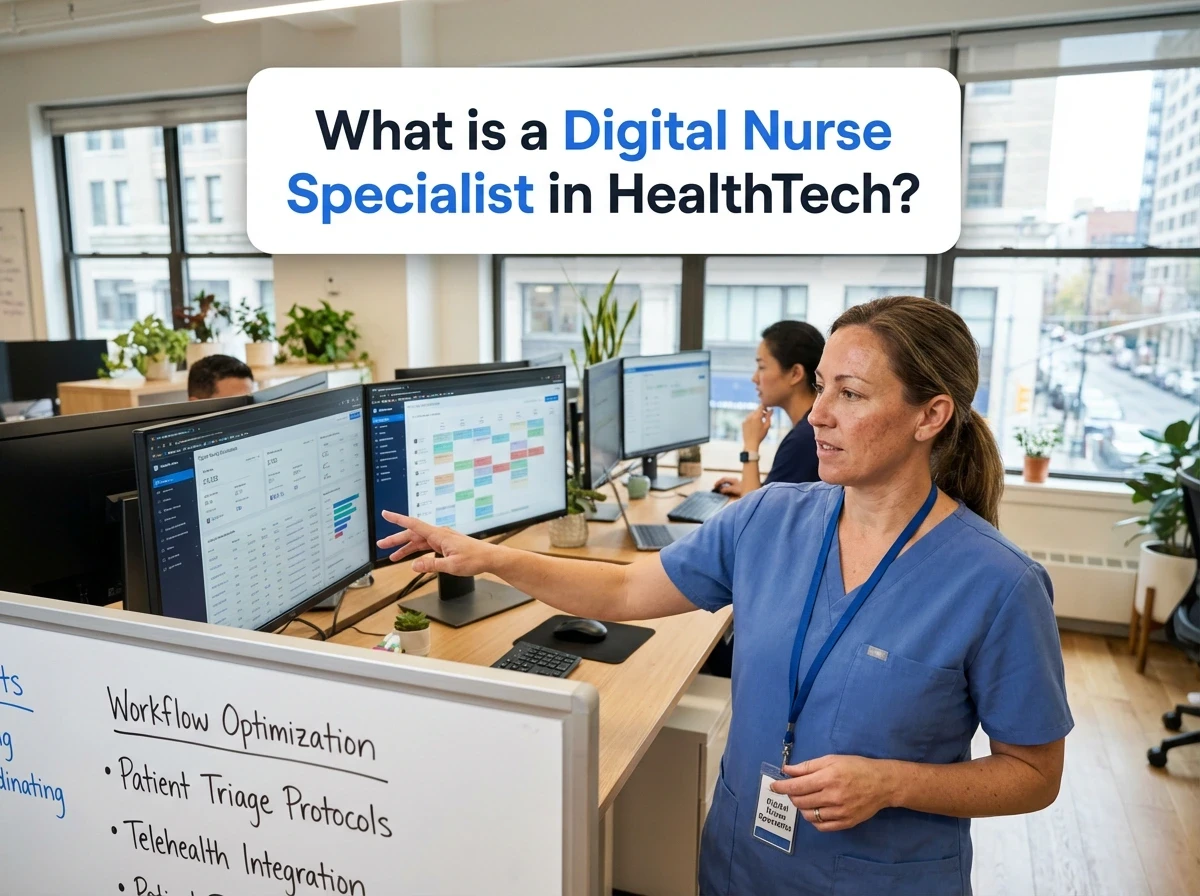
What is a Digital Nurse Specialist in HealthTech?
A Digital Nurse Specialist in HealthTech is a clinically registered nurse who takes accountability for making digital products, pathways, and workflows safe, usable, and clinically credible in real care settings. They work at the intersection of frontline practice, clinical governance, and delivery teams, owning the "clinical truth" of how a digital service should behave when it meets real patients, real documentation standards, and real operational constraints.
This role exists because healthcare technology fails differently from most software. A confusing workflow, an unsafe default, or an unclear handover can translate into delayed care, missed escalation, or harm. HealthTech organisations need a professional who can represent nursing practice with authority, make defensible decisions under uncertainty, and ensure that adoption doesn't come at the expense of safety, dignity, or professional standards.
In practice, a Digital Nurse Specialist is responsible for outcomes: safe adoption, reliable clinical workflows, trustworthy documentation, and effective training and enablement, whilst maintaining clinical credibility and accountability to governance expectations. Methods vary by organisation, but the ownership remains constant.
🔍 How this role differs in HealthTech
In many tech sectors, product decisions can be optimised primarily for growth, engagement, or efficiency. In HealthTech, the Digital Nurse Specialist operates in a risk-weighted environment where the "best" solution is rarely the fastest or most feature-rich, because the cost of failure is higher, data is more sensitive, and clinical accountability is non-negotiable.
The difference shows up in everyday judgement. A change that looks like a minor UX improvement may alter clinical documentation quality, shift workload between professions, or introduce new safety hazards at handover. The role therefore carries an added obligation to pressure-test assumptions: who is responsible for acting on an alert, what happens when staffing is thin, how a workflow behaves out of hours, and how the product supports professional standards rather than just process completion.
HealthTech also places heavier emphasis on auditability and defensibility. When something goes wrong, the organisation needs to show not only what happened, but why decisions were made, what risks were known, and how they were mitigated. A Digital Nurse Specialist is often central to that line of sight.
🎯 Core responsibilities in HealthTech
Day to day, the Digital Nurse Specialist holds clinical accountability for how a digital service is experienced by nursing teams and how that experience translates into patient care. They work with product and delivery colleagues to shape requirements that reflect real nursing workflows, not idealised process maps, and they intervene early when a design choice creates downstream clinical risk or an adoption burden that will predictably fail in practice.
A large part of the role is decision-making under constraint: incomplete information, competing stakeholder priorities, varying local practices, and the reality that "go-live" is not the end of the work. They help the organisation choose what to standardise and what to keep flexible, balancing patient safety, professional standards, and operational feasibility. When trade-offs are unavoidable (speed of rollout vs. depth of training, data completeness vs. documentation time), they make the trade-off explicit, set guardrails, and ensure that accountability is understood.
In HealthTech organisations building or deploying regulated or safety-critical systems, the Digital Nurse Specialist is frequently involved in clinical risk thinking: identifying hazards, validating clinical assumptions, ensuring escalation pathways are unambiguous, and supporting incident learning so that the product improves without eroding trust. Even where they are not the named safety lead, they are often the person who spots the clinical "edge cases" before they become real-world incidents.
🧩 Skills and competencies for HealthTech
Core Skill | HealthTech specific requirement | Reason or Impact |
|---|---|---|
Clinical judgement | Translate messy real-world nursing practice into clear, testable, and safe digital behaviours without oversimplifying clinical nuance. | Prevents "paper-perfect" workflows that break under pressure, reducing risk at handover, escalation, and documentation. |
Ownership mindset | Take responsibility for adoption outcomes (safety, usability, training effectiveness), not just for producing clinical input. | HealthTech work fails when accountability is diluted; ownership keeps delivery decisions defensible and coherent. |
Risk-based decision-making | Recognise where small design or configuration choices create safety hazards, and know when to slow delivery to mitigate risk. | Protects patients and the organisation by avoiding avoidable incidents and unstable go-lives. |
Stakeholder leadership | Align ward realities, governance expectations, and product constraints without turning the role into "messaging" or "requirements taking." | Builds trust with clinicians whilst enabling delivery teams to move with clarity and fewer reversals. |
Data literacy (clinical meaning) | Validate that data captured in the product reflects valid clinical constructs and supports safe decisions at the point of care. | Improves documentation quality, reporting credibility, and the safety of downstream decision-making. |
Change and adoption leadership | Design training and enablement that works in busy clinical environments, including floor support during high-risk periods. | Reduces adoption failure, workarounds, and staff frustration, especially during go-live and early optimisation. |
Professional and ethical grounding | Uphold nursing standards when technology pressures documentation, triage, safeguarding, or consent workflows. | Maintains patient trust and protects staff by ensuring digital workflows support, rather than erode, professional practice. |
💷 Salary ranges in UK HealthTech
Compensation for a Digital Nurse Specialist is primarily driven by scope (single product vs. multiple services), risk and criticality (clinical decision support, triage, medication-adjacent workflows), accountability (individual contributor vs. people leadership), and how "hands-on" the role is during delivery (go-lives, incident response, out-of-hours support). Location matters, but so does the organisation type: scale-ups may pay more cash for scarce expertise; larger organisations may offer stronger benefits and clearer progression. On-call expectations and the intensity of implementation periods can also shift pay meaningfully.
Experience level | Estimated annual salary range | What drives compensation |
Junior | London & South East: £35,000–£45,000 | Early-stage digital exposure, narrower scope, typically focused on training, adoption support, and supervised configuration/input. |
Mid-level | London & South East: £45,000–£58,000 | Ownership of defined workflows or modules, stronger clinical translation skills, more independence in stakeholder management. |
Senior | London & South East: £58,000–£72,000 | Accountability across multiple clinical areas or a complex product surface, higher-risk decision-making, and leadership through go-lives and incident learning. |
Lead | London & South East: £70,000–£88,000 | Cross-team influence, responsibility for standards, adoption strategy, and often line management or programme-level ownership. |
Head / Director | London & South East: £90,000–£120,000 | Organisation-wide nursing digital leadership, governance accountability, budget/strategy influence, and responsibility for outcomes across multiple services or portfolios. |
Beyond base salary, total compensation often includes a performance bonus (more common in commercial HealthTech), pension and enhanced benefits, and (particularly in scale-ups) equity options. Where the role includes out-of-hours incident support, go-live coverage, or formal safety responsibilities, packages may add an on-call allowance or uplift. Variation is usually driven by how frequently on-call is used, whether clinical incidents are in scope, and how business-critical the service is.
🚀 Career pathways
Most people enter this role from clinical nursing with a track record of digital adoption leadership: being a superuser, supporting EPR rollouts, acting as a ward-based champion, or taking on governance-adjacent responsibilities. Others move in from clinical education, quality improvement, or service transformation, especially where they've owned change in high-pressure environments.
Progression is typically marked by expanding ownership. Early on, responsibility is local: helping teams use a system safely and consistently. With experience, the role shifts upstream into design authority (shaping requirements, setting documentation standards, and preventing risk before it reaches the ward). At senior levels, progression comes from owning outcomes across services: standardisation decisions, governance alignment, clinical risk trade-offs, and building teams that can deliver safely at scale.
The strongest career moves are rarely title-led. They come from being the person trusted to make difficult calls, balancing safety, feasibility, and adoption without compromising professional standards.
❓ FAQ
Do I need to keep working clinical shifts to be credible as a Digital Nurse Specialist?
Not always, but you need demonstrable clinical credibility. Some roles expect occasional clinical practice or structured time in clinical areas; others rely on recent experience and strong engagement with frontline teams. What matters most is that your judgement reflects real constraints and that clinicians trust your decisions.
What will I be judged on in interviews: clinical experience or tech skills?
Typically both, but not in equal measure. Hiring teams look for evidence you can own decisions under pressure: handling stakeholder conflict, preventing unsafe workflows, and driving adoption without creating workarounds. Tool knowledge helps, but clear clinical reasoning and accountability usually matter more.
Will I be expected to do on-call or out-of-hours work?
Sometimes, especially around go-lives, incident response, or high-availability services. The practical expectation varies from planned weekend floor support to structured on-call rotations. You should ask how often it is triggered, what counts as an escalation, and whether it's compensated as allowance, uplift, or time off in lieu.
🔎 Find your next role
If you're ready to move into nursing-led digital ownership, search Digital Nurse Specialist roles on Meeveem and compare scope, safety expectations, and progression paths before you apply.
You might also like