Published Date: January 7, 2026
Updated Date: January 7, 2026
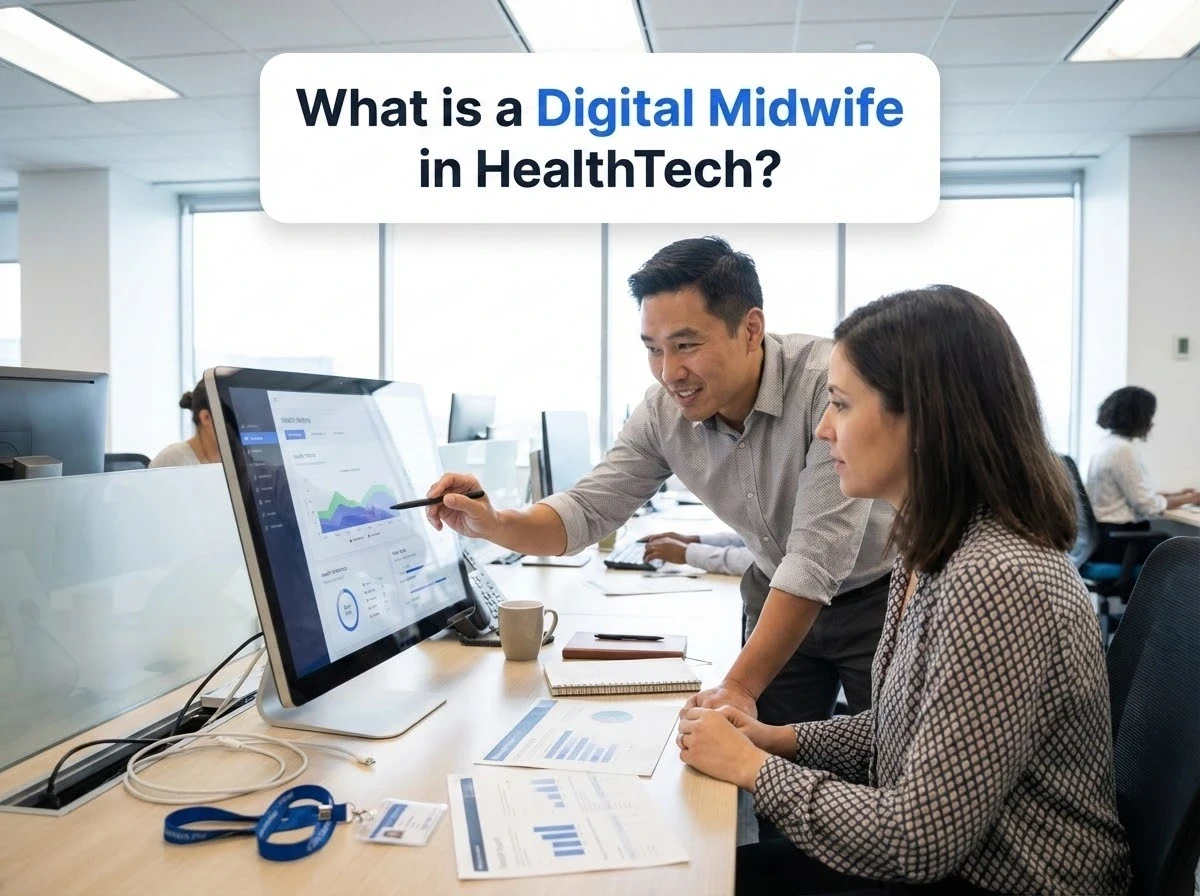
What is a Digital Midwife in HealthTech?
A Digital Midwife in HealthTech is a clinically registered midwife who takes responsibility for the safe, effective use of digital systems across the maternity pathway. This typically includes the digital maternity record, maternity modules within an EPR, and the data flows that underpin national and local reporting. The role exists to ensure that digital change in maternity is not imposed on clinical teams, but is instead clinically led, safety-assured, and operationally workable in real-world settings.
In practice, this job is less about being "good with tech" and more about being accountable for how technology changes care: whether the right information is captured at the right time, whether workflows support safe decision-making, whether staff can use systems reliably under pressure, and whether data is trustworthy enough to drive governance, audit, and service improvement.
A Digital Midwife typically sits between maternity leadership and digital delivery (IT, informatics, EPR teams, vendors), acting as the named clinical owner for maternity digital configuration, adoption, and safety, especially during optimisation and major go-lives.
🔍 How this role differs in HealthTech
In many tech industries, digital roles can prioritise speed, experimentation, and user growth because the downside of a wrong decision is usually financial or reputational. In HealthTech, the downside can be clinical harm, compromised safeguarding, broken continuity of care, or data that misrepresents risk.
That difference changes what "good" looks like. A Digital Midwife must protect clinical integrity while still enabling modernisation: not simply shipping features, but ensuring that documentation, escalation, and handover remain safe across antenatal, intrapartum, and postnatal contexts. Decisions are shaped by constrained staffing, variable digital confidence across teams, complex multi-service pathways, and the reality that maternity care doesn't pause for system changes.
The role also carries a heavier accountability for information quality. In HealthTech, "data quality" is not a reporting nice-to-have; it directly influences governance, oversight, prioritisation, and the ability to identify deterioration, inequality, and service risk.
🎯 Core responsibilities in HealthTech
Day to day, a Digital Midwife is accountable for translating maternity practice into digital reality and then owning the consequences of that translation. That means shaping how the digital maternity record is configured, how templates and pathways reflect clinical policy, and how changes land in busy clinical environments without introducing new failure modes.
They spend significant time arbitrating trade-offs: reducing documentation burden without losing clinically essential detail; standardising workflows while keeping flexibility for complex cases; improving reporting while avoiding "tick-box" behaviours that distort care. When things go wrong (missing fields, confusing screens, poor interoperability, adoption drop-offs), the Digital Midwife is often the person expected to diagnose whether the root cause is training, configuration, policy mismatch, or a genuine safety issue that needs escalation and governance.
During implementations and go-lives, the role becomes more operational and higher intensity: coordinating readiness, supporting users, handling rapid feedback loops, and ensuring that urgent fixes don't bypass clinical safety thinking. Even outside go-live windows, the work is continuous because maternity practice evolves, standards change, and services are under constant pressure to do more with less.
🧩 Skills and competencies for HealthTech
Core Skill | HealthTech specific requirement | Reason or Impact |
|---|---|---|
Clinical ownership | Taking responsibility for how digital workflows affect risk recognition, escalation, and continuity across the maternity pathway | Keeps digital change anchored to safe care rather than convenience or legacy habits |
Safety judgement | Knowing when a "minor configuration tweak" is actually a patient safety concern that needs formal clinical safety handling | Prevents silent failure modes that only appear under pressure, at night, or in rare scenarios |
Workflow translation | Converting real maternity practice into structured documentation without breaking team flow across roles and settings | Makes systems usable in time-critical moments while protecting clinical meaning |
Data accountability | Owning completeness and correctness of maternity data, including how it is captured, validated, and reported | Enables trustworthy governance, audit, and improvement without misleading conclusions |
Change leadership | Leading adoption with credibility in clinical teams and firmness in digital delivery discussions | Reduces resistance, improves consistency, and avoids unsafe workarounds becoming normalised |
Cross-boundary collaboration | Operating effectively across maternity leadership, IT, suppliers, informatics, and training functions | Prevents "handoff gaps" where responsibility is diluted and patient-facing issues linger |
Policy-to-system alignment | Ensuring local guidance, SOPs, and pathways match what the digital record asks staff to do | Avoids compliance theatre and reduces the risk of staff documenting incorrectly to "make the system happy" |
Training design under constraint | Building practical, role-relevant learning that works for shift patterns and varied digital confidence | Improves competence quickly, which matters most during go-lives and high turnover periods |
Prioritisation under pressure | Making defensible calls on what gets fixed now, what gets mitigated, and what can wait | Keeps services safe and functioning without creating chaos or constant rework |
💷 Salary ranges in UK HealthTech
Pay for a Digital Midwife in UK HealthTech tends to track three factors more than title: (1) clinical accountability for safety and governance, (2) the scale/criticality of the maternity digital estate (single site vs group, optimisation vs replacement), and (3) operational intensity, especially whether the role supports go-lives with out-of-hours expectations. Location still matters, but scope and on-call intensity can move pay meaningfully even outside London.
Experience level | Estimated annual salary range | What drives compensation |
Junior | London & South East: £40,000–£48,000 | Usually support-focused (training, adoption, basic reporting) with narrower ownership and limited go-live accountability |
Mid-level | London & South East: £48,000–£56,000 | Owning defined workstreams (templates, pathways, data quality) and acting as the day-to-day clinical bridge into digital teams |
Senior | London & South East: £56,000–£66,000 | Larger service footprint, deeper governance involvement, higher autonomy, and more frequent escalation decisions |
Lead | London & South East: £65,000–£78,000 | Programme leadership across multiple teams/sites, stronger vendor and delivery accountability, and heavier go-live/incident ownership |
Head / Director | London & South East: £80,000–£105,000 | Executive-level accountability for maternity digital strategy, safety governance, performance outcomes, and budget/vendor management |
Beyond base salary, total compensation often includes an on-call or out-of-hours element during implementations and major releases (ranging from occasional paid sessions to formal on-call arrangements), plus performance bonus in some HealthTech vendors and private providers. Equity is most common in venture-backed HealthTech organisations and usually shows up at senior, lead, and head levels. Variation is driven by how close the role sits to regulated safety obligations, whether you are accountable for go-live risk, and whether you lead across multiple sites/products rather than a single maternity system.
🚀 Career pathways
Most Digital Midwives enter from clinical practice with a strong interest in quality, governance, training, or service improvement, often after becoming a "go-to" person for digital documentation or supporting a local system change. Others come via informatics or EPR super-user routes, where they have already learned how configuration choices change behaviour on the ward.
Progression is best understood as widening ownership. Early on, you may own adoption and training for a module or workflow; then you take accountability for end-to-end pathway design, data integrity, and safety escalation. With seniority, the remit expands beyond maternity documentation into cross-service integration, supplier accountability, governance rhythms, and the ability to lead multiple stakeholders through high-risk change without disrupting care. Titles change, but the real marker of growth is being trusted to make hard calls when clinical reality and digital constraints collide.
❓ FAQ
Do I need to be a practising midwife to become a Digital Midwife in HealthTech, or can I come from a tech background?
Most roles expect a registered midwife because the job holds clinical credibility and accountability for how systems affect care. Tech experience helps, but it rarely substitutes for clinical authority in maternity settings. If you're coming from tech, consider adjacent roles first (clinical workflow analyst, implementation consultant) while building maternity domain depth.
What will I be judged on in the first few months: features delivered or something else?
You'll usually be judged on stability, adoption, and trust: whether staff can use the system safely, whether issues are triaged and resolved without chaos, and whether data quality improves rather than deteriorates. Clear governance, predictable training support, and sensible prioritisation typically matter more than "shipping" changes.
How intense is out-of-hours work for a Digital Midwife in HealthTech?
In steady-state optimisation, most work sits in business hours with occasional flexibility. During go-lives, upgrades, or major migrations, out-of-hours support can become an explicit expectation, especially to cover clinical risk and rapid fixes. Candidates should ask directly how on-call is organised, how often it occurs, and how it is compensated.
🔎 Find your next role
Ready to step into digital maternity leadership? Search Digital Midwife roles on Meeveem and find a team where clinical ownership is taken seriously.
You might also like