Published Date: January 7, 2026
Updated Date: January 7, 2026
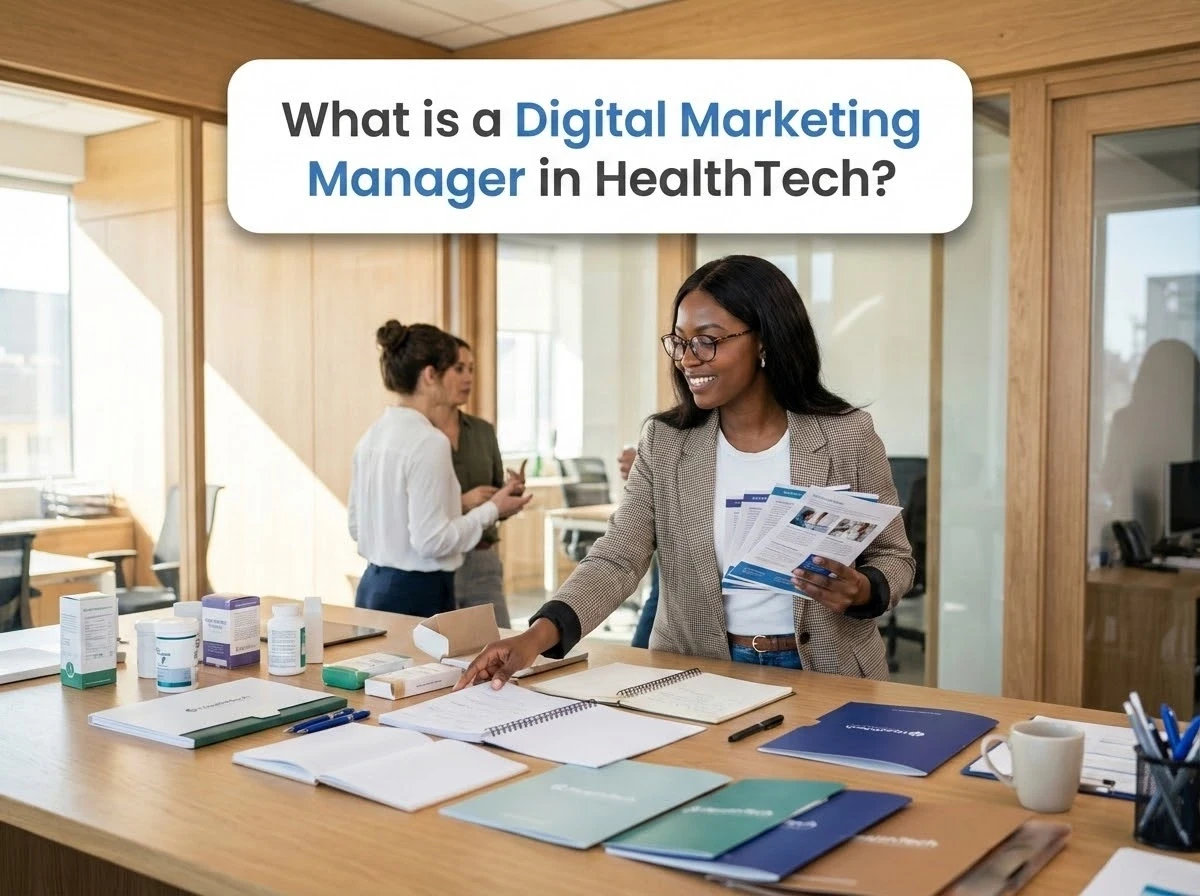
What is a Digital Marketing Manager in HealthTech?
A Digital Marketing Manager in HealthTech owns how a health technology company is discovered, understood, and trusted through digital channels. They're accountable for turning that visibility into measurable demand, adoption, or patient engagement. The role exists because HealthTech organisations can't rely on brand goodwill alone: they need a disciplined, trackable engine for reaching specific audiences (clinicians, care providers, payers, patients, carers, or partners) whilst staying aligned with clinical realities, privacy expectations, and higher standards of accuracy.
This is a responsibility-first role. You're not hired simply to "run campaigns"; you're hired to own outcomes such as qualified pipeline, product adoption, retention signals, or service uptake whilst protecting the organisation from avoidable reputational and compliance risk. In many HealthTech teams, the Digital Marketing Manager sits between growth goals and real-world constraints, ensuring performance marketing and content distribution stay credible, evidence-aware, and operationally usable.
🔍 How this role differs in HealthTech
In many tech industries, digital marketing optimises for speed: faster testing, louder positioning, and aggressive retargeting. In HealthTech, the same tactics can backfire because the cost of being misleading is higher and the audiences are more risk-sensitive. Claims need to be careful; language needs to be precise; and the path from click to "conversion" often involves multiple stakeholders who don't behave like typical consumer buyers.
Data sensitivity also changes the playbook. Even when you're not directly handling clinical data, the way you segment, measure, and message can raise privacy questions and internal scrutiny. You're often working with stricter interpretations of consent, more conservative tracking setups, and a greater need to justify why each channel is appropriate for the audience and the problem being solved.
Finally, the impact is more tangible. A campaign isn't just "good performance" if it generates the wrong demand (for example, attracting unsuitable users, mis-setting expectations, or overwhelming clinical/support pathways). The role therefore requires stronger judgement: success is growth that the product, service, and organisation can safely deliver.
🎯 Core responsibilities in HealthTech
Day to day, a Digital Marketing Manager in HealthTech is accountable for building and running a reliable digital demand engine whilst keeping messaging accurate and defensible. That typically means shaping acquisition and nurture strategy across paid, owned, and earned channels; defining what "qualified" interest looks like for a HealthTech buyer or user; and aligning measurement to outcomes the business actually cares about (not just clicks).
A large part of the work is decision-making under constraints. You may need to trade off tracking depth for privacy risk, trade off short-term lead volume for higher-quality intent, or slow down a campaign until product, clinical, or legal stakeholders are comfortable with the claims. You'll also be balancing multiple internal realities: sales capacity, customer success bandwidth, clinical safety expectations, and the reputational impact of how the company shows up online.
In practice, the best HealthTech Digital Marketing Managers act as owners of the end-to-end journey: they ensure that what's promised in the ad is what's delivered on the landing page, what's followed up by sales or partnerships, and what's experienced in onboarding. Inconsistency in HealthTech erodes trust quickly and can create real operational risk.
🧩 Skills and competencies for HealthTech
Core Skill | HealthTech specific requirement | Reason or Impact |
|---|---|---|
Outcome ownership | Define success in terms that match real adoption (clinical workflow fit, provider uptake, sustained engagement), not just lead volume | Prevents "vanity growth" that overwhelms teams or attracts the wrong users and protects credibility with cautious buyers |
Risk-based judgement | Make channel and messaging decisions with an explicit view of reputational, privacy, and claims risk | Reduces the chance that performance optimisation creates compliance issues or trust loss |
Stakeholder management | Work smoothly with product, clinical, legal/compliance, security, and commercial leaders without stalling delivery | HealthTech sign-off paths are more complex; progress depends on alignment and clear accountability |
Evidence-aware messaging | Translate product value into accurate, supportable statements and avoid over-claiming | Buyers and users scrutinise claims; precision improves conversion and reduces escalation later |
Measurement under constraints | Build reporting that remains useful even with limited tracking, longer sales cycles, and multi-touch journeys | Enables confident budget decisions when attribution is imperfect and stakeholders demand defensible proof |
Audience empathy | Understand how clinicians, care teams, patients, and procurement interpret risk, time pressure, and trust signals | Improves creative and journey design so the message lands in real-world contexts |
Operational thinking | Anticipate downstream load (sales follow-up, onboarding, support, clinical pathways) when driving demand | Ensures growth is serviceable, reduces churn drivers, and avoids creating friction for front-line teams |
💷 Salary ranges in UK HealthTech
Salary in UK HealthTech digital marketing is driven less by channel "skill" and more by scope and accountability: budget ownership, revenue impact, buyer complexity (B2B, B2B2C, patient), the scrutiny around claims and privacy, and how directly the role influences commercial outcomes. Location still matters, but the biggest variation usually comes from whether the role is a delivery manager within a broader team, or the owner of digital growth strategy across the funnel. On-call expectations are uncommon for this role, but some organisations expect responsiveness during critical incidents or high-stakes launches, which can influence compensation at senior levels.
Experience level | Estimated annual salary range | What drives compensation |
Junior | London & South East: £30,000–£38,000 | Usually execution-heavy with limited budget control; higher pay when managing regulated messaging, multiple audiences, or complex journeys with limited tracking |
Mid-level | London & South East: £38,000–£52,000 | Ownership of channels and reporting; increases with responsibility for pipeline targets, lifecycle performance, or specialist demand gen in complex buyer environments |
Senior | London & South East: £52,000–£70,000 | Accountable for strategy and outcomes across multiple channels; higher ranges where claims scrutiny is intense, budgets are larger, or the role shapes positioning and conversion strategy |
Lead | London & South East: £65,000–£85,000 | Leadership across digital demand, experimentation roadmap, and cross-functional alignment; compensation rises with people management, multi-product scope, and revenue ownership |
Head / Director | London & South East: £85,000–£120,000 | Org-wide accountability for growth performance, brand-to-revenue strategy, and risk management; higher pay when owning forecasting, major budgets, or leading through regulated go-to-market complexity |
Typical add-ons include performance bonus (often tied to pipeline, revenue contribution, or adoption metrics), pension and benefits, and (more commonly in venture-backed HealthTech) equity or options at senior levels. Total compensation varies most with budget size, measurable commercial ownership, how "regulated" the marketing environment is in practice (claims and privacy scrutiny), and whether the role is expected to operate as a strategic growth partner versus a channel manager.
🚀 Career pathways
Common entry points include digital marketing executive roles in healthcare-adjacent organisations, demand generation roles in B2B SaaS with a move into HealthTech, or content/performance roles where you've proven you can own measurable outcomes. Some people transition from communications or patient engagement work, especially if they've built strong audience judgement and can operate under sign-off constraints.
Progression is typically earned through expanding ownership: first owning a channel, then owning a funnel segment (acquisition to qualification, or activation to retention), then owning a demand engine across multiple stakeholders and products. As seniority grows, the work shifts from "running" to "deciding": setting growth priorities, defending trade-offs, shaping messaging that remains credible under scrutiny, and building operating rhythms with product, sales, and clinical stakeholders.
The strongest pathway is not title-driven but scope-driven. If you can repeatedly deliver growth that the organisation can safely serve, and you can explain outcomes in a way that withstands internal challenge, you'll progress quickly in HealthTech.
❓ FAQ
Do HealthTech employers expect me to have healthcare experience before I apply? Not always. Many teams will hire strong digital marketers who can demonstrate sound judgement, comfort with ambiguity, and the ability to work within constraints. What matters most is whether you can show you'll avoid over-claiming, handle stakeholder scrutiny, and still deliver measurable outcomes.
How will I be evaluated in interviews for a Digital Marketing Manager role in HealthTech? Expect questions on how you define "quality" leads or adoption, how you would measure success when attribution is imperfect, and how you handle sign-off friction without losing momentum. You may be asked to critique a landing page or positioning and explain the trade-offs you'd make to protect trust whilst improving performance.
Will I be on-call, and what does "urgent" look like in this role? Formal on-call is uncommon, but you may be expected to be responsive during launches, high-spend campaign windows, or reputational issues. "Urgent" usually means pausing spend, correcting messaging, coordinating with comms, or adjusting journeys quickly to prevent misleading demand or operational overload.
🔎 Find your next role
If you want to apply your digital marketing craft to products with real-world impact, search open Digital Marketing Manager roles on Meeveem.
You might also like