Published Date: December 30, 2025
Updated Date: December 30, 2025
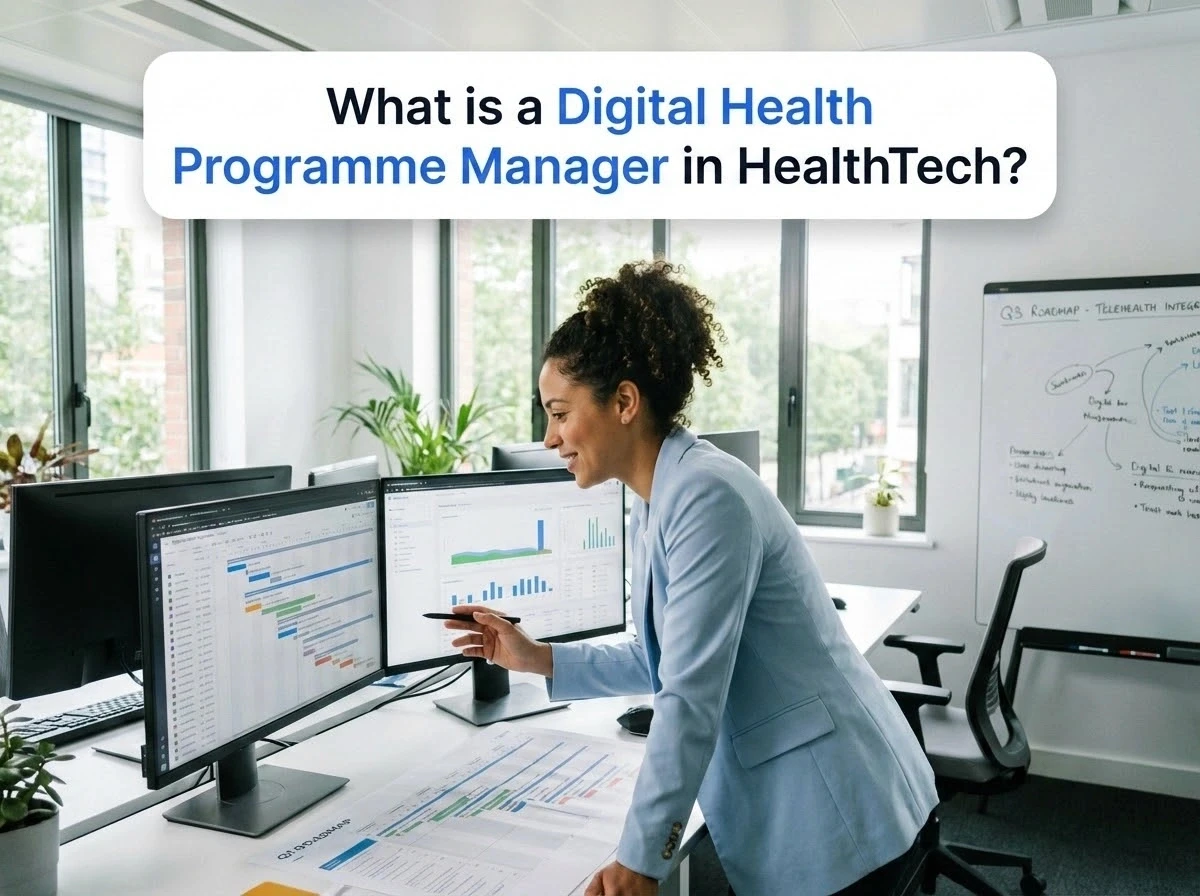
What is a Digital Health Programme Manager in HealthTech?
A Digital Health Programme Manager in HealthTech is the person accountable for turning a multi-workstream digital health ambition into a deliverable, safe, operational reality. They own the outcomes across timelines, budget, dependencies, risks, and stakeholder alignment so that a digital product, platform, or service can be implemented, adopted, and run reliably in a real clinical or care environment.
This role exists because digital health delivery is rarely "just software". It is coordinated change across people, process, data, governance, vendors, and front-line workflows, often whilst services continue running and patient safety cannot be compromised. A programme manager provides the single point of accountable delivery leadership across that complexity, ensuring decisions are made, trade-offs are explicit, and commitments are credible.
In practice, the job is less about being the best at a methodology and more about being the owner of delivery: setting direction with sponsors, shaping the plan that can survive reality, and holding the line on safety, scope control, and value.
🔍 How this role differs in HealthTech
In many tech sectors, programme management focuses on predictable delivery mechanics: shipping capabilities, coordinating releases, and keeping stakeholders informed. In HealthTech, the same coordination is required, but the context changes the threshold for "done".
Health data is sensitive by default, and mistakes are rarely confined to a single customer account. Decisions are shaped by consent, information governance, clinical and operational safety, procurement constraints, and the friction of integrating into legacy environments. Delivery isn't only about feature completeness; it's about whether the service is safe, auditable, supportable, and usable by time-pressured clinical and operational teams.
Because the consequences can be clinical, reputational, and legal, HealthTech programme managers are typically closer to risk ownership than in consumer tech. They spend more time ensuring the programme can be defended (in governance terms), not just delivered, and they often need to manage "two truths" at once: moving fast enough to create value, whilst moving carefully enough to avoid harm.
🎯 Core responsibilities in HealthTech
Day to day, a Digital Health Programme Manager holds together a shifting set of priorities and constraints and keeps the programme moving without creating hidden risk. That means translating strategic intent into a delivery plan that accounts for real-world dependencies: clinical engagement, data access, integrations, supplier timelines, operational readiness, training, and support.
They make decisions under constraint: what must be proven before rollout, what can be phased, what needs clinical sign-off, what cannot ship without governance clearance, and where risk is acceptable versus irresponsible. When something slips, they are expected to renegotiate scope or sequencing with sponsors rather than letting the team drift into uncontrolled delay or unsafe shortcuts.
A large part of the role is managing accountability across organisational boundaries. In HealthTech, you may be coordinating engineering, clinical safety, information governance, customer success, implementation, and external partners (none of whom report to you, all of whom can block progress for legitimate reasons). The programme manager's value is in creating a delivery system where those constraints are surfaced early, decisions are documented, and everyone understands what "safe delivery" means for that programme.
🧩 Skills and competencies for HealthTech
Core Skill | HealthTech specific requirement | Reason or Impact |
|---|---|---|
Accountable delivery leadership | Willingness to own end-to-end outcomes across product, implementation, adoption, and operational readiness | HealthTech programmes fail when delivery is treated as "shipping software" rather than changing care processes safely and measurably |
Risk judgement | Ability to identify patient, data, and service risks early and drive mitigations without paralysing progress | The role is often the practical bridge between governance requirements and real delivery decisions |
Stakeholder authority without hierarchy | Credibility with clinicians, operators, engineers, and executives, including handling disagreement and escalation | HealthTech delivery depends on multiple decision-makers who have valid reasons to slow or stop a rollout |
Information governance awareness | Comfort working with data protection, consent, retention, DPIAs, and access controls as delivery-critical items | Data constraints can invalidate a plan late unless they are treated as first-class dependencies from the start |
Operational realism | Ability to plan around clinical capacity, training burden, service continuity, and support coverage | Adoption and safety issues frequently emerge from workflow mismatch, not from code defects |
Commercial and supplier management | Managing vendor obligations, procurement constraints, and contract-driven milestones without losing delivery integrity | HealthTech programmes often involve third parties where contractual incentives and clinical needs can misalign |
Decision traceability | Habit of making trade-offs explicit, documenting rationale, and maintaining audit-friendly programme artefacts | When outcomes are questioned, the programme needs a defensible narrative of why decisions were made and what was done to reduce risk |
Change leadership | Designing rollout and adoption approaches that respect frontline constraints and reduce disruption | Sustainable value comes from adoption and outcomes, not from "go-live" dates alone |
💷 Salary ranges in UK HealthTech
Salary levels for Digital Health Programme Managers tend to track the size of the programme, the criticality of the service, and how much risk sits with the role. The biggest drivers are whether you own a multi-year portfolio versus a contained implementation, the degree of clinical and data risk, the number of teams and suppliers involved, and whether the role carries incident escalation or out-of-hours expectations. Location also matters, with London & South East typically paying more, whilst some specialist roles (high-risk deployments, complex integrations, regulated delivery) can price above local norms in any region.
Experience level | Estimated annual salary range | What drives compensation |
Junior | London & South East: £40,000–£50,000 | Coordination complexity, exposure to regulated delivery, and whether you are supporting one programme or several workstreams |
Mid-level | London & South East: £50,000–£65,000 | Ownership of a full programme plan, stakeholder management depth, governance responsibility, and delivery through adoption (not just build) |
Senior | London & South East: £65,000–£85,000 | Multi-team delivery, supplier management, complex integrations, higher-risk data flows, and accountability for outcomes/benefits |
Lead | London & South East: £85,000–£105,000 | Portfolio ownership, leading other PMs, high-stakes rollouts, board-level reporting, and shaping delivery governance and operating model |
Head / Director | London & South East: £105,000–£140,000 | Organisation-wide accountability, budget ownership, strategic prioritisation, external relationships, and risk acceptance at executive level |
Beyond base salary, typical add-ons include performance bonus (more common in venture-backed HealthTech and consultancies), pension and benefits, and sometimes equity (more common in scale-ups). On-call is not universal for programme managers, but some roles include out-of-hours incident escalation responsibility during go-lives or critical service periods; where this exists, allowances or compensatory arrangements may apply. Total compensation shifts most with company stage (start-up vs enterprise), whether delivery is tied to revenue or contractual milestones, and the criticality of the system being implemented.
🚀 Career pathways
Common entry points include project management in health or care settings, implementation roles in digital health vendors, PMO roles supporting transformation portfolios, and operational roles where you have led complex change. People also transition from product operations, clinical operations, or data/analytics delivery when they have demonstrated cross-functional ownership and the ability to make delivery decisions under constraint.
Progression typically looks like expanding the radius of ownership. Early on, you may run a defined rollout or implementation. Over time, you become accountable for interconnected workstreams (data, integrations, clinical engagement, training, and service readiness) where sequencing and governance matter as much as speed. The step into Lead is usually marked by owning a portfolio and setting delivery standards, not simply running "bigger projects".
At Head / Director level, the job becomes less about managing the plan and more about shaping which programmes exist, how risk is accepted, how teams are funded, and how delivery performance is governed across the organisation.
❓ FAQ
Do Digital Health Programme Managers need a clinical background to be credible? Not always, but you do need clinical literacy: an ability to understand workflows, safety concerns, and how decisions land on frontline teams. Credibility often comes from how you run engagement, surface risk, and respect constraints, not from having a clinical qualification. In some environments, pairing closely with clinical safety and clinical leadership is essential.
What will I be judged on in interviews for a Digital Health Programme Manager role? Expect deep probing on how you handle trade-offs: safety vs speed, governance vs delivery pressure, and scope control vs stakeholder demands. Strong candidates show they can turn ambiguity into a deliverable plan, escalate with judgement, and keep a defensible record of decisions. You'll often be assessed on stakeholder management scenarios as much as delivery technique.
Will I be expected to support go-lives out of hours or be on-call? It depends on the organisation and the type of programme. Some roles are strictly business hours, whilst others expect out-of-hours presence during deployments, hypercare, or major incidents, especially when services are critical and downtime is unacceptable. Clarify escalation expectations, compensatory arrangements, and the operating model before accepting an offer.
🔎 Find your next role
If you're ready to take ownership of complex, high-impact delivery, search Digital Health Programme Manager roles on Meeveem.
You might also like