Published Date: December 18, 2025
Updated Date: December 18, 2025
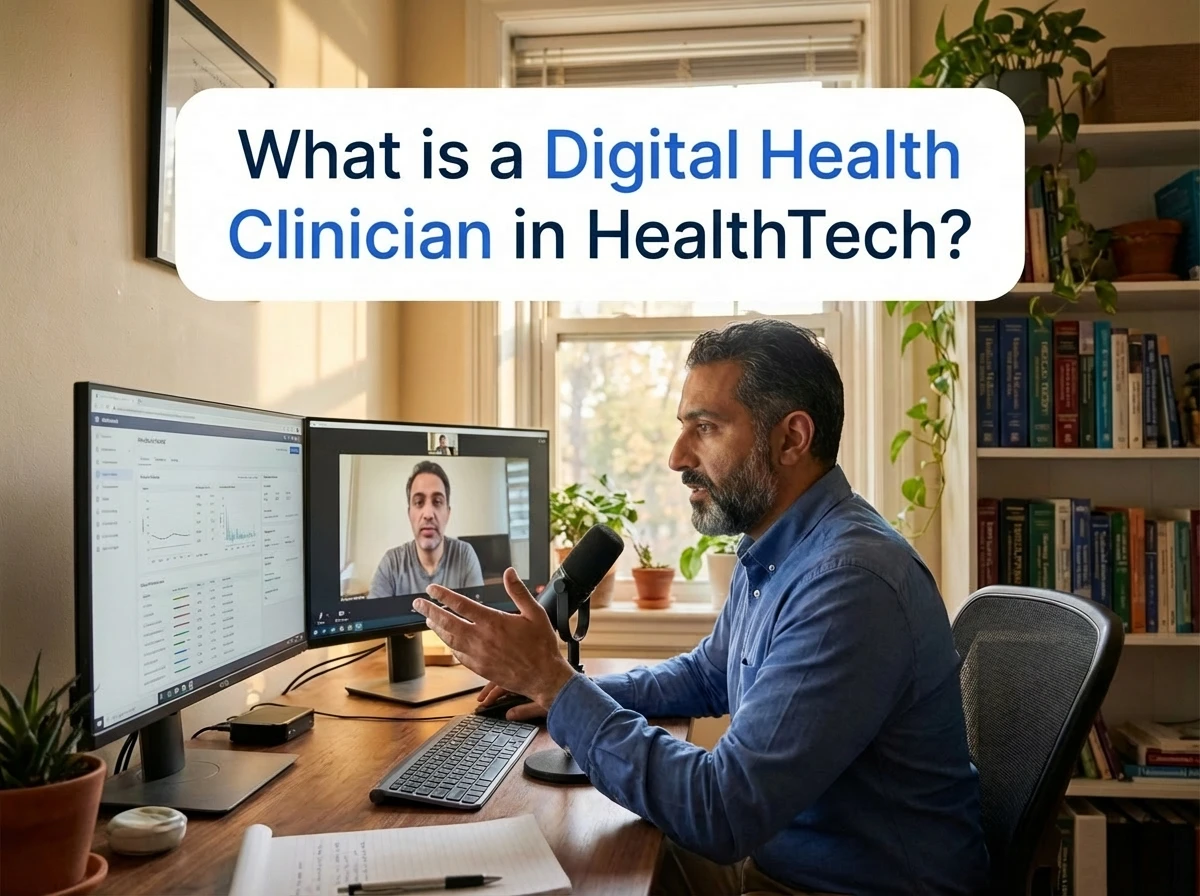
What is a Digital Health Clinician in HealthTech?
A Digital Health Clinician is a clinically trained, professionally registered practitioner who takes ownership for how clinical care, patient safety, and real-world workflows are represented inside a HealthTech product or service. In practice, the role sits at the intersection of clinical practice and product delivery: translating clinical risk into product decisions, assuring that digital pathways are safe and defensible, and making sure the technology behaves predictably in the messy reality of healthcare.
This role exists because HealthTech products don't just support work. They can shape triage decisions, influence prescribing, affect escalation routes, and change how clinicians document, communicate, and hand over care. When software becomes part of a clinical pathway, someone has to be accountable for the clinical meaning of the product, not just the user experience or the engineering quality. A Digital Health Clinician provides that accountability: safeguarding patients, protecting the organisation, and ensuring clinical intent survives contact with real-world delivery constraints.
In many organisations, this role is also the natural home for clinical safety ownership (either directly as the named safety role, or closely partnered with it), because patient harm in digital systems often appears as subtle workflow failure, misinterpretation, delayed action, or unsafe defaults rather than an obvious bug.
🔍 How this role differs in HealthTech
In most tech industries, product trade-offs are usually framed around growth, conversion, retention, or operational efficiency. In HealthTech, the same decisions are filtered through clinical risk, professional accountability, data sensitivity, and the reality that users may be working under pressure with incomplete information. A small UI change can create downstream safety issues if it alters how risk is perceived, how urgency is signalled, or how exceptions are handled.
HealthTech also demands stronger assurance discipline. You're not only deciding what's useful. You're deciding what's safe to deploy, what needs constraint, what requires explicit warnings or governance, and when the right answer is to slow down. The Digital Health Clinician is expected to hold the line on clinical integrity, even when that conflicts with speed, commercial deadlines, or feature ambition.
Finally, the feedback loop is different. Success is not just adoption. It's safe adoption over time, across varied settings, with reliable incident learning and defensible decision records when something goes wrong.
🎯 Core responsibilities in HealthTech
Day to day, a Digital Health Clinician carries accountability for clinical correctness and safety within the product scope. That often means making hard judgement calls about what the product can safely automate versus what must remain clinician-led, how to manage uncertainty, and how to prevent foreseeable misuse without making the service unusable. They work inside delivery teams, but they are not supporting product in a lightweight way. They are owning clinical decisions that have consequences.
A typical week includes reviewing pathway logic and content, shaping triage thresholds, challenging ambiguous requirements, and ensuring that edge cases (co-morbidity, atypical presentation, conflicting data, vulnerable groups, medication interactions, safeguarding) are handled intentionally. They also spend time on governance: documenting clinical rationale, reviewing incidents and near-misses, feeding learning back into product changes, and making sure the organisation can evidence how clinical risk is identified, mitigated, and monitored across the lifecycle.
Trade-offs are constant: safety versus friction, standardisation versus clinical discretion, automation versus interpretability, speed to ship versus the burden of proof. The clinician's value is in knowing which compromises are acceptable, which need escalation, and which are non-negotiable.
🧩 Skills and competencies for HealthTech
Core Skill | HealthTech specific requirement | Reason or Impact |
|---|---|---|
Clinical judgement under uncertainty | Ability to make defensible decisions when data is incomplete, contradictory, or delayed, and to design for safe failure modes | Prevents unsafe overconfidence in digital pathways and reduces harm from edge cases that software can't understand |
Clinical risk ownership | Comfort being accountable for identifying, documenting, and escalating clinical risk across the product lifecycle | Creates clear accountability and ensures risks are actively managed rather than discovered in production |
Systems thinking | Understanding how the product interacts with workflows, escalation routes, documentation habits, and downstream services | Avoids locally correct features that cause unsafe outcomes when embedded in real care delivery |
Governance discipline | Ability to create and maintain decision records, safety artefacts, and audit-friendly clinical rationale without losing pragmatism | Protects patients and the organisation when incidents occur and supports predictable, repeatable assurance |
Communication across disciplines | Translating clinical nuance into actionable product requirements, and explaining constraints to engineering and commercial teams | Prevents misinterpretation of clinical intent and reduces rework caused by vague or clinically unsafe requirements |
User empathy for pressured environments | Designing recommendations and interfaces for time-poor, high-stakes contexts with interruptions and cognitive load | Reduces error rates and supports safer decision-making when clinicians and patients are under stress |
Incident learning mindset | Treating safety events as system signals, not individual blame, and closing the loop into product improvements | Enables continuous safety improvement and builds trust with clinical partners and commissioners |
💷 Salary ranges in UK HealthTech
Compensation for a Digital Health Clinician is driven less by years qualified and more by the scope of clinical accountability they carry. The biggest levers are: whether the role holds formal clinical safety responsibility, how close the product is to diagnosis, triage, or prescribing decisions, the complexity of pathways, on-call or incident-response expectations, and how exposed the organisation is to regulated delivery environments. Location still matters, but remote and hybrid setups have narrowed extremes. London and the South East remain higher where market competition is strongest.
Experience level | Estimated annual salary range | What drives compensation |
Junior | London & South East: £35,000–£50,000 | Early-stage digital exposure, narrower product scope, supervised decision-making, limited governance sign-off responsibility |
Mid-level | London & South East: £50,000–£70,000 | Ownership of a pathway or feature area, regular clinical review workload, stronger governance contribution, increasing autonomy |
Senior | London & South East: £70,000–£95,000 | End-to-end clinical ownership across multiple pathways, incident leadership, cross-functional influence, higher-risk product domains |
Lead | London & South East: £95,000–£125,000 | Organisation-level clinical standards, formal assurance leadership, mentorship of other clinicians, clearer accountability for go/no-go decisions |
Head / Director | London & South East: £125,000–£170,000 | Portfolio accountability, executive-level risk ownership, external stakeholder confidence (commissioners/partners), governance design, multi-team delivery impact |
Beyond base salary, total compensation commonly includes a performance bonus (more typical in venture-backed HealthTech than in provider settings), equity (especially in startups and scale-ups), and benefits such as private medical cover and enhanced pension contributions. On-call allowances are most relevant where the clinician participates in clinical incident response, safety incident triage, or time-critical releases. Intensity varies with service hours, patient volume, and how integrated the product is into live pathways. Variation is also driven by whether the role requires maintaining professional registration, specialist safety training, and the degree to which the clinician is a formal signatory for safety artefacts or deployment recommendations.
🚀 Career pathways
Most Digital Health Clinicians enter from practice rather than from tech. Common entry points include clinicians who have acted as digital champions, supported EPR or pathway rollouts, contributed to clinical governance, or worked in informatics-adjacent roles. Others join from digital service providers where remote care delivery and protocol-led work create a natural bridge into product thinking.
Progression is primarily a story of widening accountability. Early on, you may own a narrow clinical content area under close governance. Over time, you take responsibility for whole pathways, then multiple pathways, then the organisation's clinical standards and assurance model. The step-change is not more meetings. It's being the person who can credibly say what is safe to ship, what must be constrained, and what requires redesign, and then carry that decision through scrutiny.
At the highest levels, the role becomes a portfolio function: setting clinical risk posture, building clinician capability across teams, ensuring incident learning feeds strategy, and representing the organisation's clinical credibility externally.
❓ FAQ
Do I need to keep my clinical registration active to work as a Digital Health Clinician?
In many HealthTech roles, maintaining registration is expected because the job relies on clinical accountability, credibility with partners, and safe decision-making. Some roles also require being able to act as a formally recognised clinical safety owner or to provide clinically defensible sign-off. Always check whether the employer expects ongoing practice hours, supervision, or CPD evidence.
How is my performance assessed if I'm not seeing patients all day?
Expect evaluation to centre on outcomes like pathway quality, incident reduction, clarity of clinical rationale, and how effectively you unblock teams while protecting safety. Strong candidates show they can make decisions under constraint, document them properly, and influence product direction without becoming a bottleneck. Interview processes often probe judgement through scenario questions rather than tool knowledge.
Will I be on-call, and what does on-call mean in this context?
It depends on the service model. In some organisations, on-call means supporting clinical incident response, advising during time-critical releases, or helping triage safety concerns raised from live operations. The more the product operates in extended hours and the closer it sits to urgent decision-making, the more likely structured on-call or escalation expectations become.
🔎 Find your next role
If you're ready to move into HealthTech or step up your clinical ownership in digital delivery, search Digital Health Clinician roles on Meeveem.
You might also like