Published Date: December 17, 2025
Updated Date: December 17, 2025
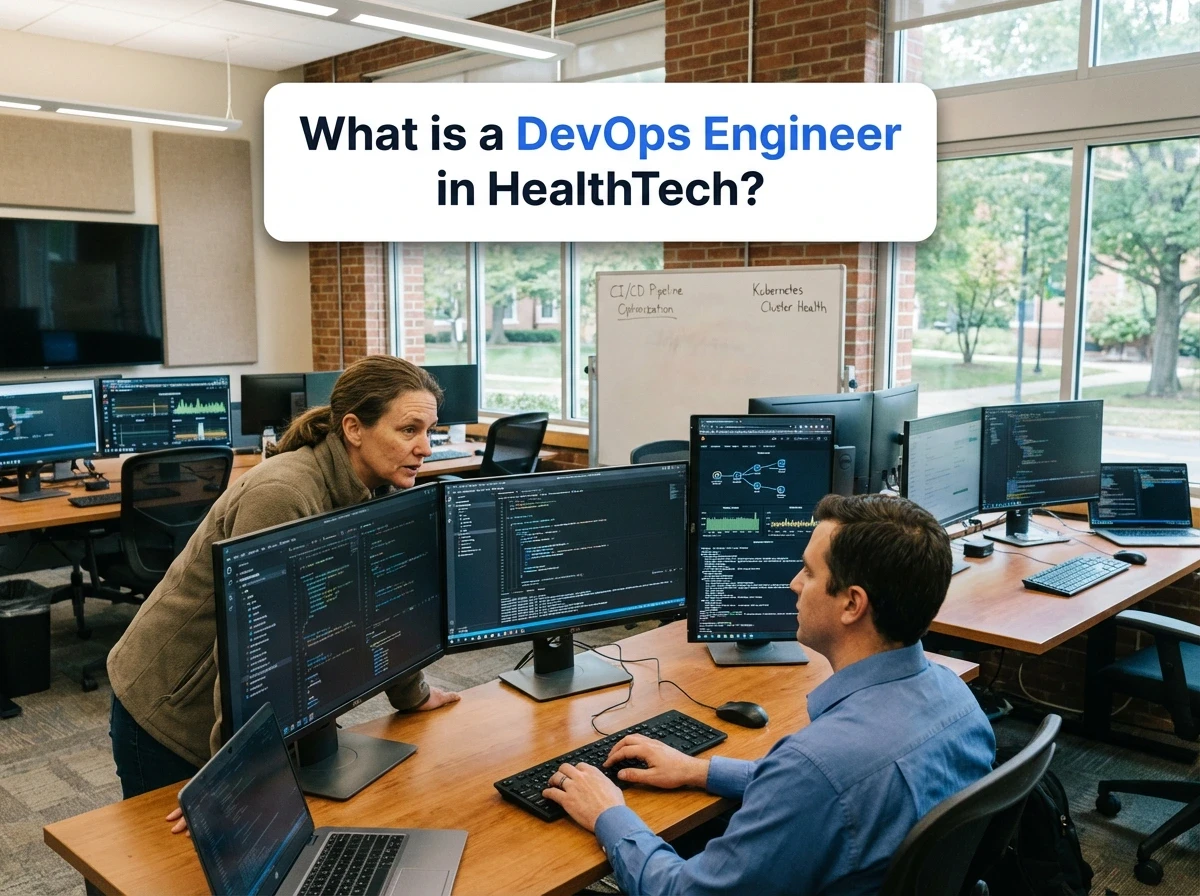
What is a DevOps Engineer in HealthTech?
A DevOps Engineer in HealthTech is accountable for how clinical and patient-facing software is built, released, operated, and recovered when things go wrong. They ensure this happens safely, predictably, and at a pace the organisation can sustain. The role exists because shipping features only matters if the service remains trustworthy: available when people need it, secure by default, and resilient under real-world conditions like peak demand, dependency failures, and human error.
This role sits at the intersection of engineering and operations, but it's defined more by ownership than by tooling. A HealthTech DevOps Engineer takes responsibility for the pathways that turn code into a running service (and keep it running), including the guardrails that reduce risk. They are often embedded with product engineering teams, paired with platform teams, or operate as a small enabling function in earlier-stage companies. Whatever the organisational shape, the underlying expectation is the same: reduce operational risk whilst improving delivery reliability.
🔍 How this role differs in HealthTech
In many industries, DevOps work is primarily about speed, cost optimisation, and developer efficiency. In HealthTech, those goals still matter, but they compete more directly with safety, privacy, auditability, and operational discipline. The difference is not that HealthTech is "slow". It's that decisions must be defensible, and failures can have more serious downstream consequences than a typical consumer product outage.
Health data tends to be highly sensitive, and HealthTech platforms frequently integrate with external clinical systems, laboratories, identity providers, or regulated partners. That changes engineering choices: access patterns become tighter, logging needs become more deliberate, and operational processes must reduce the chance of accidental exposure or uncontrolled change. Reliability is also interpreted differently: availability isn't just a metric. It's continuity of care, continuity of workflow, and continuity of trust.
🎯 Core responsibilities in HealthTech
Day to day, a DevOps Engineer in HealthTech is accountable for keeping delivery and operations "boringly reliable" under constraints. They shape how environments are built and governed, how releases move through stages, how secrets and identities are managed, and how incidents are handled, from first alert to stabilisation to learning and prevention. They spend as much time clarifying risk as they do implementing solutions: what is an acceptable failure mode, what must be prevented outright, and what can be mitigated through detection and response.
A large part of the job is making trade-offs explicit. For example, you may need to increase release frequency without weakening approval controls, improve observability without over-collecting sensitive data, or reduce cloud spend without creating fragility. In HealthTech, the "right" answer is rarely a single tool or pattern. It's a set of operational decisions that balance safety, service performance, and team throughput, whilst leaving a clear audit trail of what changed, when, and why.
🧩 Skills and competencies for HealthTech
Core Skill | HealthTech specific requirement | Reason or Impact |
|---|---|---|
Production ownership | Comfortable being accountable for service health, not just deployments, including how patient or clinician workflows degrade under failure | HealthTech teams are judged on trust and continuity. "Works on my machine" is operationally unacceptable when real-world processes depend on it |
Risk-based decision making | Ability to choose controls proportionate to harm and likelihood, and document rationale clearly | Health environments reward defensible decisions. Clarity reduces unsafe shortcuts and speeds up approvals when urgency is high |
Secure systems thinking | Treat identity, access, secrets, and logging as first-class product concerns with minimised data exposure | Health data sensitivity raises the cost of mistakes. Strong security posture reduces breach risk and limits blast radius |
Reliability engineering judgement | Prioritise resilience work based on incident patterns, dependency risk, and clinical criticality | Preventing repeat incidents and designing safe failure modes protects users and reduces out-of-hours burden |
Change governance and release discipline | Build repeatable release pathways with traceability, controlled rollout, and fast rollback | Auditability and controlled change reduce operational risk whilst still enabling frequent delivery |
Incident leadership under pressure | Stay calm, coordinate stakeholders, and restore service with clear comms and post-incident follow-through | HealthTech incidents often involve higher urgency and wider organisational impact. Effective response protects patients, partners, and reputation |
Cross-team enablement | Influence engineering teams through standards, paved roads, and coaching rather than gatekeeping | Sustainable DevOps in HealthTech scales via shared ownership. Enablement reduces bottlenecks and improves overall quality |
💷 Salary ranges in UK HealthTech
Compensation for DevOps Engineers in UK HealthTech is shaped less by the title and more by the risk profile of the platform and the scope of ownership. The biggest drivers tend to be: whether you own production for clinically critical services, the depth of security and compliance constraints, how much architectural responsibility you hold (platform design vs. team-level execution), the intensity of on-call, and location (London and South East premiums remain common, though remote roles can narrow the gap depending on company policy).
Experience level | Estimated annual salary range | What drives compensation |
|---|---|---|
Junior | London & South East: £40,000–£55,000 | Breadth of exposure (cloud, delivery pipelines, incident participation), quality of supervision, and whether the role is primarily enablement vs. production ownership |
Mid-level | London & South East: £55,000–£75,000 | Independent ownership of environments and releases, ability to improve reliability outcomes, and confidence operating within security constraints |
Senior | London & South East: £75,000–£100,000 | Leading incident response patterns, designing guardrails across teams, raising operational maturity, and handling higher-stakes services and integrations |
Lead | London & South East: £95,000–£125,000 | Platform strategy, multi-team influence, accountable ownership of reliability/security posture, and responsibility for on-call design and sustainability |
Head / Director | London & South East: £120,000–£170,000 | Organisational accountability (budgets, risk acceptance, governance), scaling platform and incident management across portfolios, and board-level reliability/security reporting |
Beyond base salary, typical add-ons include on-call allowances (often a fixed payment per shift/week or a structured standby/call-out model), performance-related bonus, and equity in venture-backed companies. Total compensation varies most with on-call intensity (frequency and response expectations), the criticality of services supported, and the company's funding stage (equity prevalence and bonus size), as well as whether the role is primarily hands-on engineering or includes formal leadership and risk ownership.
🚀 Career pathways
Common entry points into HealthTech DevOps include infrastructure engineering, software engineering with strong operational ownership, platform support roles that grew into automation, and SRE-adjacent paths where reliability work became a primary focus. Some people also move laterally from regulated industries where change control and auditability are already familiar, then adapt to HealthTech's data sensitivity and integration landscape.
Progression tends to track ownership. Early on, you're trusted with well-bounded systems: improving deployment reliability, tightening access, participating in incidents, and learning how to make safe changes. With experience, you move from "operating what exists" to setting standards for how systems should be built and run: defining guardrails, shaping incident response, and reducing the operational load across product teams. At senior and lead levels, your impact is measured by the reliability and safety of the whole delivery system, not how many pipelines you personally touched.
❓ FAQ
Do HealthTech DevOps roles usually include on-call, and what is it like in practice?
Often yes, because many HealthTech services have availability expectations that extend beyond office hours. What varies is the maturity: better teams invest in reducing alert noise, clear escalation, and safe rollback paths so on-call is sustainable. Ask about paging frequency, response windows, and whether time is protected for reliability work.
How can I show I'm safe to trust with patient-sensitive systems if I'm coming from general SaaS?
Demonstrate how you make trade-offs defensibly: least-privilege access, careful logging, change traceability, and incident learning that results in concrete prevention. Interviewers will look for judgement, not just tool familiarity, especially how you avoid "quick fixes" that create long-term risk.
Will I be expected to handle compliance and audits as a DevOps Engineer?
You're rarely the only owner, but you're often a key contributor because delivery pipelines, access controls, and evidence of change sit in your domain. Strong candidates can explain how they design systems that are auditable by default, with clear artefacts for approvals, deployments, and incident follow-up.
🔎 Find your next role
If you're ready to take ownership of reliability and safe delivery in HealthTech, search DevOps Engineer roles on Meeveem.
You might also like