Published Date: December 31, 2025
Updated Date: December 31, 2025
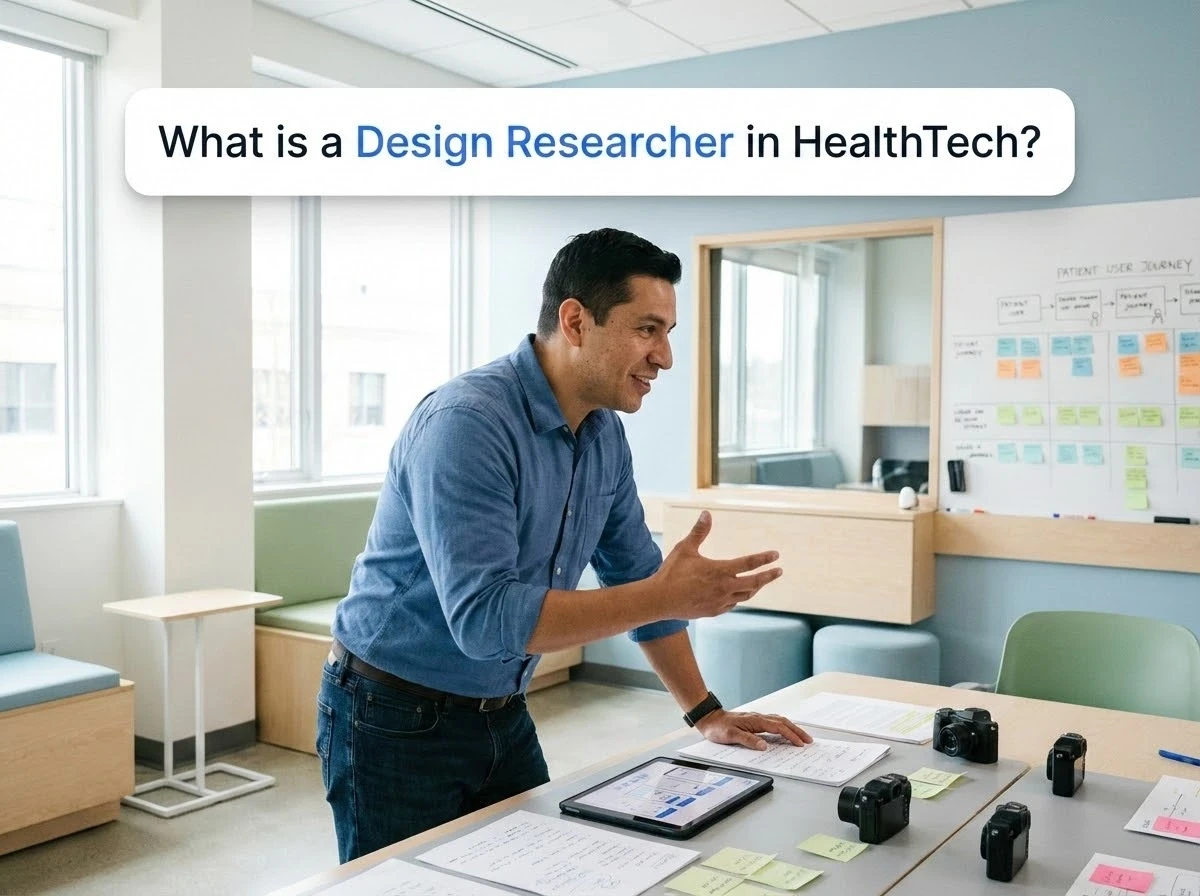
What is a Design Researcher in HealthTech?
A Design Researcher in HealthTech turns real-world patient, clinician, and operational needs into evidence that shapes product decisions. Teams rely on this evidence to build the right thing safely, in ways that can withstand scrutiny. The role sits at the intersection of product, design, clinical realities, and governance. It's not a service function that runs studies on request. Instead, it's about owning insight quality and decision confidence.
HealthTech products operate under high-stakes conditions: time pressure, complex workflows, variable environments, and vulnerable users. Assumptions that work elsewhere can lead to avoidable harm, wasted clinical time, or data misuse here. A Design Researcher reduces that risk by ensuring the team's understanding of users, context, and constraints stays accurate, current, and actionable.
Before methods come into play, the core responsibility is stewardship: deciding what must be true for a product choice to be responsible, then generating evidence strong enough to support that choice.
🔍 How this role differs in HealthTech
In many tech sectors, research primarily optimises conversion, engagement, retention, or operational efficiency. In HealthTech, those outcomes still matter, but they're routinely subordinate to safety, trust, clinical appropriateness, and legal and ethical handling of sensitive data. The Design Researcher's job changes accordingly. It's less about producing insights and more about establishing defensible decisions under constraints.
The work is shaped by higher consequence and higher ambiguity. Users may be patients managing stressful, emotional moments, or clinicians working around the realities of understaffing, interruptions, and legacy systems. Data sensitivity is also qualitatively different. Health data raises immediate trust and compliance considerations, and research practices must be designed to protect participants and organisations alike.
Organisationally, HealthTech researchers often need to operate closer to risk owners (product leadership, clinical safety, information governance, security, quality) than in typical consumer product teams. That proximity isn't bureaucracy for its own sake. It's how research remains usable, ethical, and auditable when decisions have real-world impact.
🎯 Core responsibilities in HealthTech
A Design Researcher in HealthTech is accountable for ensuring the team's decisions reflect reality, not internal consensus. Day to day, that means shaping the questions the team is trying to answer, aligning on what "good evidence" looks like, and navigating constraints that can't be designed away. Limited access to clinical settings, safeguarding requirements, privacy restrictions, and the practicalities of recruiting participants who may be unwell or time-poor all come into play.
Rather than simply running usability sessions, the role involves choosing what to validate, when, and to what standard. For one decision, directional evidence might be sufficient. For another (where the cost of error is high), the researcher may push for stronger triangulation, clearer documentation, and more conservative conclusions. They also manage trade-offs openly, balancing speed against certainty and innovation against the realities of clinical workflow, accessibility, and operational adoption.
The researcher is also responsible for making research legible and usable: translating findings into clear implications, surfacing risks early, and ensuring the team can explain why a decision was made. In mature HealthTech environments, that often includes building traceability by linking user needs and use-context evidence to requirements, design choices, and residual risk decisions.
🧩 Skills and competencies for HealthTech
Core Skill | HealthTech specific requirement | Reason or Impact |
|---|---|---|
Problem framing | Frame research around safety, appropriateness, and adoption (not just satisfaction) | Prevents teams from "optimising the UI" whilst missing clinical, behavioural, or operational failure modes |
Ethical judgement | Design studies that protect vulnerable participants and sensitive data under strict governance | Keeps research possible in real settings, avoids harm, and protects organisational trust |
Stakeholder influence | Align product, clinical, governance, and engineering stakeholders on what evidence is sufficient | Reduces rework and prevents late-stage objections that derail delivery or approvals |
Systems thinking | Understand the end-to-end care workflow and where digital tools fit (or don't) | Produces insights that work in practice, not just in a test session |
Risk-aware decision support | Communicate uncertainty, limitations, and risk trade-offs in plain language | Enables leadership to make responsible calls and document rationale when needed |
Inclusive research practice | Account for accessibility, health literacy, and uneven digital access | Improves equity of outcomes and reduces the chance of excluding high-need groups |
Operational rigour | Build repeatable, auditable approaches to recruiting, consent, and evidence handling | Makes research scalable and credible in regulated or procurement-heavy environments |
Domain fluency | Speak credibly with clinicians and operational staff without over-claiming expertise | Improves data quality, reduces misinterpretation, and increases stakeholder confidence |
💷 Salary ranges in UK HealthTech
HealthTech compensation for Design Researchers is driven less by the title and more by the risk profile of the product, the independence of the role, and the level of accountability attached to decisions. Pay typically moves with complexity of clinical workflow, proximity to patient safety, expectations to operate under governance constraints, leadership scope (team versus function), and location. On-call expectations are uncommon for design research roles, but may appear indirectly in organisations where researchers support incident follow-up, urgent releases, or safety-critical investigations.
Experience level | Estimated annual salary range | What drives compensation |
Junior | London & South East: £32,000–£42,000 | Supervised delivery, narrower problem space, limited ownership of roadmap-critical decisions |
Mid-level | London & South East: £42,000–£58,000 | Independently running studies, stronger influence on squads, handling governance constraints with limited support |
Senior | London & South East: £58,000–£75,000 | Owning discovery for complex areas, coaching others, influencing high-stakes decisions, stronger cross-functional alignment |
Lead | London & South East: £75,000–£95,000 | Setting standards, research strategy across multiple teams, managing researchers and/or research operations, handling conflicting stakeholder risk appetites |
Head / Director | London & South East: £95,000–£130,000 | Function ownership, executive influence, hiring and capability building, governance alignment, accountability for evidence quality and organisational decision-making |
Typical add-ons beyond base include an annual bonus (more common in venture-backed or larger commercial organisations), equity (more common in startups and scale-ups), and enhanced pension and benefits. Variation in total compensation is usually driven by company stage (equity versus cash), how close the product is to safety-critical use, the level of autonomy expected (embedded versus centralised), whether the role includes people leadership, and the degree of regulated documentation and audit readiness expected.
🚀 Career pathways
Entry points into HealthTech design research often come from user research in digital product teams, human factors, service design research, psychology or behavioural science, or clinical-adjacent roles where you've learnt how healthcare actually works. Many researchers move into HealthTech after building strong fundamentals in research planning, participant ethics, and stakeholder influence, then add domain fluency and governance awareness once inside.
Progression is usually a shift from executing studies to owning decision quality. Mid-level researchers become trusted partners to product and design by consistently improving outcomes and reducing uncertainty. Senior researchers expand scope: they steer discovery across riskier domains, shape strategy, and coach teams to make better decisions without over-relying on research "as a gate."
Lead and Head/Director progression is defined by organisational ownership: building standards, improving evidence maturity, creating scalable ways to do ethical research, and ensuring the function changes what the organisation does (not just what it knows).
❓ FAQ
1) Will I need clinical experience to be credible as a Design Researcher in HealthTech?
You don't need to be a clinician, but you do need humility, domain curiosity, and the ability to learn workflows quickly. Hiring teams typically look for how you handle jargon, power dynamics, and constraints without pretending to be the medical expert. Strong candidates show they can partner with clinical stakeholders and translate reality into product choices.
2) What does a HealthTech research portfolio need to show beyond "methods"?
It should demonstrate decision impact: what changed, what risk was reduced, and how you handled constraints like limited access to users or sensitive data. Teams also value evidence of stakeholder influence: how you got alignment when priorities conflicted. Clarity about uncertainty is a plus, showing what you could and couldn't conclude.
3) Is on-call ever part of the job for Design Researchers in HealthTech?
It's not common in the way it is for engineering or operations, but some organisations expect rapid support around critical releases, incidents, or safety investigations. In those cases, it's usually about helping interpret user impact or validating mitigations quickly. If this matters to you, ask explicitly about incident processes, escalation expectations, and how urgent work is handled.
🔎 Find your next role
Ready to apply your research craft to real-world health outcomes? Search Design Researcher roles on Meeveem and find a team where evidence genuinely drives decisions.
You might also like