Published Date: December 18, 2025
Updated Date: December 18, 2025
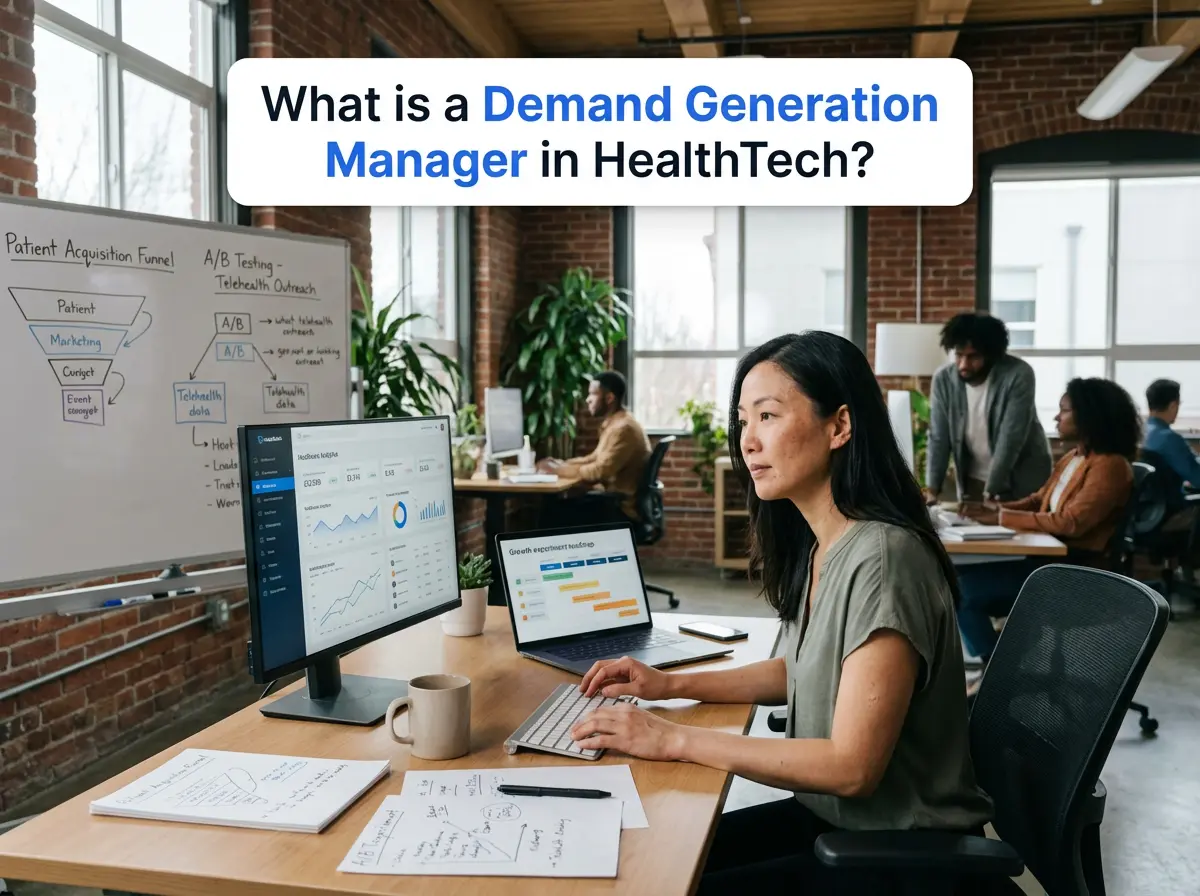
What is a Demand Generation Manager in HealthTech?
A Demand Generation Manager in HealthTech is accountable for creating predictable, measurable demand for a healthcare product or service and converting that demand into qualified pipeline that Sales (or a clinical partnerships team) can progress. In practice, they own the link between marketing activity and commercial outcomes: not "more marketing", but the right volume and quality of opportunities for the business to hit growth targets without compromising trust, compliance, or patient impact.
This role exists because HealthTech growth is rarely driven by impulse buying. Stakeholders can include clinicians, operations leaders, procurement, compliance, finance, and sometimes patients, each with different incentives and risk thresholds. A Demand Generation Manager helps the organisation move from hopeful outreach to an intentional revenue engine: defining target segments, shaping journeys, setting performance standards, and being responsible for the outcomes those decisions create.
In most HealthTech organisations, the role sits within Marketing and partners tightly with Sales, Partnerships, Product Marketing, RevOps, and often Compliance/InfoSec. The core of the job is ownership: owning pipeline targets, owning the integrity of how demand is generated, and owning the decisions that trade speed against safety, credibility, and long-term access to healthcare markets.
🔍 How this role differs in HealthTech
In many B2B SaaS categories, demand generation can optimise aggressively for volume and rapid iteration. HealthTech still needs speed and learning, but the cost of getting it wrong is higher: reputational damage can be harder to recover from, data handling expectations are stricter, and decision-makers may require deeper evidence before engaging.
HealthTech also changes what "conversion" means. You may be optimising not just for MQL-to-SQL, but for readiness to pass clinical scrutiny, procurement requirements, security reviews, and outcomes claims. Messaging that feels acceptable in consumer tech can be risky in healthcare contexts, particularly where it could be interpreted as medical advice, overstated efficacy, or mishandling sensitive data.
Finally, demand generation in HealthTech is often closer to category-building. Many products introduce new workflows or new clinical pathways, so the job becomes as much about earning permission to be considered (through trust, clarity, and proof) as it is about capturing demand that already exists.
🎯 Core responsibilities in HealthTech
Day to day, a Demand Generation Manager is accountable for shaping and running the engine that turns a defined audience into a measurable pipeline whilst protecting the organisation from preventable risk. They decide what segments to prioritise, what "qualified" means in a healthcare buying context, and how much of the funnel can be product-led versus sales-led. That accountability shows up in weekly decisions: which campaigns to scale, which to pause, and which to redesign because lead quality is harming sales efficiency or because the message creates compliance discomfort.
They work under constraints that are more rigid than in many industries. If you can't use certain types of targeting, can't phrase claims in a particular way, or must treat certain data types with heightened caution, then performance is won through better judgement rather than more aggression. Strong demand generation managers make these trade-offs explicit: they choose channels and journeys that produce credible intent, even if that means fewer leads, because the downstream cost of low-trust demand (sales time, legal review cycles, churn risk) is too high.
They also act as an operational partner. In HealthTech, "marketing performance" is often inseparable from CRM hygiene, attribution discipline, lead routing, and shared definitions with Sales and RevOps. The role is responsible for making performance legible so the business can confidently invest more, rather than arguing about whether growth is real.
🧩 Skills and competencies for HealthTech
Core Skill | HealthTech specific requirement | Reason or Impact |
|---|---|---|
Commercial accountability | Comfort owning pipeline targets where multiple stakeholders influence conversion (clinical, procurement, security, finance) | Prevents over-optimising for lead volume and refocuses work on opportunities that can realistically close in healthcare buying cycles |
Risk and claims judgement | Ability to pressure-test messaging so it stays credible under scrutiny and doesn't overstate outcomes | Protects brand trust, reduces rework with compliance stakeholders, and avoids campaigns that create downstream objections |
Stakeholder alignment | Aligning Sales/Partnerships, Product Marketing, RevOps, and compliance-minded teams on definitions and priorities | Creates consistent qualification standards and eliminates "marketing vs sales" disputes that slow growth |
Funnel design thinking | Designing journeys that respect long evaluation cycles and need for evidence, not just clicks | Improves conversion by matching content and proof points to real buyer concerns and decision stages |
Data discipline | Treating performance measurement as an operational system (tracking, routing, attribution, governance), not a dashboard | Enables confident budget decisions and reduces the risk of misreporting performance in a high-stakes context |
Experimentation under constraints | Running tests that improve outcomes without relying on questionable targeting, exaggerated urgency, or sensitive-data shortcuts | Sustains learning velocity whilst maintaining compliance and trust expectations |
Cross-functional execution | Managing dependencies across teams where approvals, reviews, and security input can be required | Keeps delivery predictable and reduces the "everything takes longer" drag that can stall growth teams in HealthTech |
💷 Salary ranges in UK HealthTech
Compensation for Demand Generation Managers in UK HealthTech typically reflects the commercial criticality of pipeline ownership, the complexity of the buying cycle, and the level of autonomy in setting strategy and budget. Pay tends to increase when the role is accountable for revenue outcomes across multiple channels and segments, when it influences go-to-market strategy, and when the organisation operates in more regulated or trust-sensitive contexts that demand tighter judgement and governance. Location still matters, especially for London & South East, though remote setups can narrow the gap when roles are national.
Experience level | Estimated annual salary range | What drives compensation |
|---|---|---|
Junior | London & South East: £40,000–£50,000 | Execution scope (single channel vs multi-channel support), closeness to revenue targets, and whether the role owns a full funnel stage or supports a senior owner |
Mid-level | London & South East: £50,000–£65,000 | Ownership of campaigns and reporting, budget responsibility, channel mix, and expectations around lead quality and sales alignment |
Senior | London & South East: £65,000–£80,000 | End-to-end funnel ownership, strategic segment choices, measurable pipeline contribution, and complexity of buyer journey (clinical/procurement/security gates) |
Lead | London & South East: £80,000–£100,000 | Leading the demand engine across teams/channels, setting targets and definitions, managing significant budgets, and influencing GTM planning with Sales/RevOps |
Head / Director | London & South East: £100,000–£140,000 | Function ownership and accountability for predictable pipeline, leadership scope (team size, global remit), board-level visibility, and the cost of being wrong (brand, compliance, revenue) |
Beyond base salary, typical add-ons include an annual performance bonus (often tied to pipeline, revenue influence, or company targets) and, more commonly in scale-ups, equity or stock options. On-call allowances are not usually a standard feature for demand generation roles, but total compensation can rise when the role carries high commercial pressure, manages large paid budgets, operates across multiple markets, or is expected to deliver against aggressive targets with limited brand maturity or strict governance constraints.
🚀 Career pathways
Many Demand Generation Managers enter HealthTech from B2B marketing roles such as growth marketing, performance marketing, lifecycle/CRM, content-led acquisition, or marketing operations, often after proving they can own a measurable part of a funnel. Others transition from agency backgrounds where they've run multi-channel programmes, then move in-house to take responsibility for outcomes rather than deliverables.
Progression is usually less about titles and more about increasing ownership. Early on, success looks like running campaigns reliably and improving conversion with disciplined measurement. Mid-career, the scope expands to owning qualification standards, budget allocation across channels, and tighter alignment with Sales and RevOps. Senior and Lead levels typically add strategic responsibility: segment prioritisation, forecasting, and building repeatable motions that survive team changes and budget cycles. Head/Director progression comes from building a durable revenue engine, one that balances growth with trust, evidence, and operational control.
❓ FAQ
Do I need a clinical background to be a Demand Generation Manager in HealthTech?
Usually not, but you do need comfort working with clinical or compliance stakeholders and translating evidence into clear, responsible messaging. Hiring teams tend to look for judgement and learning speed over domain credentials. The strongest candidates show they can market in trust-sensitive environments without overselling.
How will I be evaluated in a HealthTech demand gen role: leads, pipeline, or revenue?
Most roles are measured on qualified pipeline contribution and lead-to-opportunity quality, not just lead volume. Expect scrutiny on whether your programmes help Sales progress deals through real-world buying stages (including security and procurement hurdles). You'll often be assessed on how well you define and defend "quality" with data.
Will I be expected to run paid acquisition the same way as in B2B SaaS?
Sometimes, but the approach is typically more conservative and evidence-led, especially where claims and data handling require care. You may need more emphasis on education, proof points, and longer nurture paths than pure direct-response tactics. In interviews, be ready to explain how you balance growth targets with credibility and compliance constraints.
🔎 Find your next role
If you're ready to own pipeline growth in a trust-sensitive market, search Demand Generation Manager roles in HealthTech on Meeveem.
You might also like