Published Date: January 6, 2026
Updated Date: January 6, 2026
What is a Delivery Manager in HealthTech?
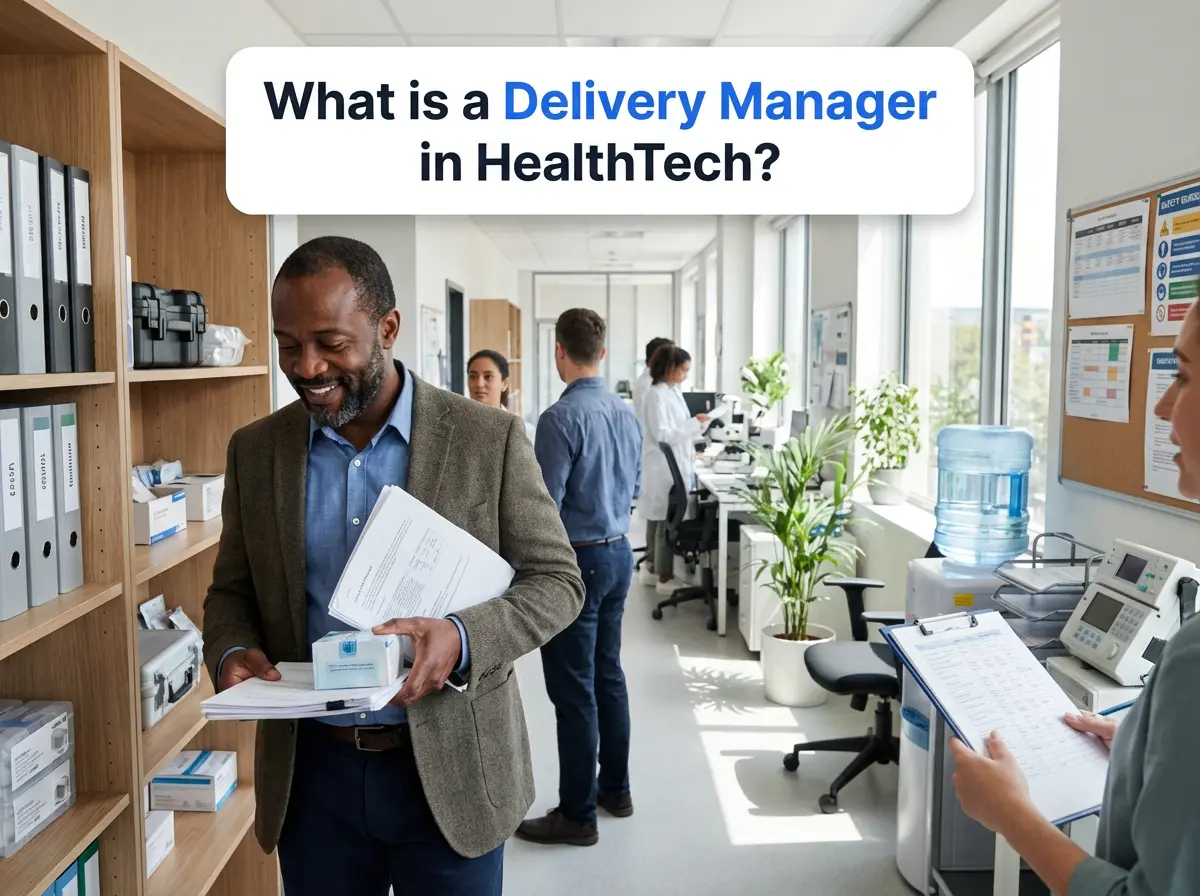
A Delivery Manager in HealthTech is accountable for turning a roadmap into reliable outcomes. They make sure a multidisciplinary team delivers the right thing, at the right quality, within real constraints such as patient safety expectations, information governance, and operational dependencies. The role exists because HealthTech work is rarely "just software": it often touches clinical workflows, sensitive data, regulated environments, and services where failure has real-world consequences.
In practice, a Delivery Manager holds the delivery system together. They create clarity when priorities compete, surface risks before they become incidents, and ensure decisions are made with eyes open, balancing speed, safety, cost, and user needs. Methods (agile, hybrid, waterfall) are secondary; the core is ownership for progress, predictability, and integrity of delivery.
🔍 How this role differs in HealthTech
In many SaaS or consumer tech environments, delivery is primarily optimising for pace, usability, and commercial outcomes, with a relatively direct line between a release and customer impact. In HealthTech, delivery decisions are shaped by higher stakes: risk tolerance is lower, assurance requirements are heavier, and implementation is often inseparable from service operations.
Data sensitivity changes the work. Teams may need to design delivery plans around stricter access controls, auditability, incident response expectations, and more cautious change management, especially where systems integrate with care delivery, diagnostics, or patient communications. The "definition of done" can expand to include operational readiness, training, measurable adoption, clinical safety considerations, and support models that are realistic for front-line settings.
The organisational context also differs. HealthTech Delivery Managers frequently operate across federated stakeholders (digital, clinical, operational, commercial, and external partners) where decision rights can be distributed and timelines are constrained by governance cycles, procurement, and integration dependencies.
🎯 Core responsibilities in HealthTech
Day to day, a Delivery Manager is accountable for maintaining a credible plan and a healthy delivery cadence, while continuously testing whether the team is solving the right problem in the right order. They translate strategy into sequencing: what must be proven first, what can be safely deferred, and what requires earlier validation because it's high-risk or hard to reverse once deployed.
A big part of the job is decision-making under constraints. That might mean choosing between releasing a partial capability that reduces operational burden now versus holding for a more complete feature set that could be safer long-term, or deciding whether to accept technical compromise to meet a clinical or operational deadline whilst documenting the trade-off and funding the remediation.
HealthTech delivery also demands stronger attention to "the last mile": implementation, migration, and adoption. A Delivery Manager often coordinates readiness across training, comms, support, monitoring, and escalation paths because a technically successful release can still fail if it increases workload, introduces ambiguity, or breaks established workflows. When incidents happen, they help drive the recovery path, ensuring the team learns, improves controls, and restores trust without freezing delivery.
🧩 Skills and competencies for HealthTech
Core Skill | HealthTech specific requirement | Reason or Impact |
|---|---|---|
Outcome ownership | Own delivery outcomes across build, implementation, and operational readiness, not just sprint throughput | Prevents "shipped but unusable" releases and improves real-world adoption in clinical and care settings |
Risk judgement | Comfort making trade-offs where failure modes affect safety, continuity of care, or sensitive data exposure | Keeps delivery moving whilst ensuring risk is explicitly managed rather than accidentally accepted |
Stakeholder authority without hierarchy | Align teams where clinical, operational, commercial, and technical leaders may have different decision rights | Reduces deadlock and ensures decisions are made at the right level with clear accountability |
Governance fluency | Navigate assurance, approvals, and audit expectations without turning them into blockers | Maintains pace whilst meeting obligations that protect patients, users, and the organisation |
Systems thinking | Understand downstream impacts across integrations, workflows, support, and data flows | Avoids local optimisation that breaks adjacent services or increases operational burden |
Communication under pressure | Provide precise status, risks, and options during incidents or high-visibility milestones | Builds trust and enables fast, informed decisions when timelines and safety expectations collide |
Dependency management | Plan around external suppliers, platform teams, clinical availability, and operational change windows | Improves predictability where delivery is constrained by parties outside the immediate team |
Continuous improvement mindset | Improve delivery mechanics whilst respecting that change itself can introduce risk | Increases throughput and reliability without destabilising teams operating in sensitive environments |
💷 Salary ranges in UK HealthTech
Salary in UK HealthTech is primarily a function of scope and risk: how many teams or workstreams you own, whether you're delivering patient-facing services versus internal platforms, the level of governance and assurance expected, and how costly failure would be operationally. Location still matters (especially London and South East), but so do sector context (public, private, scale-up), delivery complexity (legacy integrations, multi-site rollout), and whether the role includes incident leadership or on-call expectations.
Experience level | Estimated annual salary range | What drives compensation |
Junior | London & South East: £40,000–£50,000 | Supporting a delivery lead, smaller scope, lighter governance ownership, fewer high-stakes dependencies |
Mid-level | London & South East: £50,000–£65,000 | Owning a team's delivery cadence end-to-end, stronger stakeholder management, more integration and rollout accountability |
Senior | London & South East: £65,000–£85,000 | Multiple workstreams, higher risk environments, complex governance, leading delivery through operational constraints and incidents |
Lead | London & South East: £85,000–£110,000 | Portfolio ownership, shaping delivery strategy, managing other Delivery Managers, accountability for predictability across teams |
Head / Director | London & South East: £110,000–£150,000 | Organisational accountability, operating model design, senior governance, budget influence, delivery performance across domains |
Beyond base salary, total compensation commonly includes a performance bonus (often tied to delivery outcomes and organisational goals) and, in some HealthTech employers, equity (more typical in venture-backed companies than in public sector settings). On-call or incident allowances can apply where Delivery Managers are expected to join rota-based response or lead major incident coordination; this varies widely based on service criticality and operational model. Benefits (pension, private healthcare, enhanced leave) can materially change overall value, especially where base pay is more structured.
🚀 Career pathways
Many Delivery Managers enter HealthTech from project management, implementation, business change, operations, or agile delivery roles, often after gaining experience working with multidisciplinary teams and stakeholders who don't share the same incentives. Others transition from product operations, clinical systems administration, or consultancy, where they've already learned to deliver through ambiguity and constraints.
Progression typically comes from expanding ownership. Early on, you may own delivery hygiene and team cadence; then you become accountable for outcomes across build and rollout, including governance and service readiness. Senior progression is less about running more ceremonies and more about running higher-consequence delivery: multi-team dependencies, complex integrations, incident-led improvements, and shaping how delivery works across the organisation. Lead and Head/Director paths are defined by building delivery capability in others, setting standards, and being accountable for portfolio-level predictability and risk management.
❓ FAQ
Do HealthTech Delivery Manager interviews test agile "rules", or real delivery judgement?
Stronger processes help, but most hiring teams look for judgement: how you manage risk, unblock dependencies, and communicate trade-offs. Expect scenario questions about incident response, stakeholder conflict, and delivering through governance constraints.
Will I be expected to be on-call as a Delivery Manager in HealthTech?
Sometimes, yes, particularly where the product is operationally critical or patient-facing and the Delivery Manager is part of major incident coordination. Clarify whether it's formal rota, escalation-only, or "business hours with occasional out-of-hours", and whether there's an allowance.
How do I prove I can deliver in regulated or safety-conscious environments if I'm coming from another industry?
Show evidence of disciplined delivery under constraints: auditability, change management, incident learning, and stakeholder alignment. Hiring teams respond well to concrete examples where you slowed down to reduce risk, and where you accelerated responsibly by narrowing scope and improving controls.
You might also like