Published Date: December 18, 2025
Updated Date: December 18, 2025
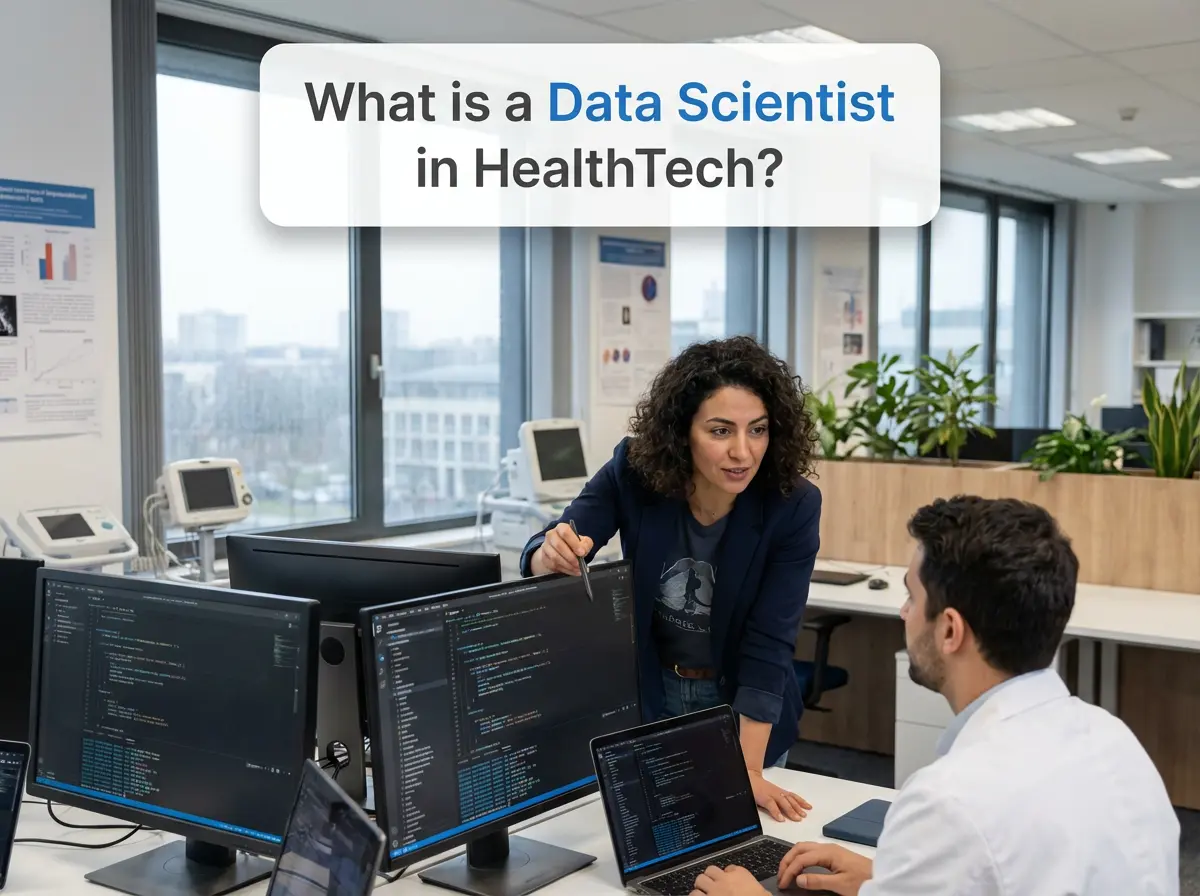
What is a Data Scientist in HealthTech?
A Data Scientist in HealthTech is the person accountable for turning health and healthcare data into decisions a product, service, or clinical workflow can safely rely on. The role exists because HealthTech organisations sit on rich but messy signals (clinical events, operational processes, patient-reported outcomes, device telemetry, claims, and care pathways) and someone needs to own the translation from "data we have" to "outcomes we can trust."
This is not primarily a modelling role; it is an ownership role. A HealthTech Data Scientist is responsible for defining what "good" looks like (clinically, operationally, ethically, and commercially), proving whether a system is meeting that bar, and setting up the checks that keep it true as real-world conditions change. In most teams, they sit at the intersection of product, engineering, clinical/medical stakeholders, and governance, often acting as the person who can say "yes, with these controls" or "not yet, because the evidence isn't strong enough."
🔍 How this role differs in HealthTech
In many tech industries, the cost of being wrong is typically revenue, growth, or engagement. In HealthTech, the cost of being wrong can be delayed diagnosis, inappropriate prioritisation, biased access to care, avoidable workload for clinicians, or a loss of trust that blocks adoption entirely. That shifts the Data Scientist's centre of gravity from "optimise a metric" to "make a defensible decision under constraints."
HealthTech data also behaves differently. It's more sensitive, more tightly governed, and more context-dependent: identical numbers can mean different things depending on a pathway, a population, and how the data was captured. A Data Scientist in this space is expected to think in terms of evidence, traceability, and monitoring, not just performance. That includes being comfortable with slower, more deliberate iteration, because health systems often require stronger justification before changing what people rely on.
🎯 Core responsibilities in HealthTech
Day to day, a HealthTech Data Scientist owns the integrity of data-driven decisions: choosing what to measure, what to predict or classify (if anything), and how to demonstrate that outputs remain reliable once they touch real workflows. They spend as much time defining requirements and evidence as they do analysing data, working with product to clarify the decision that will be made, with engineering to ensure the right data is captured and reproducible, and with clinical or operational stakeholders to ensure the output fits the reality of care delivery.
A large part of the job is navigating trade-offs openly. You may have a model that performs well overall but underperforms for a subgroup; an insight that is directionally useful but built on incomplete records; or a feature that improves accuracy but creates explainability challenges. The Data Scientist's responsibility is to make these tensions explicit, quantify risk where possible, and design safeguards (thresholding, fallback behaviour, human-in-the-loop steps, monitoring, auditability, and change control) so the organisation can move forward without pretending uncertainty doesn't exist.
In mature HealthTech teams, the Data Scientist is also accountable for lifecycle stewardship: validation approaches that fit the use case, drift and performance monitoring, incident-style review when outputs misbehave, and a clear narrative of what changed, why it changed, and how you know it's safe and useful after the change.
🧩 Skills and competencies for HealthTech
Core Skill | HealthTech specific requirement | Reason or Impact |
|---|---|---|
Problem framing | Translate a clinical or operational need into a decision that can be evidenced, not just a metric that can be improved | Prevents "model theatre" and keeps work anchored to patient and system outcomes people will actually rely on |
Stakeholder judgement | Work credibly with clinicians, safety/governance, and product without deferring ownership to any one group | HealthTech decisions are multidisciplinary; progress depends on clear accountability and shared definitions of acceptable risk |
Data provenance thinking | Treat source systems, coding practice, missingness, and collection incentives as first-class inputs | Reduces harm from silent bias, misinterpreted fields, and spurious correlations common in healthcare records |
Evaluation design | Choose evidence that matches the real-world decision, including subgroup effects and workflow impact | Avoids shipping "high AUC" outputs that fail when embedded in care pathways or that disadvantage specific populations |
Risk management | Decide when to automate, when to assist, and when to stop; design safeguards and escalation paths | Keeps systems safe under uncertainty and makes failure modes manageable rather than surprising |
Communication under constraint | Explain uncertainty, limitations, and trade-offs in plain language without oversimplifying | Enables responsible go/no-go decisions and prevents stakeholders from treating probabilistic outputs as facts |
Operational ownership | Build monitoring, alerting, and review practices that survive real-world variability and organisational change | HealthTech performance degrades when populations, pathways, or coding practices shift; ownership must extend beyond launch |
Ethics and fairness reasoning | Anticipate how incentives, access, and bias can be encoded into data and decisions | Protects trust and helps prevent unequal outcomes, which can be more consequential in healthcare than in many other sectors |
💷 Salary ranges in UK HealthTech
Salaries for Data Scientists in UK HealthTech vary most with accountability: whether your work influences clinical decisions versus internal operations, whether you own model lifecycle and governance, and whether you're expected to lead cross-functional decision-making. Location still matters (especially London and the South East), but so do regulated constraints, the criticality of the workflow, and whether you're effectively operating as a "product-facing owner" versus a more research or analytics-oriented contributor. On-call expectations are not universal for Data Scientists, but they do appear in teams running production ML services where incidents and monitoring require clear escalation.
Junior | London & South East: £40,000–£55,000 | Breadth of responsibility, quality of mentoring, and whether you're primarily supporting analysis vs owning a measurable slice of a product or service |
Mid-level | London & South East: £55,000–£75,000 | Independent ownership of problem framing and evaluation, stakeholder exposure, and whether you influence roadmap decisions rather than only delivering analyses |
Senior | London & South East: £75,000–£100,000 | Accountability for reliability in production, governance expectations, handling high-sensitivity data, and leading trade-offs that affect patient or clinical risk |
Lead | London & South East: £95,000–£125,000 | Team leadership, cross-product ownership, standards for validation/monitoring, and being the final decision-maker on evidence and readiness |
Head / Director | London & South East: £120,000–£170,000 | Org-level accountability, strategy, hiring, multi-team governance, external stakeholder scrutiny, and responsibility for failures as well as results |
Typical add-ons beyond base include a performance bonus (often tied to company and product outcomes), equity (more common in venture-backed HealthTech and scale-ups), and occasionally on-call or incident-response allowances where Data Science owns production ML monitoring. Total compensation rises when the role carries higher clinical or operational criticality, broader scope (multiple products or a platform), deeper governance expectations, and greater responsibility for production reliability rather than one-off analysis.
🚀 Career pathways
Entry points into HealthTech Data Science are often through analytics roles in healthcare, data roles in regulated industries, academic or research paths with real-world evaluation experience, or generalist data science roles followed by a deliberate move into healthcare contexts. The strongest transitions happen when candidates can show they've owned decisions end-to-end: how they defined success, handled messy data, and changed outcomes, rather than simply built models.
Over time, progression is less about accumulating techniques and more about expanding responsibility. A junior Data Scientist earns trust by being careful with data meaning and by communicating limitations clearly. A mid-level Data Scientist becomes valuable by owning a complete decision loop: framing, evidence, deployment considerations, and measurement after release. Senior and Lead levels are defined by stewardship: setting standards for evaluation and monitoring, making go/no-go calls under uncertainty, and building systems and team habits that reduce risk whilst enabling progress. At Head/Director level, the job becomes organisational: aligning product strategy with safe evidence, building governance that enables delivery rather than blocking it, and being accountable for outcomes across teams.
❓ FAQ
Do HealthTech Data Scientist interviews test clinical knowledge, or do they assume you'll learn it on the job?
Most roles don't expect you to arrive as a clinician, but they do expect you to respect domain complexity and ask the right questions. You'll usually be evaluated on how you handle ambiguity, data quality, and risk, not on memorising medical facts. Demonstrating that you can learn a pathway, define failure modes, and design sensible evaluation goes a long way.
How can I prove I'm safe to hire for patient-impacting work if my background is in general tech?
Show evidence of ownership in high-stakes or high-scrutiny settings: careful measurement, monitoring, incident learning, and clear communication of uncertainty. Be specific about how you validate assumptions, how you check subgroup performance, and how you would build guardrails when the data is incomplete. Hiring teams look for judgement and humility as much as technical strength.
Will I be on-call as a Data Scientist in HealthTech?
Not always. On-call is more common when Data Science owns production models that directly power workflow decisions, and less common for insight-only roles. If it exists, clarify what triggers an escalation, who owns remediation, and whether the team has monitoring and runbooks. Those details matter more than the label "on-call."
🔎 Find your next role
If you're ready to take ownership of data-driven decisions in HealthTech, search roles on Meeveem and compare opportunities by scope, risk, and real responsibility, not just titles.
You might also like