Published Date: January 3, 2026
Updated Date: January 3, 2026
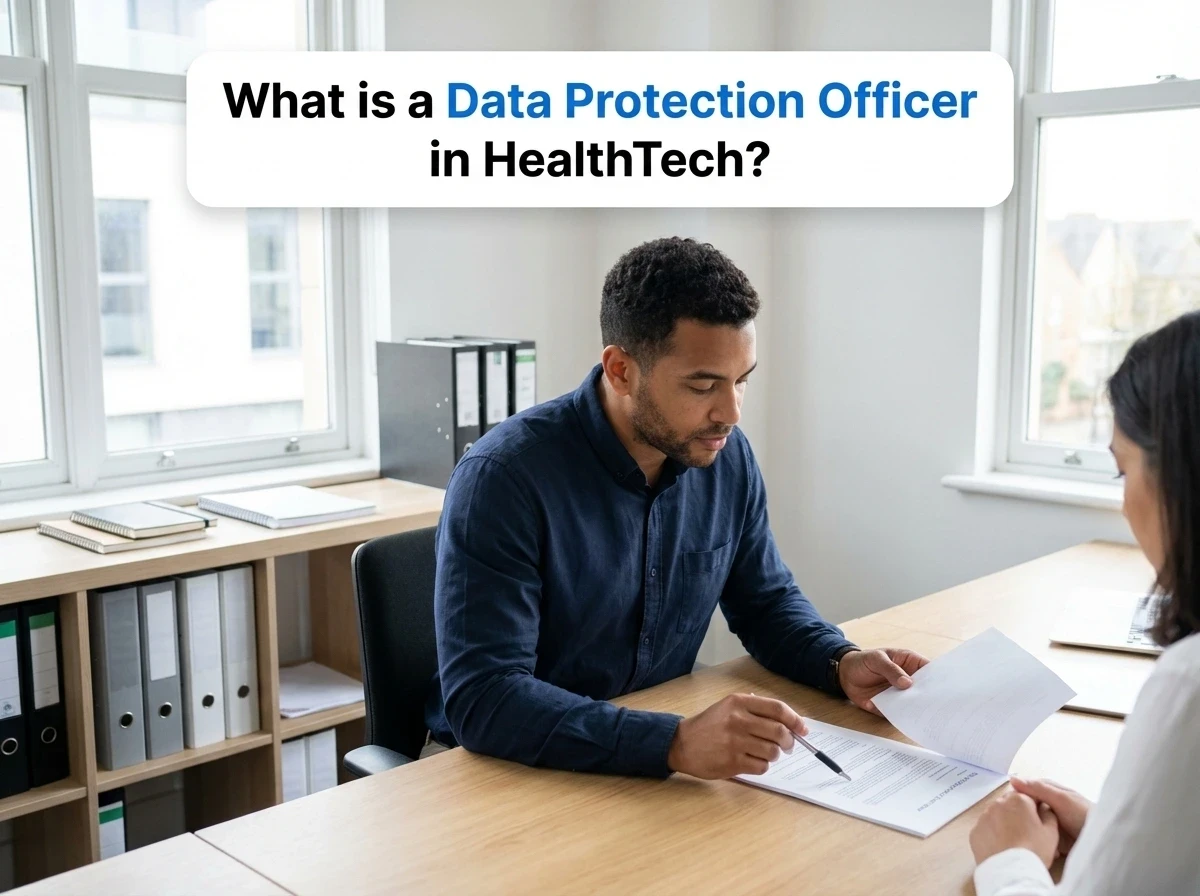
What is a Data Protection Officer in HealthTech?
A Data Protection Officer (DPO) in HealthTech is the accountable privacy leader who helps an organisation lawfully and safely use personal data, especially health and care data, while proving it can be trusted to do so. In practice, the DPO exists to protect individuals and the organisation at the same time: individuals from misuse or avoidable exposure of sensitive information, and the business from preventable regulatory, contractual, and reputational harm.
This role exists because HealthTech routinely handles data that is intrinsically sensitive, high-impact, and difficult to "undo" once disclosed or misused. When mistakes happen, consequences can extend beyond inconvenience into clinical risk, safeguarding concerns, or loss of access to critical partners and deployments. The DPO is therefore defined less by documentation and more by responsibility: they own the duty to challenge decisions, to set a defensible standard of "what good looks like," and to ensure privacy is treated as a condition of operating, not an optional layer added at the end.
At its best, the DPO is a stabilising force in fast-moving environments: independent enough to say "no" when needed, pragmatic enough to enable delivery when the right safeguards are in place, and senior enough to be heard.
🔍 How this role differs in HealthTech
In many tech sectors, data protection is often framed as a risk to be managed around marketing, analytics, and product growth. In HealthTech, the starting point is different: the data is more sensitive by default, the downstream impact is more serious, and the tolerance for ambiguity is lower. That shifts the DPO's work from "policy ownership" into operational decision-making: what you can ship, what you must change, what you must evidence, and what you should not do at all.
HealthTech also brings denser stakeholder and assurance requirements. You may be aligning internal teams (product, engineering, security, clinical, commercial) whilst also satisfying external expectations from customers and partners who need confidence in governance, incident readiness, and accountability. The role tends to sit closer to senior leadership than in many other industries because privacy decisions can directly constrain strategy: data access models, AI usage, interoperability, hosting choices, and how the organisation responds under pressure.
Finally, the work is more "real world." A decision that seems abstract, like data retention, auditability, or purpose limitation, can affect patient contact workflows, clinical safety oversight, or service continuity. The DPO's judgement matters because the context is unforgiving.
🎯 Core responsibilities in HealthTech
Day to day, the DPO is the person who turns legal and ethical expectations into decisions the organisation can actually run on. They set the tone for accountability: making sure privacy risks are recognised early, discussed honestly, and resolved with clear ownership rather than pushed into "later." In HealthTech, that often means being brought into product and data design conversations at the moment trade-offs first appear, when teams are choosing what data to collect, where it flows, who can access it, and how to prove the controls work.
A typical week might include advising on a high-risk assessment for a new feature that touches special category data, challenging whether the intended purpose is properly defined and communicated, and testing whether security controls and operational processes really match what is being claimed in customer assurance responses. The DPO also tends to be central in incident leadership: ensuring the organisation reacts decisively, contains risk, documents reasoning, and communicates appropriately, without turning every event into panic or defensiveness.
Crucially, the DPO is accountable for independence and credibility. They must be able to disagree with powerful stakeholders, avoid conflicts of interest, and still help teams reach outcomes that ship safely. The job is often about choosing the least-worst option under constraints (time pressure, complex integrations, legacy data, or urgent clinical needs) whilst keeping decisions defensible and aligned with the organisation's stated values.
🧩 Skills and competencies for HealthTech
Core Skill | HealthTech specific requirement | Reason or Impact |
|---|---|---|
Independent judgement | Ability to challenge senior stakeholders on high-impact use of health and care data without becoming a blocker-by-default | Maintains credibility with regulators, partners, and internal teams, and prevents "rubber-stamping" risky launches |
Risk-based decision-making | Comfort making proportionate calls where clinical urgency, service continuity, and privacy obligations collide | Enables safe delivery under pressure and creates a clear rationale when perfect solutions are not feasible |
Stakeholder leadership | Ability to align product, engineering, security, clinical/operational, and commercial stakeholders around one privacy position | Reduces drift, contradictions, and last-minute rework that can derail deployments and renewals |
Deep understanding of sensitive data handling | Practical grasp of what "special category" means operationally: access discipline, audit expectations, minimisation, retention, and justified sharing | Prevents quiet escalation of risk through convenience-driven data sprawl |
Incident command mindset | Ability to lead calm, evidence-led privacy decision-making during breaches or near-misses, including triage and communications | Protects individuals, reduces organisational exposure, and speeds recovery without sacrificing accuracy |
Assurance and evidence orientation | Capability to convert "we do the right thing" into traceable artefacts, controls, and accountability records | Builds trust with healthcare customers and partners who rely on demonstrable governance, not promises |
Pragmatic communication | Explaining complex privacy constraints in clear, actionable language for non-legal teams | Increases compliance through understanding rather than fear, and improves adoption of good practices |
Boundary setting and role integrity | Knowing what the DPO must own versus what must stay with security, legal counsel, engineering, or operational leadership | Preserves independence, avoids conflicts of interest, and makes accountability clear across the organisation |
💷 Salary ranges in UK HealthTech
Compensation for DPOs in HealthTech is shaped less by job title and more by the risk profile of the product and the organisation's exposure. Handling large volumes of sensitive health data, operating at scale across multiple customers, supporting complex integrations, or taking accountability for incident readiness and regulatory interactions typically pushes pay upward. Location still matters, but the biggest driver is usually scope: whether the DPO is advising a contained team, or effectively running the privacy function for a mission-critical platform. On-call expectations are not universal, but when the DPO is part of the incident rota or must respond rapidly to breaches and operational escalations, that can influence both base and total compensation.
Experience level | Estimated annual salary range | What drives compensation |
Junior | London & South East: £40,000–£55,000 | Often a stepping-stone role supporting a privacy lead; variation comes from whether you're mainly handling governance administration versus being trusted to advise on real product decisions |
Mid-level | London & South East: £55,000–£75,000 | Pay rises with autonomy: owning DPIA workflows, supplier and contract privacy review support, and practical guidance to teams without constant oversight |
Senior | London & South East: £75,000–£100,000 | Driven by breadth (multiple products/customers), complexity (data sharing, integrations, AI usage), and expectation to lead incidents, partner assurance, and executive-level risk decisions |
Lead | London & South East: £95,000–£125,000 | Typically accountable for the privacy programme end-to-end, influencing strategy and governance; higher compensation when the role is business-critical to winning and retaining regulated customers |
Head / Director | London & South East: £115,000–£160,000 | Highest ranges reflect organisational accountability: building the function, owning regulator-facing posture, setting standards across teams, and carrying responsibility through major incidents or rapid scaling |
Beyond base salary, HealthTech DPO packages commonly include pension and private healthcare, and often add a performance bonus (frequently modest to mid-range) tied to company or functional goals. Equity or share options are more common in venture-backed HealthTech, especially at Lead and Head/Director levels where continuity and trust are strategic. On-call allowances are less standard than in security operations, but some organisations include formal incident-response rota payments or enhanced compensation when the DPO is expected to be reachable for high-severity events; this is most likely where platform uptime and patient-facing communications depend on rapid, defensible decisions.
🚀 Career pathways
Entry points into a HealthTech DPO track are usually through privacy operations, information governance, compliance, security assurance, or legal-adjacent roles where you've already had to translate rules into operational decisions. Some people arrive via healthcare delivery environments, bringing a strong understanding of patient confidentiality and governance, then expanding into digital product and data-sharing realities. Others come from general tech privacy roles and build healthcare fluency by taking ownership of high-risk work: DPIAs that genuinely change designs, incident handling that requires calm judgement, and customer assurance processes that demand evidence.
Progression tends to follow ownership. Early roles build credibility by reliably making decisions and documenting reasoning. Mid-career growth comes from handling ambiguity: complex data flows, third parties, and product innovation that needs a principled "yes, if..." approach. Senior and leadership progression arrives when you can set direction for the organisation: shaping governance, influencing product strategy, developing a privacy culture, and carrying accountability through incidents and external scrutiny without losing trust.
❓ FAQ
Do I need healthcare experience to be a DPO in HealthTech, or is strong GDPR knowledge enough?
Strong GDPR knowledge is a baseline, but healthcare context quickly becomes the differentiator. Employers look for candidates who understand why health data raises the stakes, and who can make proportionate calls when clinical and operational pressures are real. If you don't have healthcare experience, demonstrate it through projects involving sensitive data, complex stakeholders, and evidence-based assurance.
How independent is the DPO in practice? Can I actually overrule product or commercial decisions?
A DPO typically influences decisions through governance, risk escalation, and executive reporting rather than "veto power" in a vacuum. In strong HealthTech organisations, the DPO's independence is operationally respected: you can escalate to the highest management level and you are not penalised for doing your job. In interviews, ask how disagreements are handled and who ultimately owns acceptance of privacy risk.
Will I be on-call as a DPO in HealthTech?
Not always, but you may be expected to be reachable for serious incidents, especially where patient communications, service continuity, or regulated deployments are involved. Some organisations formalise this through an incident rota; others treat it as an expectation of seniority. Clarify the escalation model, response-time expectations, and whether compensation recognises this responsibility.
🔎 Find your next role
If you're ready to take on privacy ownership in a mission-critical environment, search Data Protection Officer roles on Meeveem.
You might also like