Published Date: January 6, 2026
Updated Date: January 6, 2026
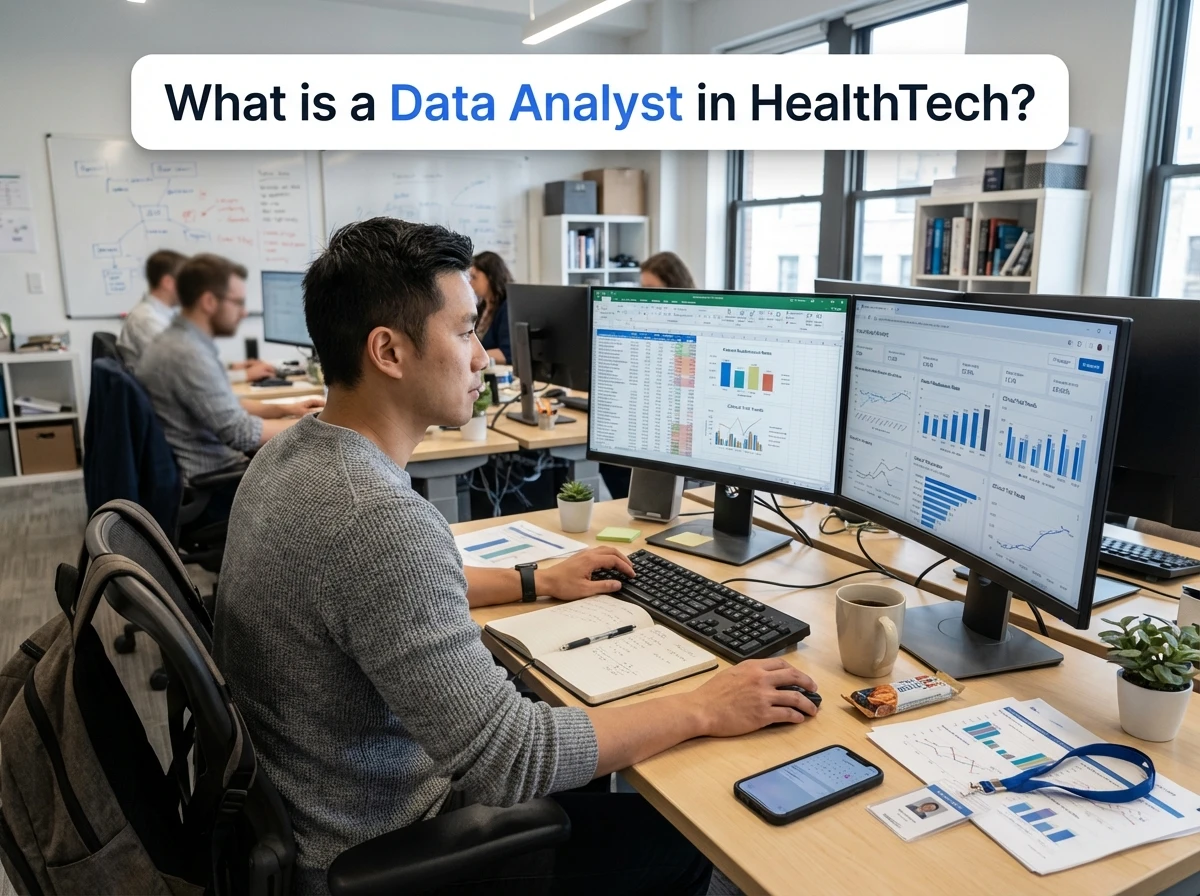
What is a Data Analyst in HealthTech?
A Data Analyst in HealthTech is responsible for turning health and care data into decisions that improve outcomes, operations, and product performance, without compromising privacy, safety, or trust. In practice, this means owning the definition of "what good looks like" in metrics, ensuring the organisation can rely on its numbers, and making sure analysis is usable in the real world of clinical workflows, commissioning constraints, and audited reporting.
This role exists because HealthTech organisations make high-stakes choices with imperfect data: what to prioritise in a roadmap, where patients are falling through a pathway, whether an intervention is working, and whether a service is meeting required standards. A Data Analyst provides the evidence base for those choices, and is often the person who prevents "insight" from becoming an unsafe, non-compliant, or simply misleading conclusion.
Unlike a purely technical reporting role, the HealthTech Data Analyst typically carries end-to-end responsibility for the interpretation layer: clarifying questions, aligning stakeholders on definitions, validating data quality, and deciding what is safe and appropriate to share, both internally and externally.
🔍 How this role differs in HealthTech
In many industries, analytics is mostly about growth efficiency and competitive advantage. In HealthTech, analytics is also about harm avoidance and defensibility. Data is more sensitive, the context is more complex, and decisions can affect clinical care, access to services, or operational capacity.
HealthTech analysts work in environments where datasets may be fragmented across systems, identifiers may be restricted, and "simple" metrics can embed clinical assumptions. The bar for auditability is higher: stakeholders need to know where data came from, what transformations occurred, and what limitations remain. There is also a stronger expectation that analysts understand how data is generated on the ground, because reporting shapes behaviour, and behaviour shapes care delivery.
As a result, the role leans heavily on judgement: what to measure, how to define it fairly, how to prevent perverse incentives, and how to communicate uncertainty without blocking progress.
🎯 Core responsibilities in HealthTech
Day to day, a HealthTech Data Analyst owns the reliability of the story the organisation tells with its data. That starts with translating vague questions ("Is this service working?") into measurable definitions that reflect clinical and operational reality. The analyst then traces those definitions back to source systems, assessing whether the data is fit for purpose, where it can mislead, and what safeguards are needed to avoid incorrect conclusions.
Much of the work involves navigating constraints: partial coverage, changing pathway rules, inconsistent coding, delayed feeds, and competing stakeholder needs. A strong analyst does not just produce a dashboard; they make explicit trade-offs between speed and certainty, between granularity and identifiability, and between stakeholder expectations and what the data can honestly support.
In HealthTech, analysis is often inseparable from data quality ownership. Analysts frequently lead investigations into anomalies, reconcile conflicting sources, and drive changes to upstream capture, because the most valuable "insight" might be that the metric cannot yet be trusted. They also operate with heightened accountability around information governance, ensuring outputs are appropriate for the audience and aligned with privacy and security requirements.
🧩 Skills and competencies for HealthTech
Core Skill | HealthTech specific requirement | Reason or Impact |
|---|---|---|
Metric ownership | Define measures that reflect clinical pathways, operational rules, and reporting obligations rather than convenience | Prevents misleading KPIs that drive unsafe behaviour or incorrect decisions |
Data quality judgement | Distinguish between "data is missing" and "the service failed," and know when to block publication vs proceed with caveats | Avoids harm from false reassurance or false alarms in high-stakes settings |
Privacy-aware analysis | Make safe choices about cohort sizes, segmentation, linkage, and what can be shared with different audiences | Protects confidentiality while keeping analysis useful and actionable |
Auditability and traceability | Maintain clear lineage from source to output, including assumptions, transformations, and known limitations | Enables scrutiny, reduces rework, and supports external reporting confidence |
Stakeholder translation | Align clinicians, ops, product, and leadership on a single interpretation of "the truth" | Reduces metric disputes and improves decision speed under pressure |
Risk-based communication | Present uncertainty and limitations without obscuring the decision that must still be made | Helps teams act responsibly rather than waiting for perfect data |
Systems thinking | Understand how workflows, incentives, and system constraints create the data you see | Produces insights that are implementable, not just analytically correct |
Prioritisation under constraints | Manage competing asks (ad hoc requests, scheduled reporting, investigations) while protecting quality | Keeps the organisation compliant and prevents silent metric drift |
💷 Salary ranges in UK HealthTech
Compensation for Data Analysts in HealthTech is primarily driven by scope and accountability: the breadth of domains you own (product, clinical operations, commercial), the criticality of the decisions your work influences, and how much governance, auditability, and stakeholder complexity sits on your shoulders. Location still matters, but HealthTech also adds variation based on data sensitivity, integration complexity, and whether your outputs feed regulated, contractual, or externally scrutinised reporting.
Experience level | Estimated annual salary range | What drives compensation |
Junior | London & South East: £30,000–£38,000 | Supervised delivery, narrower metric ownership, lower risk surface, learning governance and domain context |
Mid-level | London & South East: £38,000–£52,000 | Ownership of core dashboards/metrics, independent stakeholder management, stronger accountability for data quality |
Senior | London & South East: £52,000–£68,000 | Leading ambiguous investigations, shaping measurement strategy, higher scrutiny outputs, mentoring and cross-team influence |
Lead | London & South East: £68,000–£85,000 | Multi-area ownership, prioritisation across teams, governance leadership, setting standards and ensuring consistency at scale |
Head / Director | London & South East: £85,000–£120,000 | Org-wide accountability for analytics outcomes, risk management, strategy, hiring, and external-facing credibility |
Typical add-ons beyond base include performance-related bonus (more common in venture-backed and commercial HealthTech), pension and benefits, and sometimes equity (usually in startups and scale-ups, less common in traditional providers). On-call allowance is not standard for Data Analysts, but it can appear where analytics supports time-critical operational reporting, incident response, or executive reporting during service pressures; in those cases, compensation varies with rota frequency, response expectations, and whether you're expected to actively troubleshoot data pipelines versus simply monitor metrics.
🚀 Career pathways
Entry points into HealthTech data analytics often come from general data roles, healthcare operations, or reporting-heavy environments where accuracy and consistency matter. Some analysts move from administrative and performance reporting functions into more product and outcome-focused analytics; others enter via graduate routes or adjacent disciplines (e.g. epidemiology-style analysis, service evaluation, or quality improvement support).
Progression is typically marked by expanding ownership. Early on, you are trusted with a defined report or dataset. Over time, you become accountable for how whole areas are measured: agreeing definitions across teams, deciding what to publish, and setting quality thresholds. Senior progression comes when you can lead through ambiguity, handling messy data, conflicting stakeholder incentives, and high scrutiny, while still delivering decisions that stand up to challenge.
The strongest career growth in HealthTech comes from becoming the person who can safely connect data to action: shaping what the organisation believes, and making that belief dependable.
❓ FAQ
Do HealthTech employers expect me to understand NHS data and pathways before I join?
Not always, but they do expect you to learn quickly and to be careful with assumptions. What matters most is your ability to ask precise questions, document definitions, and validate data against reality. Domain familiarity becomes a major differentiator at senior levels.How do interviews test HealthTech analytics judgement, not just reporting skills? You'll often be assessed on how you handle messy data, unclear requirements, and conflicting stakeholder interpretations. Expect questions about metric definitions, bias or missingness, and how you would communicate uncertainty to a non-technical audience. Strong answers show how you protect safety, privacy, and decision integrity.
Will I be on-call as a Data Analyst in HealthTech? Most roles are not formally on-call, but some organisations expect responsiveness during reporting deadlines, operational surges, or incident investigations. Clarify expectations around out-of-hours availability, turnaround times, and whether you'd be troubleshooting data issues versus providing interpretive support. If there is a rota, confirm how it's compensated and what "response" actually means.
🔎 Find your next role
Ready to apply your analytics skills to real-world health impact? Search Data Analyst roles on Meeveem and compare opportunities across product, operations, and outcomes-focused teams.
You might also like