Published Date: January 6, 2026
Updated Date: January 6, 2026
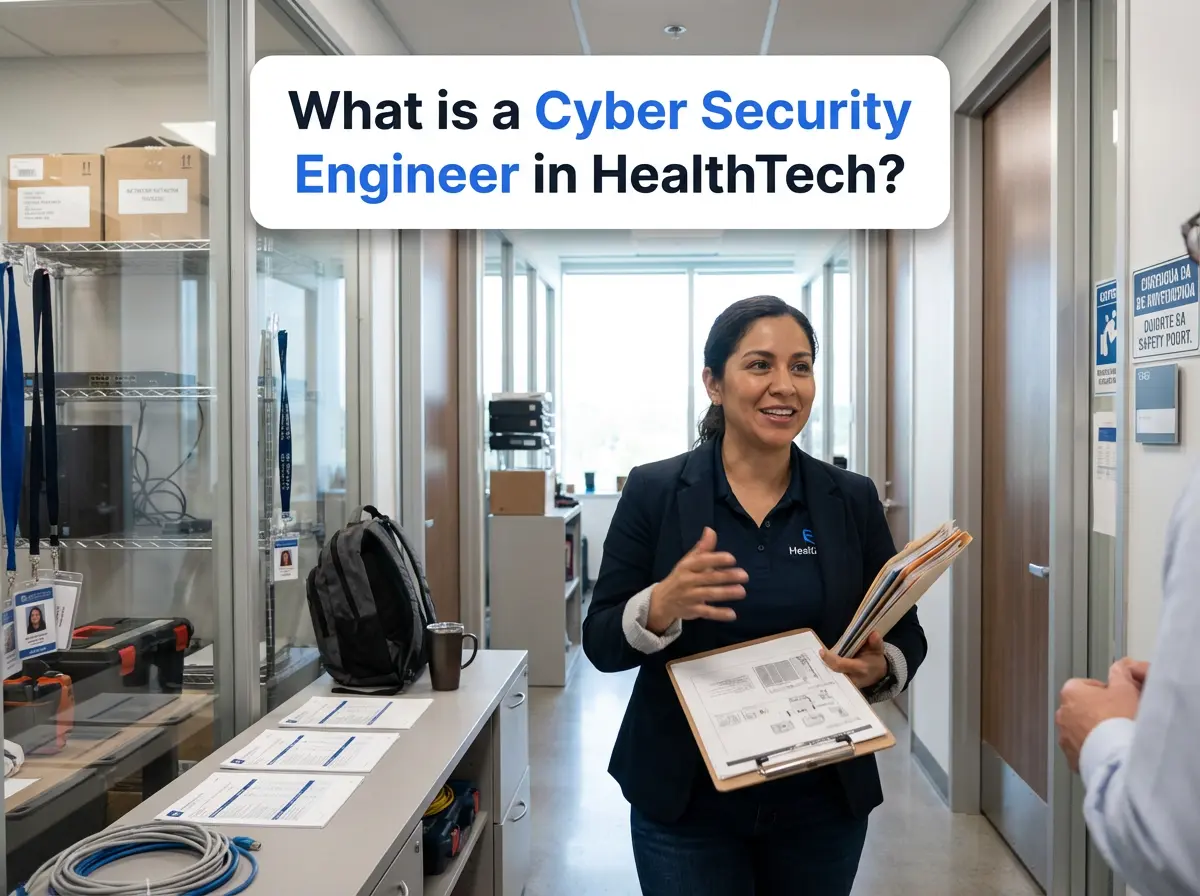
What is a Cyber Security Engineer in HealthTech?
A Cyber Security Engineer in HealthTech is responsible for keeping health-facing products, platforms, and connected services safe to run in the real world, where outages disrupt care, breaches expose highly sensitive data, and security incidents become operational emergencies rather than "IT problems". The role exists because HealthTech combines modern software delivery (cloud, APIs, continuous releases) with clinical workflows, regulated handling of confidential information, and supplier dependencies that can expand risk far beyond a single codebase.
This job isn't defined by tools first. It's defined by ownership: preventing avoidable security failures, reducing blast radius when something goes wrong, and ensuring security decisions hold up under scrutiny from customers, partners, and auditors. A strong Cyber Security Engineer in HealthTech is trusted to make risk-based calls, document them clearly, and be accountable for outcomes, especially when the safest option conflicts with delivery timelines or usability in care settings.
🔍 How this role differs in HealthTech
In many SaaS or consumer environments, security trade-offs are often framed around brand risk, customer churn, or revenue exposure. In HealthTech, the same technical issue can also become a patient-safety and service-continuity problem. That difference changes how decisions get made: availability, recovery, and operational resilience are treated as security concerns, not separate domains.
Health data is intrinsically sensitive, and health organisations frequently operate within structured assurance regimes and formal incident reporting expectations. That creates a different cadence for security work: clearer evidence requirements, more emphasis on defensible controls, and more pressure to make changes without disrupting clinical operations. Compared with FinTech, the drivers can look similar (regulated environments, serious incident response), but HealthTech often adds complexity through mixed estates, shared-care pathways, and third-party clinical systems where control is partial and collaboration is mandatory.
🎯 Core responsibilities in HealthTech
Day to day, a Cyber Security Engineer in HealthTech is accountable for translating security intent into engineering reality: making sure the product is designed and operated in a way that is safe to deploy into health and care environments, and that security doesn't rely on hope, heroics, or "someone remembering". That means shaping architecture decisions, defining practical security requirements with product and engineering, and then ensuring those requirements are implemented and verified in ways that stand up to audits and incident reviews.
The work is defined by constraints. You rarely get perfect conditions: legacy integrations, vendor-managed components, rapid delivery, and complex access patterns across staff, patients, and partners. A good engineer navigates those constraints by making trade-offs explicit: what risk is being accepted, what compensating controls exist, what monitoring will detect failure early, and what the rollback or containment plan is if reality differs from the design. When incidents occur, the accountability becomes immediate: triage, containment, evidence capture, communication readiness, and supporting the organisation's wider reporting and recovery obligations without turning incident response into blame or chaos.
🧩 Skills and competencies for HealthTech
Core Skill | HealthTech specific requirement | Reason or Impact |
|---|---|---|
Risk-based security judgement | Ability to prioritise controls based on patient impact, service continuity, and confidentiality, not just theoretical severity | Prevents "checkbox security" whilst ensuring the highest-consequence risks are treated as engineering priorities |
Secure architecture ownership | Comfort making and defending design decisions across APIs, identity boundaries, and third-party clinical integrations | HealthTech systems often span multiple organisations; clarity in boundaries reduces systemic risk and ambiguity during incidents |
Incident readiness and operational resilience | Designing for containment, recovery, and safe degradation when parts of the system fail | In HealthTech, the question is often "how do we stay safe whilst partially broken?" not "how do we stay perfect?" |
Evidence-driven assurance | Producing artefacts that demonstrate control effectiveness (not just policy intent) | HealthTech buyers and partners commonly require assurance; poor evidence slows sales, onboarding, and renewals |
Identity and access accountability | Defining access models that reflect real clinical and operational roles, including least privilege and break-glass expectations | Incorrect access design creates hard-to-detect harm: overexposure of records, unsafe privilege creep, and fragile operational workarounds |
Security influence without authority | Aligning product, engineering, compliance, and customer teams around decisions and timelines | HealthTech security is cross-functional; outcomes depend on coordination as much as technical competence |
Supplier and dependency risk management | Assessing and constraining risk introduced by vendors, hosted services, and embedded components | HealthTech platforms often rely on supplier ecosystems; unmanaged dependencies become the easiest path to material incidents |
Clear written communication | Writing concise risk acceptances, incident summaries, and control narratives that non-security stakeholders can act on | In regulated, high-stakes environments, the ability to explain decisions is part of being accountable for them |
💷 Salary ranges in UK HealthTech
Salary in HealthTech security engineering is primarily driven by scope (single product vs multi-platform), accountability (advisory vs decision owner), criticality (clinical workflows and uptime expectations), and the operational load (incident intensity, on-call expectations, and customer assurance pressure). Location still matters, but variation within the same city can be large when the role is tied to regulated deployments, major customer contracts, or high-severity incident ownership.
Experience level | Estimated annual salary range | What drives compensation |
Junior | London & South East: £40,000–£55,000 | Supported delivery scope, learning curve, and whether the role is closer to security operations support or product engineering |
Mid-level | London & South East: £55,000–£75,000 | Independence in delivery, ownership of key controls, ability to handle audits and customer assurance with minimal supervision |
Senior | London & South East: £75,000–£100,000 | Architecture influence, incident leadership expectations, and responsibility for security outcomes across multiple services or teams |
Lead | London & South East: £95,000–£125,000 | Organisational ownership, decision-making authority, cross-team alignment, and accountability for risk acceptance and major remediation programmes |
Head / Director | London & South East: £120,000–£170,000 | Executive accountability, governance and assurance ownership, budget and strategy responsibility, and responsibility for organisational incident posture |
Beyond base salary, packages commonly include performance bonus, employer pension contributions, and sometimes equity (more typical in venture-backed HealthTech than in provider organisations). On-call arrangements vary widely: some roles include a formal on-call allowance and/or time off in lieu, whilst others price incident accountability into the base. This is one of the biggest drivers of total compensation differences at Senior and above. Equity and bonus are also shaped by company stage, security maturity (how much "catch-up" is required), and the intensity of customer assurance obligations tied to revenue.
🚀 Career pathways
Entry points into HealthTech security engineering are often pragmatic rather than linear: software engineers who take ownership of security-critical areas, infrastructure engineers who become responsible for identity and hardening, SOC/incident responders who move closer to engineering controls, or compliance-minded technologists who prove they can translate assurance needs into working systems.
Progression happens when responsibility expands from "I can implement controls" to "I can choose the right controls, get them shipped, and be accountable when they fail". Over time, engineers typically grow from securing a service to securing a platform, then to influencing architectural patterns across teams, and finally to owning the organisation's security outcomes: incident posture, assurance readiness, and long-term risk reduction. Titles matter less than whether you can consistently make decisions under pressure, communicate them clearly, and deliver measurable reductions in risk without blocking the business.
❓ FAQ
Do I need healthcare-specific security experience to get hired into HealthTech as a Cyber Security Engineer?
Not always. Many teams will hire strong security engineers from other regulated or high-availability environments if you can show mature judgement and evidence-driven thinking. What usually matters is whether you can operate calmly under incident pressure and work within formal assurance expectations.
What will interviews focus on in HealthTech security engineering: tools or decision-making?
Expect a strong emphasis on how you reason about risk and trade-offs: what you would do when security conflicts with delivery, or when uptime and confidentiality pull in different directions. You may also be assessed on how you document decisions, handle ambiguous incidents, and collaborate with product and clinical-adjacent stakeholders.
How common is on-call for this role in HealthTech, and what should I clarify before accepting?
On-call is common when the role includes operational ownership of security incidents, especially in organisations running 24/7 services. Clarify whether on-call is formal or informal, what the escalation path looks like, expected frequency, compensation (allowance/TOIL), and whether you have the authority and support to make containment decisions during an incident.
🔎 Find your next role
Ready to take on real-world security ownership in HealthTech? Search Cyber Security Engineer roles on Meeveem and find a scope that matches the level of accountability you want.
You might also like