Published Date: January 6, 2026
Updated Date: January 6, 2026
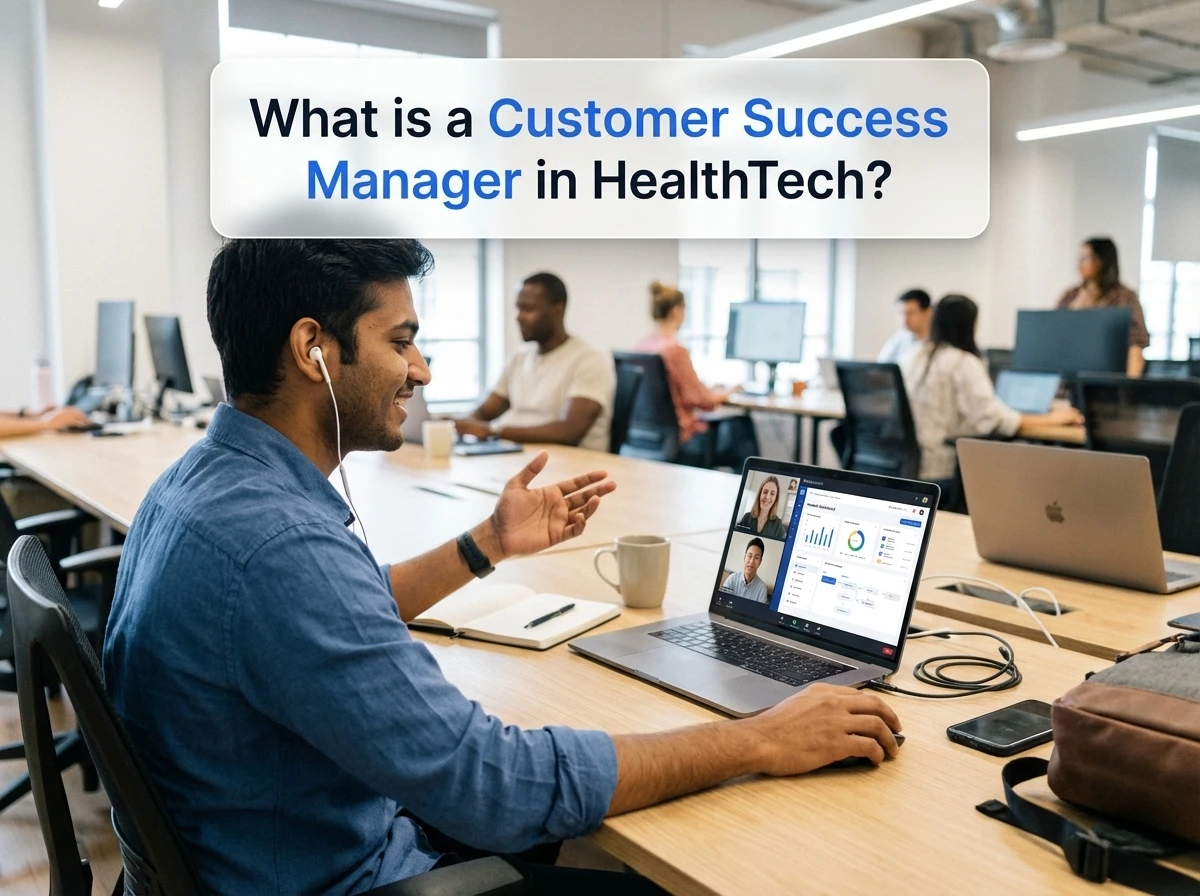
What is a Customer Success Manager in HealthTech?
A Customer Success Manager (CSM) in HealthTech owns post-sale customer outcomes. They ensure healthcare organisations adopt the product safely, realise measurable value, and stay successful over time so that renewals and expansion flow naturally from outcomes rather than appearing as surprises at contract time.
This role exists because HealthTech products don't deliver value simply by being purchased or deployed. Value only materialises when real teams change behaviour: clinicians, administrators, IT staff, information governance teams, and operational leaders all need to trust the system, integrate it into workflows, and keep it functioning through changes in staffing, service pressure, and policy. The CSM owns the ongoing relationship and the "value continuity" challenge, preventing drift, avoiding unnecessary risk, and ensuring customers can continue using the product confidently as conditions shift.
In most organisations, a HealthTech CSM sits within Customer Success (sometimes part of a broader Customer or Revenue function) and acts as the cross-functional coordinator for their accounts. They don't "do everything" themselves, but they're responsible for making sure the right things happen: escalation, prioritisation, decision-making, and alignment across Support, Implementation, Product, Security, and Commercial teams.
🔍 How this role differs in HealthTech
In many SaaS categories, a CSM can focus primarily on adoption metrics and commercial outcomes: usage, retention, and growth. In HealthTech, those still matter, but decisions are constrained by higher risk, greater scrutiny, and more serious consequences.
A HealthTech CSM works in environments where data sensitivity is standard rather than exceptional, and where customers often have formal governance around change control, access, auditability, and supplier assurance. This shifts the job from "driving engagement" to "driving safe, governed, outcome-led adoption." The pace can be slower in some areas (approvals, clinical safety sign-off, security reviews) and faster in others (incidents, operational pressure, service continuity).
The other difference is the reality of impact. When a product touches clinical workflow, patient communications, scheduling, triage, documentation, or operational decision-making, success isn't a nice-to-have. Your customer's tolerance for ambiguity is lower, and your company's need for consistent, defensible decision-making is higher. A strong HealthTech CSM earns trust by making trade-offs explicit and keeping both patient risk and organisational risk in view without becoming paralysed.
🎯 Core responsibilities in HealthTech
Day to day, a HealthTech CSM is accountable for keeping each customer on a controlled path from "implemented" to "embedded." That means owning the narrative of value: what outcomes the customer is trying to achieve, what needs to change for those outcomes to appear, what risks could derail progress, and what evidence shows the product is delivering safely and consistently.
Much of the work involves judgement under constraints. You might have a customer requesting rapid configuration changes whilst internal teams want stricter change management. You might see adoption friction that looks like a training gap but is actually a workflow or clinical-safety concern. You might need to hold a firm line on scope and governance whilst still preserving momentum and trust. The best CSMs don't simply "keep everyone happy"; they make clear decisions, document assumptions, and align stakeholders around a realistic success plan.
HealthTech also demands a different style of escalation. When something goes wrong, the question isn't only "how fast can we fix it?" but "how do we stabilise service, communicate responsibly, protect data, and prevent recurrence?" A CSM often coordinates the customer-facing side of incident handling: setting expectations, ensuring updates are accurate, and making sure the customer understands both immediate mitigations and longer-term corrective actions.
Finally, a HealthTech CSM typically serves as the internal signal for product reality. They translate frontline constraints into actionable feedback: what's blocking adoption, what governance requirements are common, what outcomes customers genuinely measure, and where the product is creating avoidable operational burden.
🧩 Skills and competencies for HealthTech
Core Skill | HealthTech specific requirement | Reason or Impact |
|---|---|---|
Outcome ownership | Define success in terms customers can defend internally (service impact, safety, efficiency), not just feature usage | HealthTech buyers often need evidence for governance and budget scrutiny; outcome clarity reduces churn driven by "it's installed but not essential." |
Risk judgement | Recognise when "quick wins" create unacceptable operational, privacy, or safety risk | Helps prevent unsafe workarounds, reduces escalations, and builds credibility with clinical and operational stakeholders. |
Stakeholder leadership | Navigate multi-stakeholder decision-making where authority is distributed (ops, IT, governance, clinical leaders) | Keeps programmes moving without over-relying on a single champion who may rotate or be redeployed. |
Structured communication | Communicate incidents, constraints, and trade-offs with precision and calm | In high-pressure settings, unclear messaging damages trust quickly; clear comms protect relationships and reduce confusion during service events. |
Governance fluency | Work comfortably with access control, audit expectations, change control, and supplier assurance processes | Speeds adoption by anticipating approvals and reducing rework; prevents "late surprises" that stall rollout or renewals. |
Commercial discipline | Hold boundaries on scope whilst preserving partnership, especially where services and configuration are tightly coupled to outcomes | Prevents unmanaged cost-to-serve and keeps delivery predictable without undermining customer success. |
Cross-functional influence | Translate customer reality into prioritised internal action without "shouting into the void" | Ensures Support, Product, and Security decisions reflect real-world constraints and reduce recurring issues across the customer base. |
💷 Salary ranges in UK HealthTech
Compensation in UK HealthTech Customer Success is shaped less by the label "CSM" and more by scope: the number and size of accounts, whether the portfolio is enterprise/public-sector, the criticality of the workflow, and the level of accountability for renewals/expansion. Regulated constraints, incident exposure (including any rota-style participation), and location also influence ranges. Some HealthTech companies run CSM as a purely outcomes/adoption role, others attach revenue targets (renewal ownership, expansion sourcing, or an OTE model), which can lift total compensation.
Experience level | Estimated annual salary range | What drives compensation |
Junior | London & South East: £32,000–£42,000 | Smaller portfolios, lower-risk deployments, more supervision, and less ownership of renewals or escalations. |
Mid-level | London & South East: £42,000–£60,000 | Independent account ownership, complex stakeholder management, stronger renewal influence, and higher expectation of operational rigour. |
Senior | London & South East: £60,000–£80,000 | Enterprise/public-sector complexity, higher product criticality, formal success planning, and responsibility for recovering at-risk accounts. |
Lead | London & South East: £78,000–£100,000 | Leadership of strategic accounts and/or mentoring, playbook ownership, escalation leadership, and stronger linkage to retention/NRR outcomes. |
Head / Director | London & South East: £95,000–£140,000 | Department-wide retention and expansion accountability, forecasting, operating model design, team leadership, and ownership of cost-to-serve and delivery quality. |
Beyond base salary, typical add-ons include a performance bonus (often tied to retention, renewals, expansion influence, or customer outcomes), and equity in venture-backed HealthTech. Some roles use an OTE-style structure where variable pay increases meaningfully with commercial accountability. On-call is less common for pure CSM roles than for Support/Engineering, but where CSMs are expected to participate in incident communications or customer-facing escalation rotas, pay can be adjusted via allowance or a higher base, especially when the product is operationally critical and customers expect rapid, structured updates.
🚀 Career pathways
Many HealthTech CSMs enter from adjacent roles where they already carry customer accountability: implementation, healthcare operations, account management, consulting, clinical workflow optimisation, or support leadership. The best transitions happen when someone can demonstrate not just "helpfulness" but ownership, being the person who made outcomes happen across messy constraints.
Progression usually involves a shift in the type of risk you own. Early on, you prove you can run a portfolio reliably: onboarding, adoption, stakeholder alignment, and predictable renewals. At senior levels, you're trusted with higher-criticality deployments, complex governance environments, and accounts where escalation handling and trust repair are part of the job. Lead roles expand scope to shaping how success is delivered (methods, standards, escalation practice, and coaching), whilst Head/Director roles formalise accountability for retention performance, forecasting, customer operating model, and cross-functional alignment at company level.
The consistent theme is that responsibility expands faster than title: the quickest route upward is being the person others rely on when outcomes, risk, and reputation are on the line.
❓ FAQ
Do HealthTech CSM interviews focus more on healthcare knowledge or SaaS customer success skills?
Most hiring processes test both, but in practice they're looking for judgement: can you lead stakeholders, hold boundaries, and drive outcomes in a constrained environment. You don't need to be a clinician, but you do need to show you understand operational pressure, governance expectations, and how trust is earned.
Will I be expected to carry a sales target as a HealthTech Customer Success Manager?
It depends on the company's go-to-market model. Some roles are primarily adoption and retention, with expansion handled by a commercial counterpart; others expect CSMs to influence or directly carry renewal and expansion outcomes, which typically changes the variable pay structure.
How should I talk about incidents and risk in interviews without sounding negative?
Frame it as service continuity and decision-making: how you stabilised a situation, communicated clearly, and prevented repeat issues. HealthTech employers usually prefer calm, structured handling of high-stakes moments over polished "everything is always fine" narratives.
🔎 Find your next role
Ready to take ownership of customer outcomes in HealthTech? Search Customer Success Manager roles on Meeveem and find a team where responsibility matches the mission.
You might also like