Published Date: December 18, 2025
Updated Date: December 18, 2025
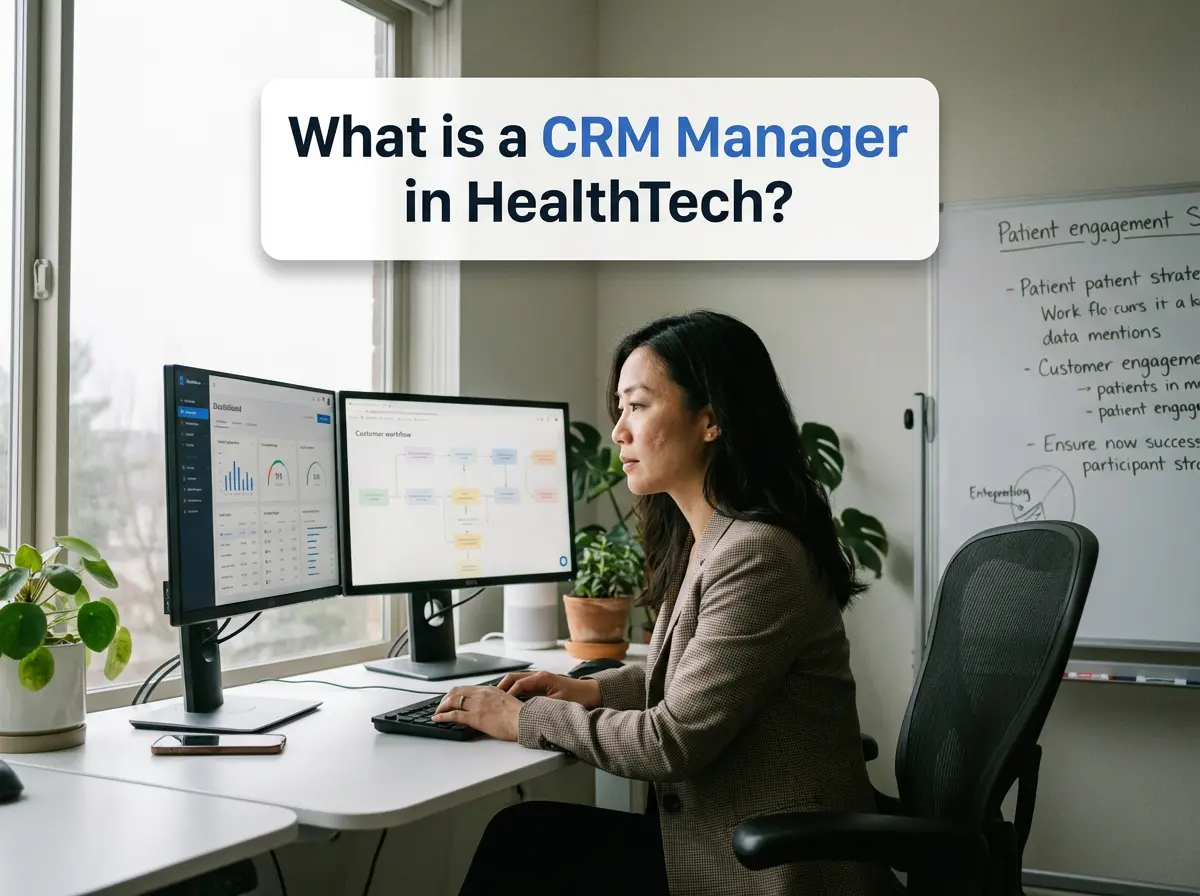
What is a CRM Manager in HealthTech?
A CRM Manager in HealthTech is the person accountable for how an organisation uses customer and patient communications to drive engagement, retention, and safe growth across the product lifecycle. In practice, that means owning the rules, decisions, and outcomes behind when people are contacted, what they are told, what they are asked to do next, and how those journeys are measured and improved.
This role exists because HealthTech outcomes depend on continuity: people need to start, continue, and complete journeys that can be clinically meaningful (or operationally time-sensitive), not just commercially convenient. A CRM Manager creates and governs the engagement system that helps users move through onboarding, education, appointments, adherence, renewals, referrals, and reactivation, whilst respecting consent, sensitivity, and organisational risk.
The emphasis is on ownership: the CRM Manager is responsible for the end-to-end performance and integrity of lifecycle communications, not merely "sending campaigns". They are expected to make trade-offs, defend decisions, and operate as a cross-functional partner to marketing, product, data, clinical/ops teams, and compliance.
🔍 How this role differs in HealthTech
In many SaaS, FinTech, or consumer businesses, CRM can optimise for speed, revenue, and experimentation volume. In HealthTech, the same levers exist (segmentation, personalisation, automation, and testing) but the acceptable risk profile is different.
Health data is inherently sensitive, and the consequences of a poorly designed message can be more than reputational: it can erode trust at moments when users are anxious, unwell, or making high-stakes decisions. HealthTech CRM Managers therefore spend more time thinking about permissioning, language, timing, channel appropriateness, and escalation paths. Decisions that might be "growth wins" elsewhere (aggressive nudges, frequent retargeting, opportunistic cross-sell) may be inappropriate if they conflict with patient expectations, clinical guidance, or the organisation's duty of care.
Real-world impact also changes measurement. HealthTech teams still care about conversion and retention, but they often need to balance those against complaint rate, opt-out rate, clinical capacity, appointment utilisation, service quality, and the operational reality of care delivery.
🎯 Core responsibilities in HealthTech
Day to day, a CRM Manager in HealthTech is accountable for the quality and performance of lifecycle journeys across channels (often email, SMS, push, and in-product messaging), ensuring that the right people receive the right communication at the right time, for the right reason.
They typically work from a clear engagement strategy: defining lifecycle stages, mapping decision points (for example, registration, triage, booking, treatment milestones, follow-ups, renewal windows), and then translating that into governed automation. Crucially, they are making decisions under constraints: consent and preferences, sensitive-topic handling, data quality limits, clinical and operational capacity, and the need to avoid confusing or distressing messaging. When trade-offs arise (such as whether to optimise for appointment fill-rate versus reducing message frequency), the CRM Manager is expected to set guardrails, align stakeholders, and be accountable for the outcome.
They also own the measurement loop. Rather than reporting vanity metrics, they build an evidence base that connects CRM activity to meaningful outcomes (activation, adherence, repeat usage, retention, and service utilisation) whilst monitoring risk signals (complaints, opt-outs, deliverability degradation, and problematic cohort behaviour). In a well-run HealthTech organisation, the CRM Manager becomes the steward of "communication safety" as well as communication performance.
🧩 Skills and competencies for HealthTech
Core Skill | HealthTech specific requirement | Reason or Impact |
|---|---|---|
Lifecycle ownership | Ability to define what "good engagement" means when user needs vary by condition, pathway stage, and service capacity | Prevents growth-led messaging from undermining trust, clinical flow, or operational reality |
Consent and preference governance | Comfort making conservative decisions where permissions, channel suitability, and sensitivity differ by cohort | Reduces compliance risk and avoids communications that feel intrusive or inappropriate |
Data judgement | Ability to work with imperfect records, identity resolution issues, and delayed clinical/ops signals | Stops automation from misfiring (wrong message, wrong time) and improves reliability over time |
Stakeholder leadership | Confidence to align product, marketing, clinical/ops, and compliance on shared rules and escalation paths | Keeps journeys consistent, reduces last-minute changes, and protects users from conflicting communications |
Risk-aware experimentation | Knowing what can be tested safely, what needs review, and where to prioritise clarity over optimisation | Enables improvement without "growth at any cost" behaviours that can harm vulnerable users |
Crisis and exception handling | Ability to plan for failures (system downtime, capacity shocks, clinical changes) and adjust comms quickly | Protects patient experience and reduces avoidable inbound volume, cancellations, and complaints |
Measurement discipline | Linking CRM work to retention, utilisation, and quality signals, not just opens/clicks | Produces credible decision-making and helps leadership invest in the right improvements |
💷 Salary ranges in UK HealthTech
Pay for CRM Managers in UK HealthTech varies most by scope and risk. The biggest drivers are: how much of the lifecycle you own (single product vs multi-brand), the sensitivity and complexity of pathways, proximity to regulated or clinically-led processes, how embedded the role is with data and product teams, and whether you manage people or a platform roadmap. Location still matters, and hybrid expectations can compress or widen ranges depending on talent supply.
Experience level | Estimated annual salary range | What drives compensation |
Junior | London & South East: £30,000–£40,000 | Entry into lifecycle ownership, limited autonomy, narrower channel scope, more execution within established rules |
Mid-level | London & South East: £40,000–£55,000 | Ownership of key journeys, stronger segmentation and performance accountability, higher expectations on data quality and consent handling |
Senior | London & South East: £55,000–£75,000 | End-to-end lifecycle responsibility, cross-functional leadership, complex cohorts, stronger governance, platform depth, measurable impact on retention/utilisation |
Lead | London & South East: £70,000–£90,000 | Multi-journey strategy, line management or functional leadership, portfolio prioritisation, scalable governance, influence over roadmap and operating model |
Head / Director | London & South East: £85,000–£120,000 | Organisation-wide ownership, team and budget leadership, multi-product complexity, senior stakeholder management, accountability for growth and trust metrics |
Typical add-ons beyond base pay include an annual bonus (more common where CRM is tied directly to revenue or retention targets), equity/options in venture-backed HealthTech, and enhanced benefits. On-call is less common for CRM managers than for clinical operations or engineering roles, but may appear where CRM owns business-critical patient messaging workflows; when it does, compensation tends to be handled through a modest allowance or broader seniority-based uplift. Total compensation moves most with platform complexity, business criticality of communications, and the degree of leadership and risk ownership expected.
🚀 Career pathways
Common entry points include email marketing, lifecycle marketing, customer engagement, marketing operations, or retention roles in regulated or data-sensitive environments. Some CRM Managers also come from service operations backgrounds, especially when a HealthTech business's engagement strategy is tightly linked to appointment flow, triage, or ongoing care support.
Progression is usually less about adding channels and more about expanding ownership. Early on, growth comes from reliably running journeys and improving performance without creating risk. At senior levels, you're trusted to set the rules: defining consent-safe segmentation, aligning stakeholders, and deciding what the organisation will and won't automate. Moving into Lead and Head roles tends to require building an operating model: how requests are prioritised, how quality is assured, how measurement is standardised, and how the team balances experimentation with duty of care.
❓ FAQ
1) Will I be expected to write clinically sensitive messages myself, or just manage the system? Often you'll do both: you may draft and iterate messaging, but you'll also be responsible for the approval process and guardrails. In HealthTech, the key is being able to recognise when copy needs clinical or compliance review and to build that into delivery timelines.
2) How do HealthTech teams evaluate CRM performance beyond open and click rates? Expect to be assessed on downstream outcomes like activation, repeat usage, appointment utilisation, renewals, and reduction in avoidable churn, alongside risk signals like complaints, opt-outs, and deliverability health. Interviewers will look for how you connect messaging decisions to operational and user outcomes.
3) Is on-call part of a CRM Manager role in HealthTech? It's not standard, but it can happen when CRM owns time-critical patient communications or major automation that impacts service delivery. If it exists, clarify what triggers an escalation, what "out of hours" really means, and whether there's a rotation, allowance, or compensatory time off.
You might also like