Published Date: December 31, 2025
Updated Date: December 31, 2025
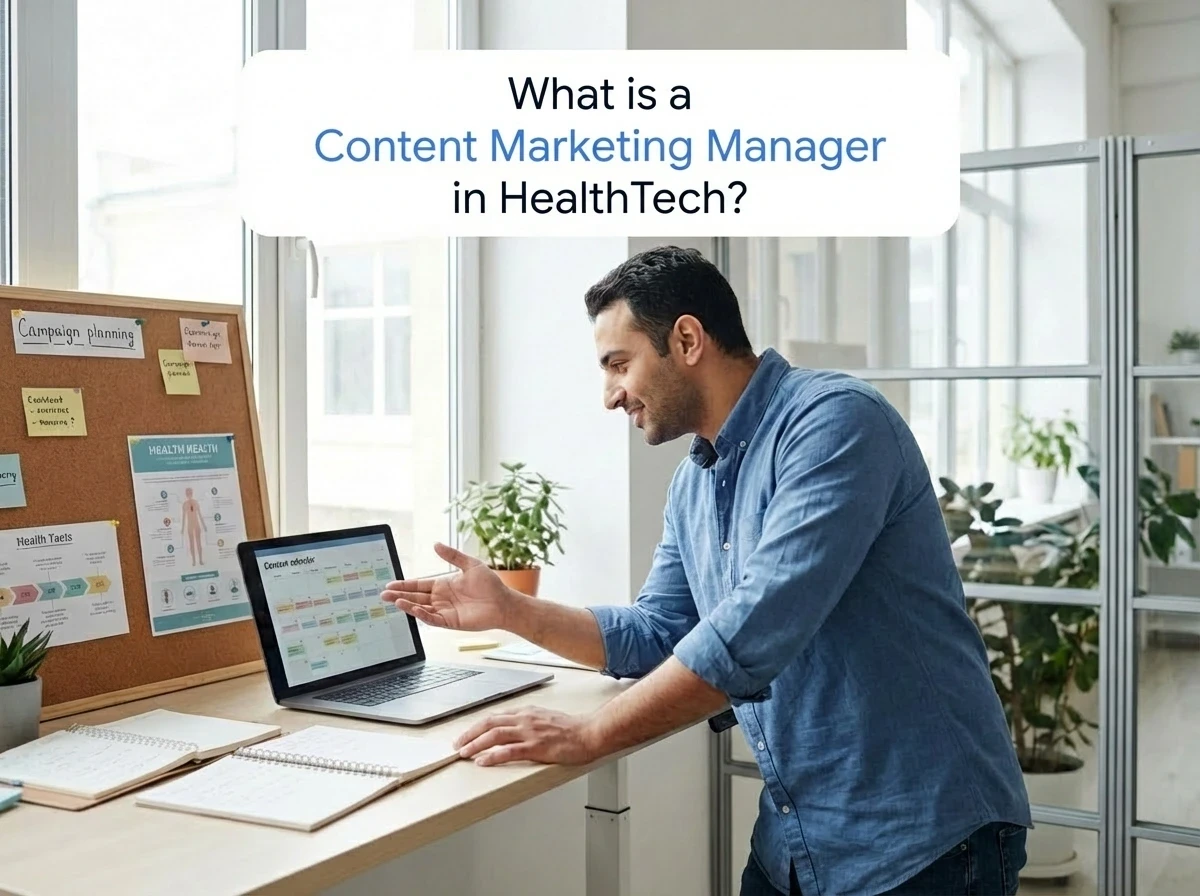
What is a Content Marketing Manager in HealthTech?
A Content Marketing Manager in HealthTech is responsible for transforming complex health-related products, services, and evidence into clear, trustworthy content that drives commercial outcomes without creating clinical, regulatory, or reputational risk. They work at the intersection of go-to-market execution and domain accuracy: close enough to product and clinical experts to ensure correctness, and close enough to sales, partnerships, and growth teams to deliver practical value.
This role exists because HealthTech buyers and users need more than persuasive messaging. They need confidence. In many HealthTech categories, the difference between "interesting" and "adopted" comes down to whether the organisation can explain benefits, limitations, outcomes, data handling, and workflow impact in language that stands up to scrutiny. The Content Marketing Manager owns that translation, ensuring content supports demand generation, sales cycles, customer adoption, and brand credibility whilst staying within the organisation's claims boundaries.
🔍 How this role differs in HealthTech
In many tech sectors, content can be optimised rapidly through experimentation: positioning shifts quickly, bold claims are common, and risk is largely commercial. In HealthTech, the same instincts can backfire. Content has a longer shelf life, a higher burden of accuracy, and a wider range of stakeholders who will challenge it. These include clinical teams, technical experts, procurement, information governance, and sometimes patient or member audiences.
Data sensitivity changes what "good" looks like. A HealthTech Content Marketing Manager must be confident about what can and cannot be implied when discussing outcomes, data use, AI, personal health information, and integrations. Real-world impact also changes editorial judgement: clarity isn't just a conversion tool, it can influence understanding, decision-making, and trust. That pushes the role towards careful substantiation, precise language, and a higher standard of internal alignment before content goes live.
🎯 Core responsibilities in HealthTech
Day to day, the Content Marketing Manager is responsible for content that moves the business forward across the funnel: thought leadership that earns trust, product content that explains value without overstating it, and sales enablement materials that help commercial teams communicate credibly in long, multi-stakeholder buying cycles. They make continual decisions about what to publish, what to delay, and what to refuse, based on evidence quality, claims risk, and the maturity of the product or service being described.
Much of the work involves trade-offs under constraints. A new feature may be valuable, but not yet proven in a way that supports strong external claims. A case study may be compelling, but too specific to share without careful approvals and anonymisation. A campaign idea may be creative, but inappropriate if it could be interpreted as medical advice. The Content Marketing Manager navigates these moments by aligning teams on a defensible message, documenting what is known and what is not, and shipping content that is both commercially effective and safe for the category.
🧩 Skills and competencies for HealthTech
Core Skill | HealthTech specific requirement | Reason or Impact |
|---|---|---|
Editorial judgement | Ability to distinguish between marketing-friendly language and what can be responsibly claimed given evidence, outcomes data, and product maturity | Prevents overclaiming, reduces reputational risk, and protects long-term trust with clinical and procurement stakeholders |
Stakeholder management | Confidence working with clinical, product, legal/compliance, info governance, and commercial teams that have different definitions of "acceptable" | Speeds up approvals, avoids rework, and ensures content is aligned with real delivery constraints and responsibilities |
Evidence-led storytelling | Comfort translating studies, audits, service metrics, and qualitative feedback into narratives that remain accurate and non-misleading | Improves credibility in high-scrutiny buying cycles and supports adoption by addressing "prove it" objections |
Audience segmentation | Ability to write for multiple stakeholders (patients/members, clinicians, ops, procurement, IT/security) without mixing requirements or tone | Increases relevance and conversion by matching the decision-maker's priorities and risk concerns |
Messaging architecture ownership | Maintaining consistent positioning across website, campaigns, sales materials, and customer lifecycle content even as products evolve | Reduces confusion, shortens sales cycles, and helps the organisation present a stable, trustworthy identity |
Risk-aware collaboration | Knowing when to escalate, when to pause publishing, and how to record rationale around sensitive topics like outcomes, safety, and data | Lowers the chance of avoidable compliance issues and protects partnerships where trust and governance are central |
💷 Salary ranges in UK HealthTech
Pay in HealthTech content marketing tends to track responsibility more than writing ability. The biggest drivers are scope (single product vs portfolio), proximity to revenue (content-led demand gen and enablement vs brand-only), risk level (claims sensitivity, governance requirements, data context), and organisational complexity (number of stakeholders and approval layers). Location still matters, but the gap narrows in roles that are highly specialised, tightly aligned to revenue, or operate at lead/head level.
Experience level | Estimated annual salary range | What drives compensation |
Junior | London & South East: £28,000–£38,000 | Usually supporting execution with lighter ownership; variation depends on how independent the role is and whether it supports revenue teams directly |
Mid-level | London & South East: £38,000–£50,000 | Ownership of channels/calendars and measurable outcomes; higher pay where content is tied to pipeline, partnerships, or regulated categories |
Senior | London & South East: £50,000–£65,000 | Strategy plus delivery, cross-functional influence, and accountability for messaging quality under constraints; premium for complex stakeholder environments |
Lead | London & South East: £65,000–£85,000 | Leading a content function or major programme, setting standards and approvals, owning performance and prioritisation across multiple workstreams |
Head / Director | London & South East: £85,000–£120,000 | Function ownership, budget and hiring, executive stakeholder management, brand and commercial alignment, and responsibility for risk in external messaging |
Beyond base salary, total compensation commonly includes an annual bonus (often linked to company and pipeline goals), and in scaling HealthTech businesses may include equity or long-term incentives. On-call allowances are uncommon for content roles, but compensation can rise when the role includes crisis-response communications expectations, rapid turnaround for incident-related messaging, or significant out-of-hours support for launches and high-stakes PR moments. Total pay shifts most with seniority, revenue criticality, governance intensity, and whether you're leading a team versus being a senior individual contributor.
🚀 Career pathways
Many HealthTech Content Marketing Managers enter from general content roles in B2B tech, agency backgrounds, journalism, or communications, often with a portfolio that shows they can explain complex topics clearly and responsibly. Early progression typically comes from moving beyond "producing content" into owning a content system: a consistent message, a prioritised pipeline, and measurable business outcomes.
Over time, responsibility expands in three directions: commercial influence (content tied to pipeline and enablement), organisational leadership (standards, approvals, and team development), and category credibility (thought leadership that withstands scrutiny). The strongest progression signal is not volume of output, but the ability to make high-quality calls under constraints: what to say, what not to say, and how to align stakeholders quickly without losing accuracy.
❓ FAQ
1) How do I prove I can handle HealthTech claims without a clinical background?
Show how you work with subject-matter experts: your briefing process, how you validate wording, and how you document assumptions and limitations. In interviews, expect scenario questions where the "right" answer is a safe, defensible message, not the boldest one.
2) Will I be expected to write for both patients and clinicians in the same role?
Sometimes, but high-performing teams usually separate audiences even if one person contributes to both. Clarify early whether the role is primarily B2B (buyers and stakeholders) or includes patient/member-facing content, because tone, risk, and approvals differ significantly.
3) How is performance evaluated when approval cycles slow content down?
Good HealthTech organisations judge you on outcomes you can influence: clarity of messaging, stakeholder alignment, content that supports sales conversations, and steady delivery of prioritised work. You can also be assessed on how you improve the system: templates, approvals, governance, and content reuse, so the organisation ships faster without increasing risk.
🔎 Find your next role
Search for your next Content Marketing Manager role in HealthTech on Meeveem and compare opportunities by scope, impact, and growth potential.
You might also like