Published Date: December 30, 2025
Updated Date: December 30, 2025
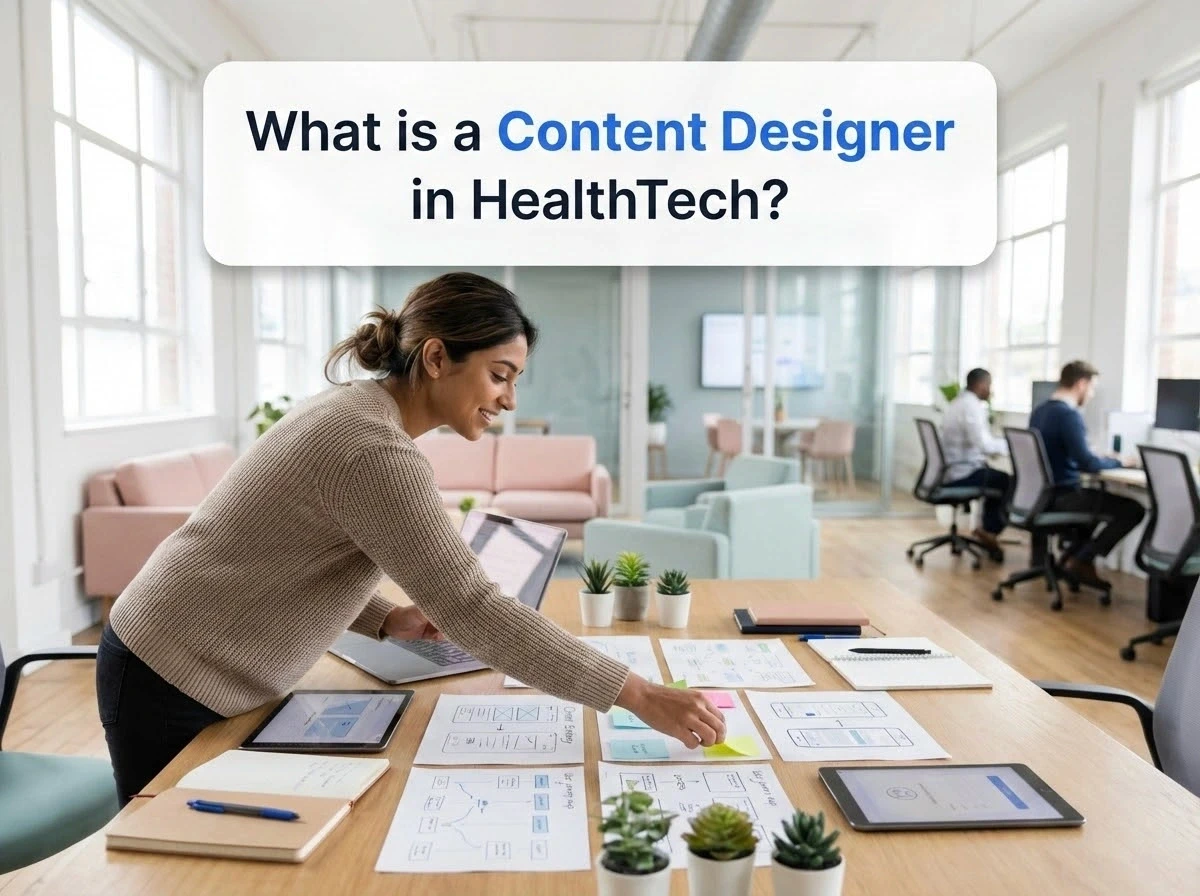
What is a Content Designer in HealthTech?
A Content Designer in HealthTech is the person accountable for how information is structured, written, and governed across a digital health product so that users can complete critical tasks safely, confidently, and with minimal friction. That might mean helping a patient understand a result, guiding a clinician through a workflow, or ensuring consent and privacy messaging is unambiguous at the point it matters.
This role exists because in HealthTech, "what the product says" is often inseparable from "what the product does". When people are unwell, stressed, time-poor, or making high-stakes decisions, unclear content becomes a product risk: it increases errors, support burden, drop-offs, and avoidable harm. A Content Designer owns decisions about language, information flow, and content quality across end-to-end journeys, working with design, product, engineering, research, clinical, legal, and compliance partners to ship content that holds up in the real world.
The value isn't in producing more words; it's in owning outcomes. A strong Content Designer is responsible for reducing misunderstanding, supporting safe action, and making complex health processes feel manageable without overpromising, oversimplifying, or drifting outside what the organisation can stand behind.
🔍 How this role differs in HealthTech
In many SaaS or consumer products, content design is primarily optimising for clarity, conversion, and brand trust. In HealthTech, those goals remain, but they sit inside tighter constraints and higher consequences. The content can influence medical decisions, escalate anxiety, trigger safeguarding concerns, or create risk if it implies clinical certainty where none exists.
HealthTech also tends to involve more sensitive data, more edge cases, and more moments where the user's context changes how content is interpreted (for example, reading something late at night, during treatment, or on behalf of someone else). That makes content decisions less about preference and more about safety, defensibility, and consistency across channels.
Organisationally, Content Designers in HealthTech usually sit within Product Design, Experience Design, or a dedicated Content Design/Content Strategy function, but they work "through" many teams. They are often a key interface between product squads and clinical/compliance stakeholders, translating policy, risk, and clinical intent into user-facing content patterns that teams can repeatedly apply.
🎯 Core responsibilities in HealthTech
Day to day, a Content Designer in HealthTech is accountable for making sure the user journey communicates the right information at the right time, in the right tone, with the right level of certainty. They shape how tasks are framed, how choices are explained, how errors are handled, and how the product supports users who are anxious, unwell, or unfamiliar with the system.
Their work is defined by constrained decision-making. They regularly balance clinical accuracy with comprehension, legal wording with usability, and speed of delivery with the obligation to be careful. They will often negotiate trade-offs: where a team wants to remove steps, they assess what must remain for informed consent; where stakeholders want to add detail, they protect the user from overload and keep the journey actionable.
Content Designers also carry quality accountability across release cycles. That includes creating patterns that scale (so content stays consistent as features expand), building review and governance workflows (so updates happen safely), and measuring whether content is working using evidence, without treating health outcomes as a copy experiment.
🧩 Skills and competencies for HealthTech
Core Skill | HealthTech specific requirement | Reason or Impact |
|---|---|---|
User-centred judgement | Make decisions for users who may be distressed, fatigued, or reading on behalf of others, while still meeting organisational constraints | Reduces misunderstandings and helps users take safe next steps when cognitive load is high |
Risk-aware communication | Know when language must be precise, when it must be cautious, and when it must direct users to appropriate care pathways | Prevents false reassurance, unsafe self-triage, and content that creates liability or harm |
Stakeholder leadership | Align product, clinical, legal, and compliance perspectives into one shippable content approach | Avoids endless review loops and ensures the product can stand behind what it tells users |
Information architecture thinking | Structure journeys and content models that remain coherent as services expand across conditions, cohorts, and channels | Protects consistency and reduces fragmentation that confuses users and increases support burden |
Accessibility and inclusion | Design content that works for varied literacy levels, disabilities, and language needs without diluting medical meaning | Improves equitable access and reduces the risk of excluding users who most need support |
Evidence-led iteration | Use research, service data, and observed errors to refine content patterns, not just tweak wording | Improves outcomes over time and creates a defensible rationale for content decisions |
Governance and lifecycle ownership | Build practical review, approval, and update mechanisms for content that must stay current and safe | Reduces drift, outdated advice, and inconsistent messaging across touchpoints |
💷 Salary ranges in UK HealthTech
Pay is driven less by "writing" and more by scope, risk and accountability. A Content Designer supporting a low-risk feature set will typically sit at a different range than someone owning end-to-end clinical journeys, consent flows, or high-impact communications. Location still matters, but so do product criticality, the maturity of the content function, the amount of stakeholder complexity, and whether the role carries governance responsibility across multiple teams.
Experience level | Estimated annual salary range | What drives compensation |
Junior | London & South East: £32,000–£42,000 | Supervised delivery, narrower journey ownership, lower-risk surfaces, limited governance responsibility |
Mid-level | London & South East: £42,000–£58,000 | Independent ownership of core journeys, stronger stakeholder influence, measurable improvements to comprehension and completion |
Senior | London & South East: £58,000–£78,000 | Leading complex, high-stakes flows (results, triage, consent), setting patterns, coaching others, handling ambiguity and risk trade-offs |
Lead | London & South East: £78,000–£100,000 | Cross-team ownership, content governance, operating model design, high leverage across portfolios, escalation point for risk and quality |
Head / Director | London & South East: £100,000–£140,000 | Function leadership, org-wide standards and assurance, hiring and capability building, accountable for content quality at scale and executive alignment |
Beyond base salary, total compensation often includes a performance bonus (more common in larger or later-stage organisations), equity or options (more common in startups and scale-ups), and enhanced pension contributions. On-call is not typical for Content Designers, but some organisations may offer additional compensation if the role participates in incident communications, regulated change windows, or urgent patient-facing updates. Variation tends to track product criticality, organisational maturity, and the intensity of governance and stakeholder load.
🚀 Career pathways
People enter HealthTech content design from adjacent roles such as UX writing, digital content, journalism, communications, service design, or clinical-adjacent education content, often after building a portfolio that shows they can simplify complex decisions without losing accuracy. Another common entry point is moving from content-heavy operational roles (support, onboarding, patient communications) into product teams, where the same judgement is applied earlier in the lifecycle.
Progression is most credible when it follows ownership. Early on, the role expands from writing screens to owning a whole journey; then from owning a journey to establishing patterns that multiple teams can reuse; then from patterns to governance, mentoring, and strategic alignment with clinical and compliance stakeholders. At senior levels, advancement depends on being able to scale quality: setting standards, reducing risk, improving outcomes, and making content a durable capability rather than a dependency on one person.
❓ FAQ
Do I need a clinical background to be a Content Designer in HealthTech?
No, but you do need the ability to work with clinical experts and translate clinical intent into user-safe language. Hiring teams often look for evidence you can handle ambiguity, ask good questions, and protect accuracy without turning the product into a leaflet.
What will my portfolio be assessed on for HealthTech roles?
Expect scrutiny on your decision-making: what you changed, why, what constraints you faced, and how you validated outcomes. Strong case studies show how you handled risk, consent, accessibility, and stakeholder disagreement, not just before-and-after copy.
Will I be expected to do on-call work in HealthTech content design?
Usually not, but it can happen indirectly if your product has urgent patient-facing updates or incident communications. If a role includes it, clarify expectations up front: frequency, decision rights, who signs off, and whether additional compensation applies.
🔎 Find your next role
Ready to apply your content judgement to work that matters? Search Content Designer roles on Meeveem and find a HealthTech team with the right scope and support.
You might also like