Published Date: December 17, 2025
Updated Date: December 17, 2025
What is a Computer Vision Engineer in HealthTech?
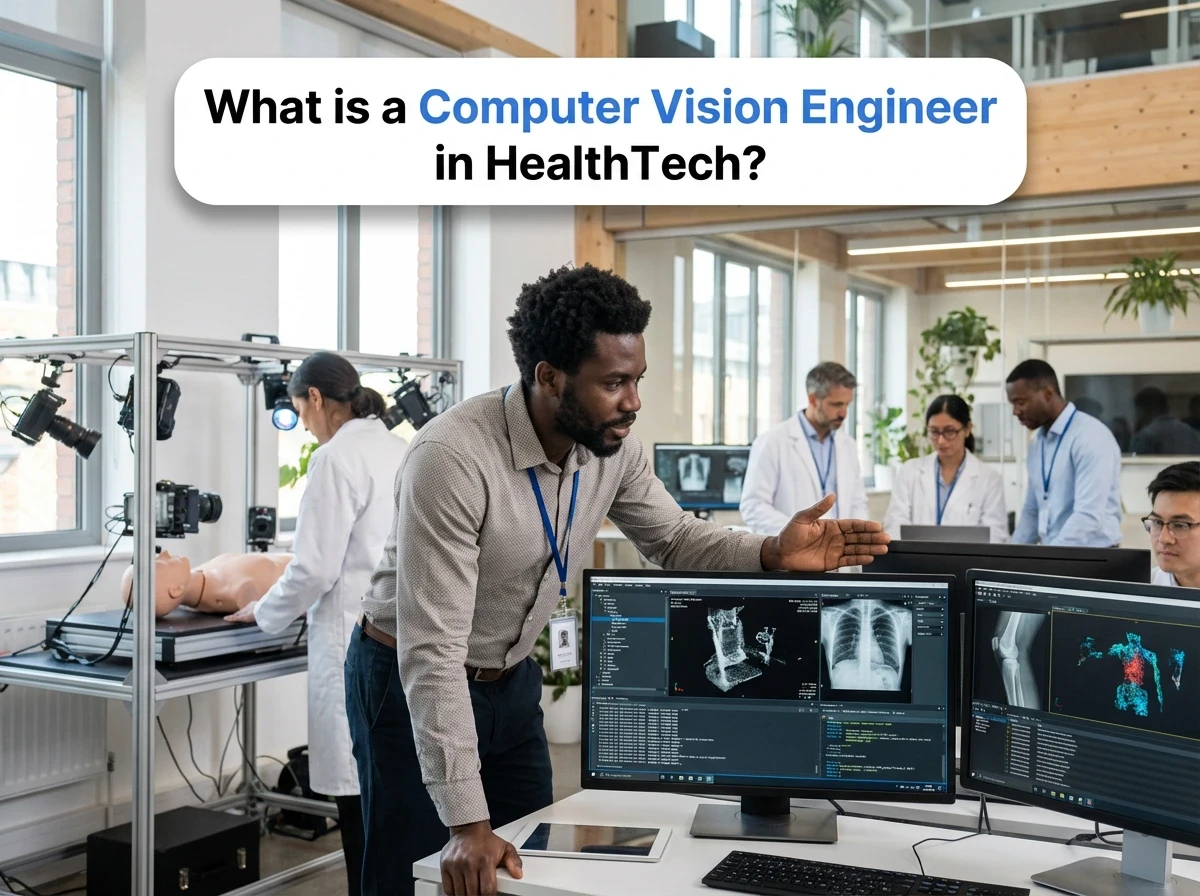
A Computer Vision Engineer in HealthTech takes responsibility for turning images and video (such as scans, microscope images, camera feeds, or device imagery) into reliable product behaviour that clinicians, patients, or operators can depend on. The job is not about "doing models"; it is about owning how visual intelligence performs in the real world, under clinical constraints, with imperfect data, and with safety, privacy, and auditability expectations that are materially higher than most industries.
This role exists because visual data is central to many healthcare workflows, yet "making it work in production" is disproportionately hard. Imaging protocols vary, equipment differs by site, labels can be sparse or ambiguous, and the cost of errors can be clinical harm, delayed care, or loss of trust. A Computer Vision Engineer is accountable for bridging research and reality: shipping capabilities that are validated, monitored, and maintainable over time, not just impressive in a notebook.
In most HealthTech organisations, the role sits within a product engineering group (often alongside ML engineering and platform), with tight working relationships to clinical, regulatory/quality, security, and operations functions. Where the product is regulated or safety-critical, the engineer's accountability expands to include evidence, traceability, and lifecycle discipline, not just performance.
🔍 How this role differs in HealthTech
In consumer tech or SaaS, computer vision often optimises experience: speed, convenience, engagement, or cost. In HealthTech, it frequently touches decisions that can change a patient pathway, influence a clinician's confidence, or interact with devices and workflows that must remain safe under stress. That shifts the centre of gravity from "best achievable accuracy" to "fit-for-purpose reliability", including how the system behaves at the edges: unusual anatomy, rare conditions, poor image quality, incomplete context, or shifts in data caused by new equipment or updated clinical processes.
Data sensitivity is also different. The work typically involves highly sensitive patient data, so access patterns, storage, logging, and model training pipelines are constrained by privacy and security expectations. Even when regulation is not the headline, the practical reality is that you will be asked to justify decisions, keep evidence of what changed and why, and design systems that can be supported and explained when something goes wrong.
Finally, the real-world impact changes how teams ship. Release cycles may include clinical review, operational readiness, and careful rollout design rather than "deploy and iterate quickly". A Computer Vision Engineer in HealthTech succeeds by balancing progress with safety, stakeholder confidence, and long-term maintainability.
🎯 Core responsibilities in HealthTech
Day-to-day, a Computer Vision Engineer in HealthTech is accountable for a chain of decisions: what the system should do, what it should explicitly not do, and how it should communicate uncertainty. The work usually starts with clarifying the clinical or operational objective (often discovering that the "obvious" metric is not the one that matters) and then designing a solution that can actually be used in a live workflow. That includes defining failure modes, setting acceptance criteria, and aligning with product and clinical stakeholders on what is safe and useful.
The role is also about engineering judgement under constraints. You may need to ship a model that is less "state of the art" but more stable, easier to validate, or more robust across hospitals and devices. You'll make trade-offs between performance and interpretability, latency and cost, automation and human review, and breadth of coverage versus confidence. In regulated or safety-sensitive contexts, you will spend meaningful time ensuring traceability: what data was used, what assumptions were made, how the model was evaluated, and how changes are controlled.
In production, ownership continues. You are expected to monitor real-world performance, investigate drift, manage incident response when outputs look wrong, and coordinate fixes without breaking clinical trust. Even when you are not formally "on-call", you are often one of the few people who can diagnose issues quickly because the intersection of data, model behaviour, and workflow is where most failures hide.
🧩 Skills and competencies for HealthTech
Core Skill | HealthTech specific requirement | Reason or Impact |
|---|---|---|
Problem framing | Translate clinical or operational goals into measurable system behaviour, including what "unsafe" looks like | Prevents shipping models that optimise the wrong objective and fail in real workflows |
Risk-based thinking | Treat false positives/negatives differently depending on downstream clinical action and escalation paths | Aligns model behaviour with patient safety and practical decision-making |
Data stewardship | Operate with strict access control, minimisation, and careful handling of identifiable or sensitive imagery | Reduces privacy risk and enables collaboration with security and governance teams |
Evaluation judgement | Build evaluations that reflect site variation, equipment differences, and real-world prevalence | Avoids "lab wins" that collapse when deployed across settings |
Robustness mindset | Design for image quality issues, protocol changes, and distribution shift as normal, not exceptional | Improves reliability and reduces operational disruption after rollout |
Communication under uncertainty | Explain confidence, limitations, and edge cases clearly to non-technical stakeholders | Builds trust and supports safe adoption without overselling capability |
Lifecycle discipline | Maintain evidence of changes, testing, and release decisions across iterations | Makes the system supportable, auditable, and safer to evolve over time |
Cross-functional leadership | Work effectively with clinicians, product, QA/regulatory, and operations without losing engineering clarity | Keeps delivery moving whilst respecting constraints that are unique to healthcare |
💷 Salary ranges in UK HealthTech
Compensation for a Computer Vision Engineer in UK HealthTech is driven less by the label and more by the scope of ownership: whether you own a clinical-grade capability end-to-end, whether you are accountable for production outcomes and incident response, and whether you are operating in a regulated or safety-critical environment. Location still matters, but so do factors like deployment footprint (single site vs multi-site), complexity of the imaging modality, expectation to mentor others, and the intensity of operational support (including any rota-style coverage).
Experience level | Estimated annual salary range | What drives compensation |
|---|---|---|
Junior | London & South East: £40,000–£55,000 | Strength of fundamentals, quality of shipped work, and ability to work safely with sensitive data under supervision |
Mid-level | London & South East: £55,000–£75,000 | Ownership of a component in production, evaluation quality, reliability work, and contribution to rollout readiness |
Senior | London & South East: £75,000–£105,000 | End-to-end responsibility for model performance in the field, leading trade-offs, mentoring, and handling incidents/drift |
Lead | London & South East: £100,000–£135,000 | Technical direction across multiple vision initiatives, standards for validation/monitoring, and accountability for outcomes across teams |
Head / Director | London & South East: £130,000–£180,000 | Strategy, governance, staffing, stakeholder management, and owning delivery risk across product lines and deployments |
Beyond base salary, HealthTech packages often include annual bonus (commonly tied to company and delivery goals), equity (more common in start-ups and scale-ups), and pension/benefits that can be meaningful in NHS-adjacent environments. On-call pay varies: many vision roles are not classic 24/7 ops, but where the product is used in time-sensitive workflows or supports clinical operations, compensation can include a formal on-call allowance or higher base to reflect operational accountability. Total compensation tends to rise with regulated constraints, clinical criticality, production incident ownership, and scarcity of relevant domain experience (especially medical imaging).
🚀 Career pathways
Entry routes are varied. Some engineers come from academic or industrial research in imaging, others from general software engineering or ML engineering roles where they've shipped production systems, and others from adjacent domains like robotics, security imaging, or industrial inspection. In HealthTech, the most credible "entry signal" is usually evidence that you can turn messy visual data into dependable product behaviour, through internships, published work that includes strong evaluation, or demonstrable production engineering.
Progression is primarily an expansion of ownership. Early on, you may own a model or pipeline component with close review. At mid-level, you're expected to take a feature from problem definition through evaluation and deployment support. At senior level, you become accountable for real-world performance and for making hard calls: when to delay release, how to design fallbacks, and how to respond when outcomes deviate from expectations.
Lead and Head/Director progression is not about doing more modelling. It's about setting standards for validation and monitoring, shaping the roadmap with clinical and product stakeholders, building teams that can sustain the system, and owning delivery risk across multiple deployments and partners.
❓ FAQ
Do I need medical imaging experience to get hired, or is strong computer vision enough?
Strong computer vision is often enough to enter, but you'll be evaluated on how you think about failure modes, evaluation design, and safe deployment. Demonstrating that you can learn the domain quickly (and that you won't optimise for a benchmark at the expense of real-world reliability) matters as much as prior modality experience.
How are Computer Vision Engineers assessed in interviews for HealthTech roles?
Expect a mix of practical engineering and judgement: designing an evaluation, discussing drift and monitoring, and explaining trade-offs under clinical constraints. Many teams also probe how you handle ambiguous labels, site variation, and how you'd communicate limitations to non-technical stakeholders.
Will I be on-call as a Computer Vision Engineer in HealthTech?
It depends on the product and deployment model. Some roles have minimal on-call, whilst others expect you to participate in incident response when models misbehave or data pipelines break. Even without a formal rota, candidates are often expected to show comfort owning production reliability and supporting critical users.
🔎 Find your next role
Ready to apply your computer vision skills to real clinical impact? Search Computer Vision Engineer roles in HealthTech on Meeveem.
You might also like