Published Date: January 6, 2026
Updated Date: January 6, 2026
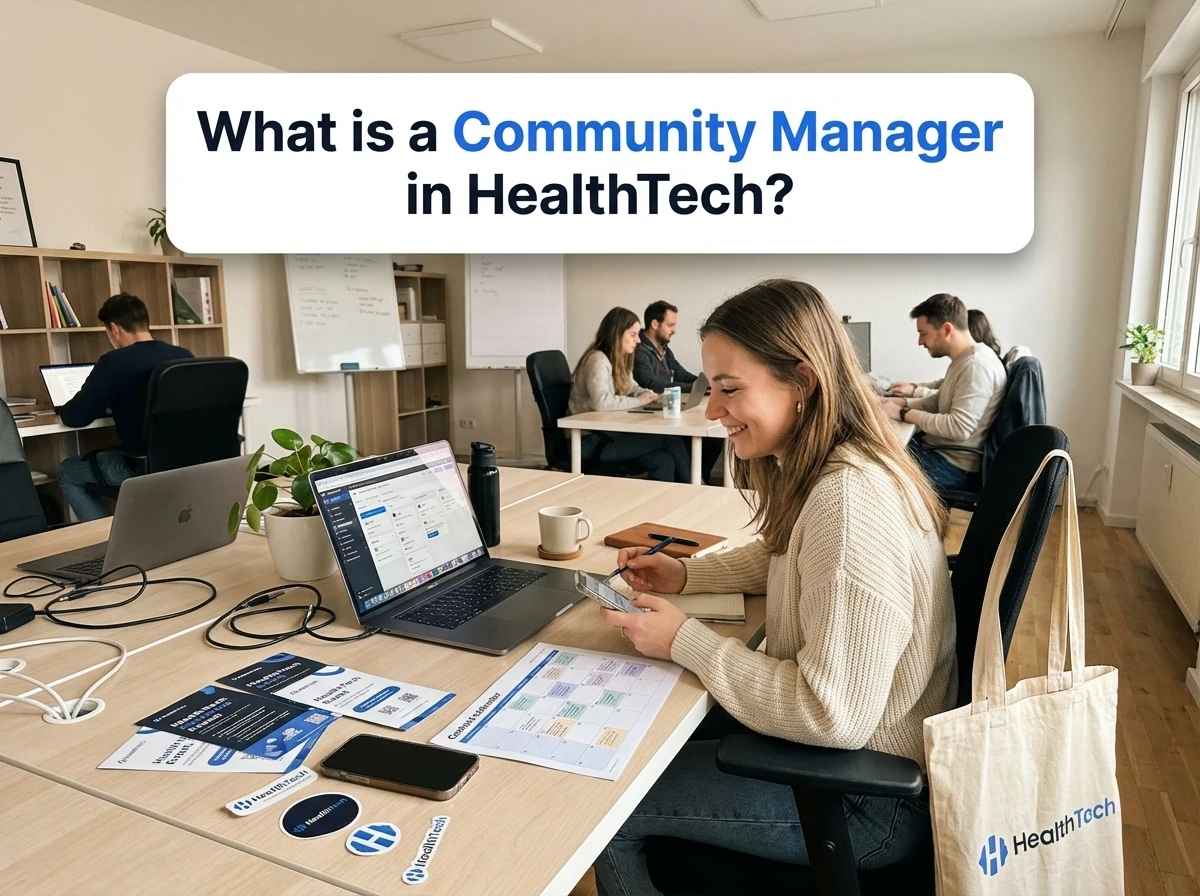
What is a Community Manager in HealthTech?
A Community Manager in HealthTech is responsible for building, protecting, and scaling a trusted space where patients, carers, clinicians, and health-interested users can safely connect around a product or service. That "space" might be a peer-support community, a condition-specific forum, a clinician network, a customer community for provider teams, or a hybrid of online groups and real-world events.
The role exists because HealthTech products live or die on sustained trust and outcomes, not just acquisition. Communities help people adopt behaviours, stay engaged over time, share practical knowledge, and feel supported. They also give the company an early-warning system for safety issues, misinformation, dissatisfaction, and emerging needs.
Before any tactics, the core responsibility is stewardship: setting and enforcing community standards, making judgement calls on sensitive situations, and ensuring the community's activity strengthens the product and brand without creating clinical, reputational, or safeguarding risk.
🔍 How this role differs in HealthTech
In many tech sectors, a community can be treated as a growth channel: a place to boost engagement, promote updates, and cultivate advocates. In HealthTech, it's still those things, but the tolerance for error is lower and the consequences are more real.
Health discussions can quickly drift into personal data, crisis situations, or advice-seeking that crosses into clinical territory. That changes what "good community" looks like: clarity over ambiguity, consistent enforcement over informal vibes, and careful escalation over fast takes. Community strategy is shaped by data sensitivity, user vulnerability, and the fact that harmful content can produce real-world impact.
HealthTech also tends to involve more stakeholders than typical consumer or B2B communities. A Community Manager often has to balance what patients want, what clinicians consider safe, what commercial teams need, and what internal governance will approve, without turning the community into a sterile helpdesk or a marketing channel users don't trust.
🎯 Core responsibilities in HealthTech
Day to day, the Community Manager owns the health of the community as a system: who joins, what they experience, what norms are reinforced, and what risks are prevented. They make decisions about how open or closed the space should be, what kinds of posts are allowed, what claims require intervention, and what "support" means in a product that sits close to healthcare.
They translate constraints into action. That might mean designing boundaries that keep discussions supportive without becoming medical advice, coaching internal experts to show up in ways that are helpful but compliant, and creating escalation paths for safeguarding concerns, potential adverse events, or threats to user safety. When trade-offs arise (growth versus safety, transparency versus privacy, speed versus accuracy), the Community Manager is often the person accountable for a defensible decision and the follow-through.
Just as importantly, they act as a bridge. They turn community signals into structured insight that product, clinical, customer success, and marketing teams can use, while protecting member trust by not treating people as "data points" or exposing personal stories inappropriately.
🧩 Skills and competencies for HealthTech
Core Skill | HealthTech specific requirement | Reason or Impact |
|---|---|---|
Risk judgement | Ability to distinguish peer support from clinical advice, and intervene early when content could cause harm | Reduces patient safety and reputational risk while keeping the community genuinely useful |
Safeguarding mindset | Comfort with sensitive situations, clear escalation pathways, and calm handling of crisis signals | Protects vulnerable users and prevents the community from becoming an unmanaged crisis channel |
Privacy-first communication | Strong instinct for minimising personal data exposure and guiding users to safer sharing patterns | Preserves trust and prevents avoidable data leakage in a high-sensitivity environment |
Policy and governance fluency | Can operationalise internal guidelines into enforceable rules and consistent moderation decisions | Keeps the community scalable and defensible as it grows and as scrutiny increases |
Stakeholder management | Aligns clinical, product, support, and marketing needs without diluting safety or trust | Prevents conflicting messages and reduces internal friction that users quickly notice |
Community systems thinking | Designs norms, onboarding, moderator support, and feedback loops rather than "posting more" | Builds a resilient community that doesn't collapse when volume, controversy, or demand spikes |
Measured empathy | Empathy with boundaries: supportive tone without over-promising, diagnosing, or becoming a therapist | Keeps interactions safe, sustainable for staff, and appropriate for a health context |
Insight synthesis | Converts qualitative community narratives into clear themes, risks, and product opportunities | Makes community work legible to leadership and actionable for product and service design |
💷 Salary ranges in UK HealthTech
Salary varies less by the word "community" and more by the operating risk and the scope you own. Compensation typically rises with: responsibility for safety escalation and moderation policy, exposure to clinically sensitive topics, line management, ownership of strategy (not just execution), and how directly the community influences retention, outcomes, or regulated delivery. Location still matters, with London and South East generally paying more, but senior roles can narrow the gap when remote hiring is genuinely national.
Experience level | Estimated annual salary range | What drives compensation |
Junior | London & South East: £28,000–£35,000 | Usually execution-heavy roles supporting moderation, member responses, and operations; higher pay when the community is high-volume or safety-sensitive |
Mid-level | London & South East: £35,000–£45,000 | Ownership of a channel or programme area, more complex escalations, tighter cross-team working with product/support/clinical stakeholders |
Senior | London & South East: £45,000–£60,000 | Accountable for outcomes (retention, activation, sentiment), writes or owns policy, leads incident response patterns, may manage moderators or freelancers |
Lead | London & South East: £60,000–£75,000 | Runs community strategy end-to-end, manages a team, sets standards, influences roadmap, and is trusted to handle reputational and safety-critical situations |
Head / Director | London & South East: £75,000–£110,000 | Multi-community or multi-product scope, budget ownership, organisational accountability for trust and safety posture, executive stakeholder influence, and measurable business impact |
Beyond base salary, total compensation often includes performance bonus (more common where community is tied to growth or retention), equity (more common in venture-backed HealthTech), and enhanced benefits. On-call allowances are not universal for Community Managers, but can appear where there is a 24/7 peer-support environment, safeguarding coverage expectations, or incident-response responsibilities; when present, they meaningfully shift take-home pay. The biggest drivers of variation are scope (one community vs a portfolio), clinical sensitivity and escalation load, team size, and how directly the function is measured against revenue retention, safety metrics, or outcomes.
🚀 Career pathways
Common entry points include social or content roles in regulated environments, customer support or patient services roles, clinical admin or care navigation roles that develop strong boundary-setting, and community roles in adjacent sectors where moderation and crisis handling are core. What matters early is proving you can run a safe, consistent operation: clear decisions, strong documentation, and reliable escalation.
As responsibility expands, you move from "being present" in the community to designing the system around it: standards, onboarding, moderator programmes, measurement, and cross-functional routines that convert community insight into product and service change. Progression is strongest when you can demonstrate ownership of outcomes: reducing harmful content, improving retention or activation, building trusted clinician participation, or creating repeatable programmes that scale without compromising safety.
At the top end, the role becomes organisational: setting the trust model for the company's relationship with patients and clinicians, shaping how public-facing conversations are governed, and ensuring community is an asset rather than a liability.
❓ FAQ
Do HealthTech Community Manager interviews test safety judgement, not just engagement skills? Yes. Expect scenarios about boundary-setting, misinformation, and what you'd escalate versus handle in-channel. Strong candidates explain how they'd act quickly while staying consistent with policy and protecting user trust.
Will I be expected to handle mental health or safeguarding situations as part of the job? Sometimes, depending on the product and audience. Even when you're not "on-call," you may need to follow defined escalation processes and know how to respond calmly, signpost appropriately, and document incidents.
How do I show I can work with clinicians and still keep the community human? Demonstrate that you can translate clinical constraints into user-friendly rules and tone, and that you can coach subject-matter experts to participate safely. Hiring teams look for candidates who protect safety without turning every interaction into a scripted response.
🔎 Find your next role
Ready to take ownership of trust, safety, and engagement in digital health? Search Community Manager roles on Meeveem.
You might also like