Published Date: December 18, 2025
Updated Date: December 18, 2025
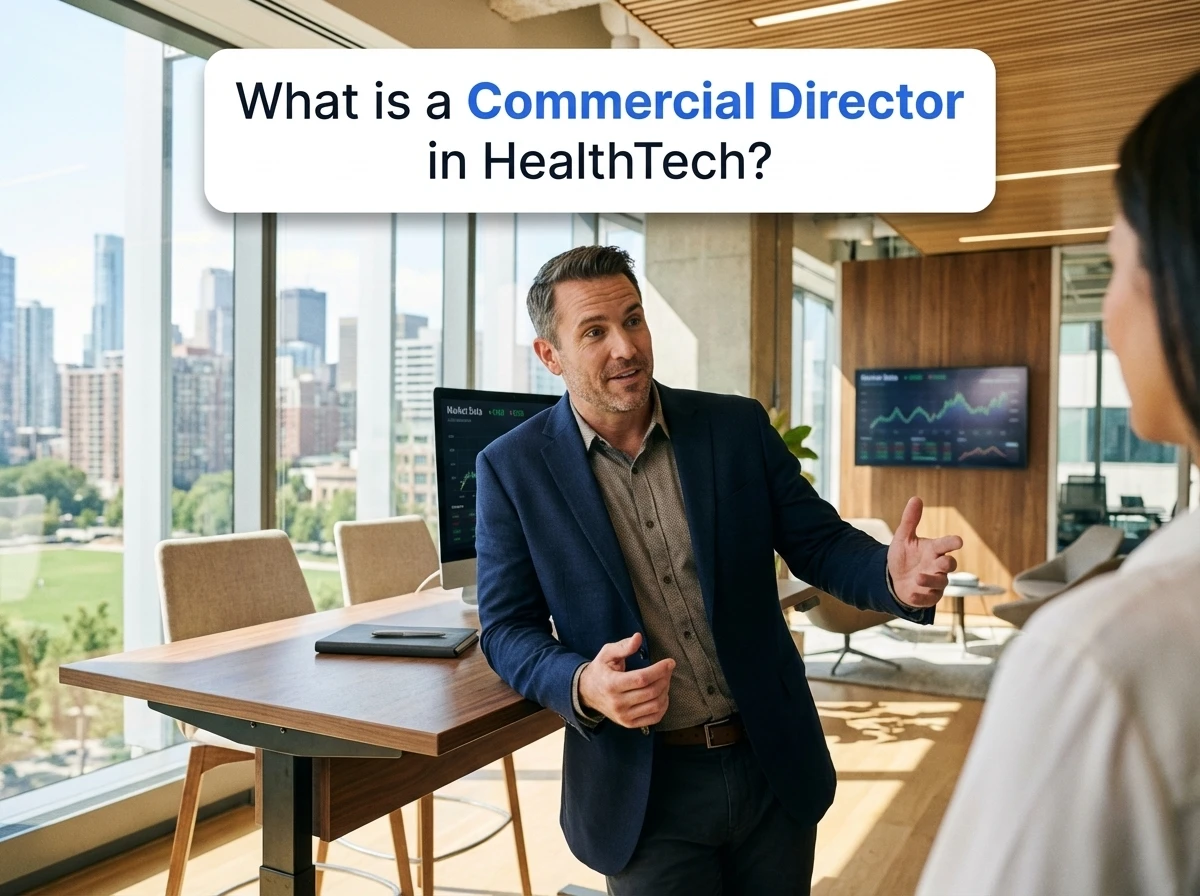
What is a Commercial Director in HealthTech?
A Commercial Director in HealthTech is the senior leader responsible for turning a healthcare technology product or service into a sustainable, scalable business. In practice, that means owning how revenue is created and protected: which customers to pursue, what outcomes the company promises, how it prices and contracts, and how it structures partnerships so delivery and margin remain viable.
This role exists because HealthTech growth is rarely "just sales". Buyers are cautious, procurement is formal, data and clinical risk are real, and value must be evidenced over time, not simply asserted in a pitch deck. A Commercial Director provides a single point of ownership for commercial performance across those constraints, ensuring the organisation can win business responsibly, fulfil obligations, and expand without creating hidden operational or regulatory debt.
🔍 How this role differs in HealthTech
In many tech sectors, commercial strategy can optimise primarily for speed: quick iterations, rapid expansion, and aggressive discounting to capture market share. HealthTech changes the equation. Decisions are shaped by higher perceived risk, longer evaluation cycles, stricter contracting, and the reputational cost of getting it wrong, because the product often touches patient pathways, clinical operations, or sensitive data.
As a result, a Commercial Director in HealthTech is typically closer to governance than their counterpart in consumer tech, and closer to delivery realities than their counterpart in "pure-play" SaaS. They must be credible with risk, information governance, and service constraints, because the deal you sign has to survive clinical scrutiny, implementation friction, and procurement transparency. The job is less about optimism and more about precision: setting expectations that the business can actually meet, then defending those expectations through disciplined contracting and lifecycle management.
🎯 Core responsibilities in HealthTech
Day to day, the Commercial Director is accountable for shaping demand into contracts that the organisation can deliver without compromising outcomes, safety, or trust. They sit at the point where market ambition meets operational truth: deciding which segments are worth pursuing, which deal structures are sustainable, and which promises create unacceptable exposure.
Much of the work is decision-making under constraint. You might be balancing a lower price against a longer contract term that creates stability, or accepting implementation complexity to win a strategic reference account while protecting the business with phased milestones and clear acceptance criteria. In HealthTech, commercial decisions are often inseparable from delivery and assurance: service levels, data processing obligations, clinical oversight, incident response expectations, and procurement rules can all shape what "good revenue" looks like.
A Commercial Director is also responsible for commercial rhythm inside the organisation: ensuring pipeline quality is real, forecasting is defensible, and growth plans don't outpace the company's ability to onboard, support, and retain customers. In scaling environments, they often translate between executive expectations and frontline constraints, making hard calls early so the organisation doesn't pay for them later in churn, disputes, or stalled deployments.
🧩 Skills and competencies for HealthTech
Core Skill | HealthTech specific requirement | Reason or Impact |
|---|---|---|
Commercial ownership | Comfort owning outcomes across the full contract lifecycle, including implementation realities, not just signed value | Prevents "paper wins" that later fail in delivery, causing churn, reputational harm, or contract disputes |
Contract and risk judgement | Ability to assess operational, data, and service risks in contract terms and negotiate proportionate protections | HealthTech contracts can carry stronger assurance expectations; poor judgement can create unbounded liabilities or impossible SLAs |
Value articulation | Framing value in terms that withstand scrutiny (outcomes, efficiency, adoption, pathway impact) rather than generic ROI claims | Buyers often need defensible benefit cases; weak articulation slows procurement and undermines stakeholder confidence |
Stakeholder navigation | Managing multi-stakeholder buying groups with competing incentives and governance steps | Healthcare decisions rarely sit with one persona; misalignment can stall deals late or dilute adoption post-sale |
Forecasting discipline | Building forecasts based on evidence and stage-gated proof, not optimism or single-thread relationships | Long cycles and formal approvals make accurate forecasting harder and more important for hiring and cash planning |
Pricing and packaging judgement | Designing pricing that matches budget structures, implementation load, and ongoing service cost to serve | Mispriced deals are amplified by onboarding and support intensity; fixing later is difficult in constrained environments |
Delivery-commercial alignment | Translating delivery constraints into commercial commitments (timelines, scope boundaries, resourcing assumptions) | Protects delivery teams and keeps customer expectations realistic, improving renewals and references |
Ethical decision-making | Recognising when commercial pressure conflicts with appropriate use, safety expectations, or trust | HealthTech success depends on credibility; short-term wins that erode trust are costly and hard to reverse |
💷 Salary ranges in UK HealthTech
Commercial Director pay in HealthTech tracks scope and accountability more than title alone. The biggest drivers are the size and complexity of the revenue number you own, the maturity of the go-to-market motion (startup build vs scale-up optimisation vs enterprise expansion), and the level of risk embedded in what you sell (implementation intensity, data sensitivity, service obligations, and contract exposure). Location still matters, especially for leadership roles concentrated around London and the South East, but compensation can also swing based on whether the role is heavily new-business, heavily partnerships/procurement, or broad "own the whole revenue engine" leadership.
Experience level | Estimated annual salary range | What drives compensation |
Junior | London & South East: £45,000–£60,000 | Usually supports commercial operations, bid work, or account support; limited P&L exposure; smaller deals and lower risk ownership |
Mid-level | London & South East: £60,000–£85,000 | Manages meaningful accounts or a defined segment; begins owning renewals/expansion outcomes; greater responsibility for forecast and contract detail |
Senior | London & South East: £85,000–£115,000 | Ownership of larger deals and more complex buying groups; higher expectation of independent judgement on pricing, terms, and deal strategy |
Lead | London & South East: £110,000–£140,000 | Leads a function or a major region/segment; accountable for target delivery and team performance; more exposure to board-level reporting and commercial governance |
Head / Director | London & South East: £130,000–£180,000 | Full accountability for commercial performance across functions or a major line of business; complex contracting and delivery alignment; strategic partnerships; higher reputational and execution risk |
Typical add-ons depend on whether the role is measured like a revenue leader or like a general executive. Many HealthTech Commercial Director roles include a performance bonus (often tied to revenue, margin, bookings, renewals, or a balanced scorecard). Equity is more common in venture-backed businesses and can be a meaningful part of total compensation, especially where base is kept tighter to preserve burn. On-call allowance is not usually a standard feature for commercial leadership, but some organisations expect senior coverage for escalations (major incidents, key account issues, or contractual service events), which can influence pay where availability expectations are explicit. Total compensation also moves with deal size, commission/OTE structure (if applicable), and the cost-of-failure: the more a business depends on a small number of high-stakes contracts, the more it pays for proven judgement.
🚀 Career pathways
Most Commercial Directors in HealthTech don't start with the title; they accumulate ownership. Common entry points include B2B sales, account management, partnerships, consulting, procurement-facing roles, or commercial operations, often in adjacent regulated sectors before moving into healthcare. Early progression tends to come from becoming the person trusted to close complex deals without creating downstream problems: you don't just "win" contracts; you win contracts that deliver.
As responsibility expands, the role shifts from individual execution to system design. You move from owning accounts to owning a segment, then to shaping pricing, packaging, and contracting standards, then to leading teams and setting the operating rhythm (forecasting, performance management, and cross-functional alignment). The final step into Head/Director scope is usually marked by being accountable for the commercial number end-to-end: making hard prioritisation calls, building a team structure that scales, and representing commercial risk and opportunity at exec level.
❓ FAQ
Do HealthTech Commercial Director roles usually own Sales only, or the full revenue engine?
It varies by company stage. In smaller HealthTech businesses, the Commercial Director often owns Sales, Partnerships, and Customer Success outcomes because the organisation needs one accountable owner for the whole revenue lifecycle. In larger organisations, responsibilities may split, with the role focused on a region, product line, or strategic accounts.
What will interviews test beyond "can you sell"?
Expect deep probing on judgement: pricing trade-offs, contract risk, handling long procurement cycles, and how you protect delivery while still hitting targets. Candidates are often evaluated on how they qualify opportunities, how they forecast with evidence, and how they structure deals that can survive implementation.
If I'm coming from SaaS, what's the biggest adjustment I should prepare for?
You'll need to be more precise about delivery assumptions, assurance expectations, and stakeholder complexity, because buyers will test credibility harder and move slower. Demonstrating you can work within governance, build trust, and still create momentum is often more persuasive than pure "hunter" energy. If the organisation expects escalation coverage for key accounts, clarify availability expectations early so it doesn't become an unspoken part of the job.
🔎 Find your next role
Ready to take ownership of growth in HealthTech? Search Commercial Director roles on Meeveem and find a scope that matches your strengths.
You might also like