Published Date: January 6, 2026
Updated Date: January 6, 2026
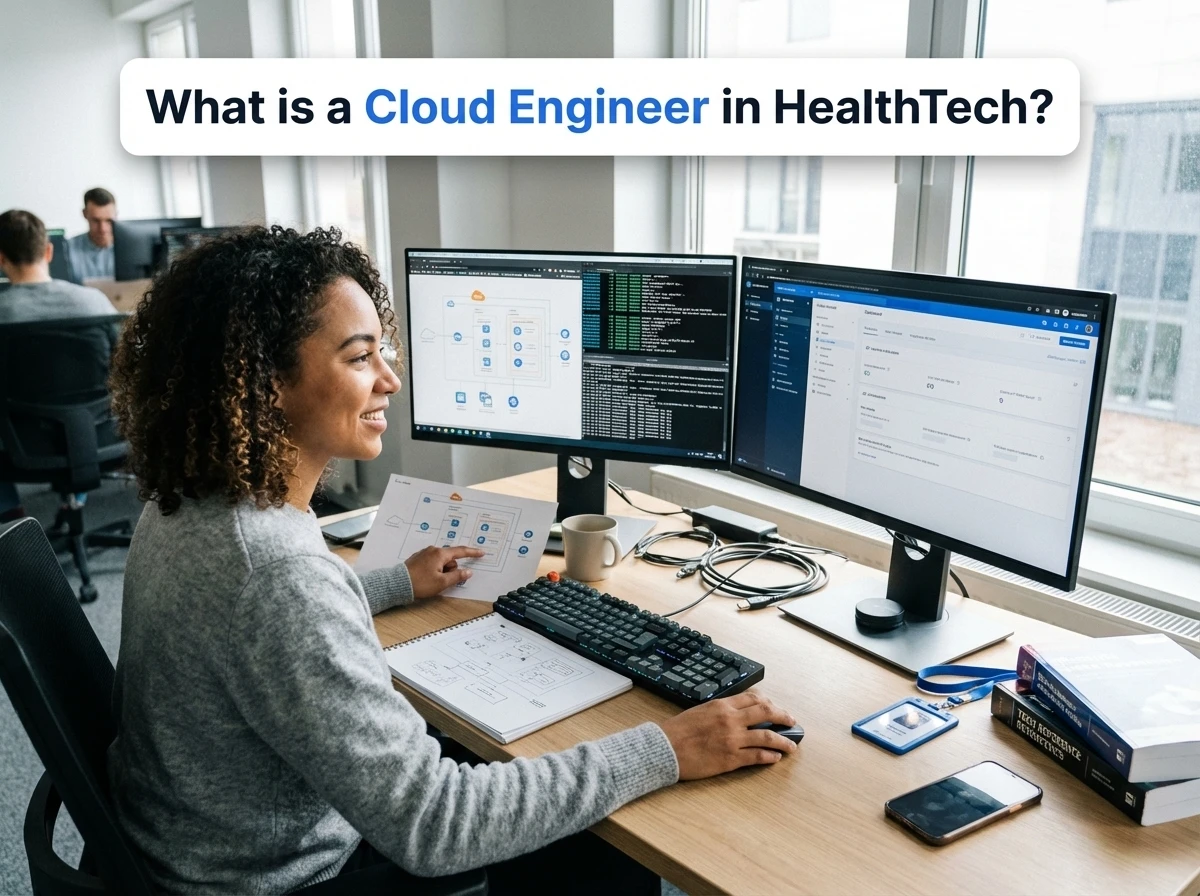
What is a Cloud Engineer in HealthTech?
A Cloud Engineer in HealthTech is responsible for the reliability, security, and cost-effective operation of cloud environments that power patient-facing and clinician-facing products, internal clinical platforms, and data services. They own the infrastructure foundations: identity, networking, compute, storage, monitoring, backup, and access controls. Their work ensures the organisation can ship healthcare software safely and keep it running when it matters most.
This role exists because HealthTech systems are rarely "just software." They are services that must remain dependable under real-world pressure. Outages disrupt care pathways, data handling must be provably controlled, and changes must be made in a way that can be explained, audited, and repeated. A Cloud Engineer is the person (or part of the team) responsible for making those constraints workable by turning them into operating standards, guardrails, and resilient platforms that product and clinical teams can rely on.
In practice, cloud engineering in HealthTech is about accountable ownership. When an incident occurs, when a supplier integration fails, when a cost spike appears, or when a compliance requirement changes, this role is expected to lead the technical response and leave the estate in a demonstrably better, safer state afterwards.
🔍 How this role differs in HealthTech
In many tech sectors, cloud engineering can prioritise speed of iteration and optimisation for scale. In HealthTech, the same engineering instincts apply, but the decision-making is shaped by a different risk profile: sensitive data, higher expectations of continuity, and a stronger need to show control rather than just claim it.
That difference shows up in everyday choices. You may accept occasional downtime in a consumer product. In HealthTech, downtime has operational consequences that ripple into appointments, triage, and service delivery. You may tolerate looser access patterns in early-stage SaaS. In HealthTech, permissions, auditability, and traceability become core design inputs. Vendor choices, architecture patterns, and rollout strategies are more likely to be constrained by governance, assurance processes, and the need to avoid "unknown unknowns" in production.
The result is a role that blends platform ownership with operational maturity: more emphasis on change control, incident management, least-privilege access, data boundaries, and resilience planning, because the organisation needs confidence that systems behave predictably under stress.
🎯 Core responsibilities in HealthTech
Day to day, a Cloud Engineer in HealthTech is accountable for keeping cloud environments fit for clinical and business use (stable, secure, and economical) whilst enabling delivery teams to move forward without taking unacceptable risks. That usually means being the person who decides how environments are segmented, how identities and permissions are managed, how connectivity is controlled, and how workloads are deployed so that failures are contained rather than contagious.
A typical week involves balancing competing pressures. Product teams want faster pathways to ship. Security and governance need evidence of control. Operations need fewer surprises. Finance needs predictable spend. The Cloud Engineer makes those trade-offs concrete by choosing when to standardise, when to introduce guardrails, when to automate, and when to slow down because the blast radius is too large.
In HealthTech, incident response is also part of the accountability. When something degrades, the expectation is not only to restore service quickly, but to improve observability, harden the design, and adjust runbooks so the same failure mode is less likely to recur. Over time, the role becomes a steady force for reliability: turning recurring pain into engineered outcomes (measurable uptime, controlled access, known recovery paths, and an environment other teams can trust).
🧩 Skills and competencies for HealthTech
Core Skill | HealthTech specific requirement | Reason or Impact |
|---|---|---|
Reliability ownership | Treat availability, recoverability, and safe degradation as product requirements, not operational niceties | Healthcare workflows don't pause politely. Resilient design reduces operational harm when systems are under load or partially failing |
Security judgement | Apply least-privilege access and defensible controls without blocking essential clinical operations | The goal is secure enablement. Poor security design either increases risk or forces unsafe workarounds |
Governance and auditability | Build systems so access, changes, and data flows can be evidenced and explained | HealthTech often needs provable control, not just best-effort intentions. Audit-ready platforms reduce delivery friction later |
Risk-based change management | Calibrate rollout strategy, approvals, and safeguards to clinical criticality and system blast radius | Over-control slows delivery, under-control causes incidents. Risk-based practice keeps both safety and momentum |
Cost accountability (FinOps mindset) | Optimise for predictable spend and clear ownership of cost drivers across environments | HealthTech budgets can be constrained and scrutiny is high. Cost clarity prevents "surprise bills" becoming a governance issue |
Stakeholder communication | Translate technical constraints into decisions that product, ops, and security can commit to | Cloud engineering choices shape delivery capacity. Clear decision framing prevents stalemates and misaligned expectations |
Incident leadership | Run calm, structured response and leave behind durable fixes: monitoring, runbooks, and design improvements | The sector rewards engineers who reduce repeat incidents and strengthen operational confidence over time |
💷 Salary ranges in UK HealthTech
Cloud Engineer pay in UK HealthTech is most strongly driven by the size and criticality of the platform you own, the operational burden (especially out-of-hours expectations), and the degree to which you are accountable for security and governance outcomes rather than only implementation. Location still matters, but in HealthTech the premium is often tied to risk and responsibility: handling sensitive workloads, building resilient foundations, and supporting services that can't tolerate prolonged disruption.
Experience level | Estimated annual salary range | What drives compensation |
Junior | London & South East: £40,000–£50,000 | Whether you're operating production systems vs supporting delivery; exposure to on-call; ability to work within governance processes with supervision |
Mid-level | London & South East: £55,000–£70,000 | Independent ownership of environments; ability to design guardrails, improve reliability, and reduce incident load; depth in identity, networking, and monitoring decisions |
Senior | London & South East: £72,000–£95,000 | Accountability for platform standards and cross-team enablement; leading incident response; shaping governance, resilience, and cost controls for regulated workloads |
Lead | London & South East: £90,000–£120,000 | Scope across multiple products or a shared platform; setting engineering direction; ownership of operational outcomes (SLAs/SLOs), change control, and stakeholder alignment |
Head / Director | London & South East: £120,000–£170,000 | Organisation-wide accountability: cloud strategy, governance model, budget control, supplier management, audit readiness, and building teams that can operate safely at scale |
Beyond base salary, total compensation commonly includes an on-call/rota allowance where the role supports business-critical services out of hours, plus performance bonus in some private HealthTech organisations. Equity is more common in venture-backed companies, typically increasing with seniority. The biggest drivers of variation are on-call intensity and frequency of call-outs, the clinical criticality of the systems you support, the regulatory and assurance burden you personally carry, and whether the role is primarily "build" (platform enablement) or "run" (operational ownership with direct service accountability).
🚀 Career pathways
Entry points into HealthTech cloud engineering are often practical rather than linear. Many people come from infrastructure engineering, IT operations, or sysadmin backgrounds and move into cloud through ownership of hybrid environments, migrations, and identity/networking modernisation. Others arrive via software engineering or DevOps routes, expanding their responsibility from application delivery into platform reliability, security controls, and operational excellence.
Progression is mainly an expansion of ownership. Early roles focus on executing changes safely and learning how healthcare constraints shape design. Mid-level engineers begin to own environments end to end (deployments, monitoring, access patterns, and cost drivers) whilst contributing to incident response and improvements. Senior engineers are trusted to make hard calls: how to segment systems, how to reduce blast radius, when to standardise, and how to prove control without paralysing delivery.
Lead and Head/Director progression happens when you can scale those outcomes through others: setting standards that teams actually adopt, building a platform roadmap tied to patient and operational risk, and creating an operating model where reliability and security are continuous properties of the system, not heroic efforts during incidents.
❓ FAQ
Do HealthTech Cloud Engineer roles usually include on-call, and how intense is it?
Often, yes, especially when you support patient-facing services, clinical operations, or shared platforms. Intensity varies widely: some roles are low-frequency escalation cover, others involve regular call-outs. Ask about rota size, historical incident volume, and what "good" looks like for reducing pages over time.
What will I be assessed on in interviews beyond cloud tools?
Expect evaluation on judgement: how you handle risk, make trade-offs under constraints, and communicate decisions to non-specialists. You may be asked to walk through an incident, explain how you'd design for recovery, or describe how you'd implement access controls that don't block clinical work.
I'm coming from general SaaS. What's the biggest adjustment in HealthTech?
The biggest shift is learning to treat auditability, change control, and data boundaries as first-class requirements. You'll still automate and move fast, but you'll be expected to prove what changed, who has access, and how the system behaves under failure, because the consequences of ambiguity are higher.
🔎 Find your next role
Ready to take ownership of cloud reliability and security in healthcare? Search Cloud Engineer roles on Meeveem.
You might also like