Published Date: December 30, 2025
Updated Date: December 30, 2025
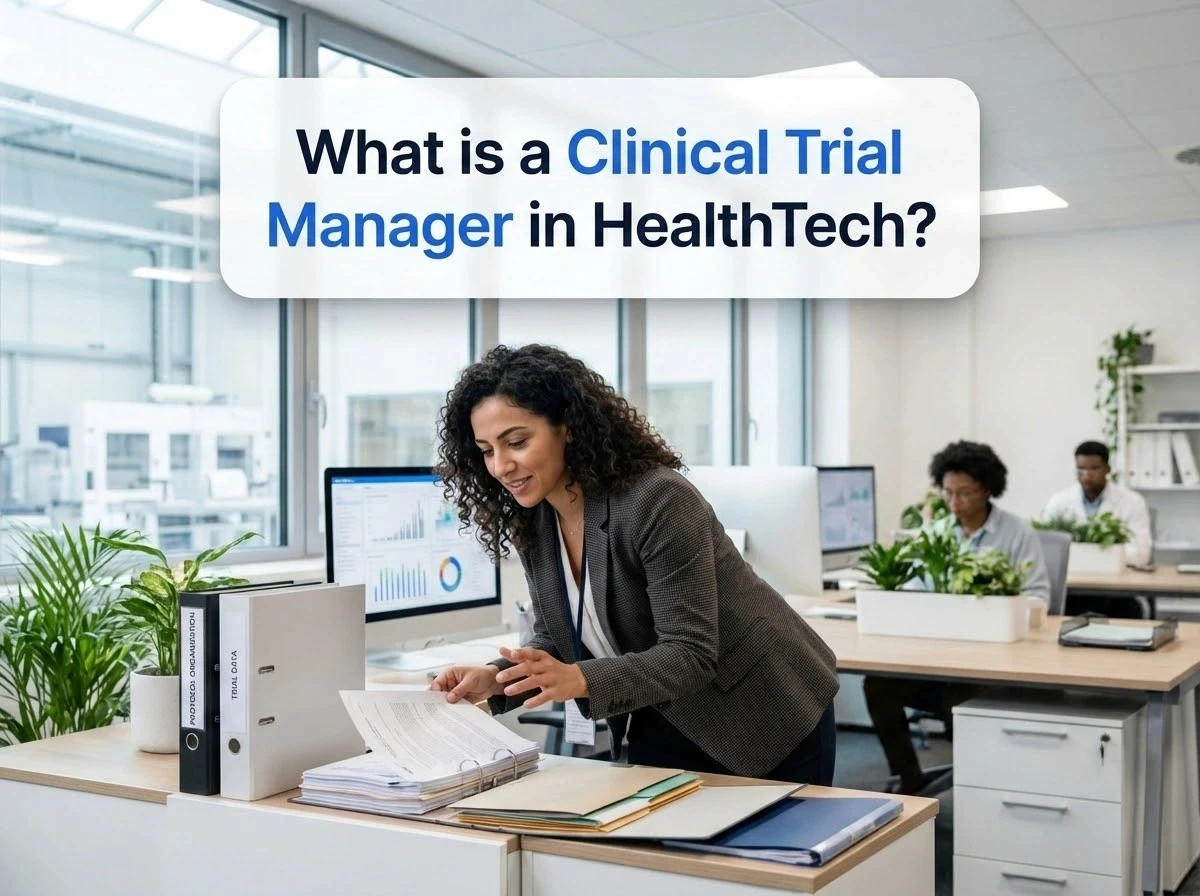
What is a Clinical Trial Manager in HealthTech?
A Clinical Trial Manager in HealthTech is responsible for turning a clinical study plan into a controlled, auditable reality so a product team can generate credible clinical evidence without compromising patient safety, data integrity, timelines, or regulatory expectations. In practice, they own the operational delivery of a study end to end: coordinating sites, vendors, internal stakeholders, and governance so the trial runs the way it was designed and can stand up to scrutiny.
This role exists because "building" a health product is not the same as proving it works and is safe in real-world conditions. Clinical evidence requires disciplined execution across many moving parts: ethics approvals, site readiness, training, monitoring, safety reporting, protocol deviations, data quality, and close-out. A Clinical Trial Manager sits at the centre of that system and is responsible for outcomes: whether the trial delivers valid results, on time, within budget, and in line with the obligations of a regulated environment.
In HealthTech specifically, this accountability often extends beyond classic pharma-style trials into digitally enabled studies, device and diagnostics evaluations, and hybrid/remote workflows, where operational decisions directly affect participant experience, data capture, and the credibility of evidence used for commercial and clinical adoption.
🔍 How this role differs in HealthTech
In many tech sectors, delivery risk is largely commercial: you can ship, learn, and iterate when something underperforms. In HealthTech, the tolerance for ambiguity is lower because decisions can affect patient safety, clinical workflows, and downstream regulatory or reimbursement narratives. That changes what "good execution" means: it's not just speed, it's controlled speed. Progress that remains defensible when audited or clinically challenged.
HealthTech trial operations also tend to be more data-sensitive. You're working with health data flows, consent boundaries, and multi-party systems (sites, platform vendors, labs, device logistics, ePRO tools). As a result, the Clinical Trial Manager's work is as much about risk management and governance as it is about project coordination.
Finally, HealthTech studies can expose a different kind of operational complexity: digital product updates, device versioning, training burden for clinicians and participants, and variability in how real-world settings adopt new workflows. The Clinical Trial Manager becomes the person who protects the study's scientific intent while navigating these realities.
🎯 Core responsibilities in HealthTech
Day to day, a Clinical Trial Manager is the owner of trial delivery, making sure the study is set up correctly, runs predictably, and closes cleanly with evidence the organisation can trust. That starts with translating the protocol into an operational plan that sites and vendors can actually execute, then holding the system together as reality inevitably diverges from the plan.
In HealthTech, decisions often arrive as trade-offs: a site wants a workflow change to reduce burden, the product team wants to deploy an update, recruitment is slower than forecast, or data quality is inconsistent because participants engage differently with digital tools. The Clinical Trial Manager decides what can be adjusted, what must be escalated, and what cannot change without jeopardising scientific validity or compliance. They manage performance through metrics and oversight, but their real value is judgement: knowing when a small operational compromise becomes a material risk.
They also act as a practical bridge between clinical and product mindsets. Clinical teams optimise for participant safety, protocol fidelity, and defensible evidence. Product teams optimise for usability and iteration. The Clinical Trial Manager ensures the trial doesn't become either a rigid academic exercise that can't recruit, or a fast-moving product experiment that can't be relied upon.
🧩 Skills and competencies for HealthTech
Core Skill | HealthTech specific requirement | Reason or Impact |
|---|---|---|
Accountability for delivery | Owns end-to-end study execution across sites, vendors, and internal teams, including readiness, oversight, and close-out | Prevents "shared responsibility" gaps that lead to delays, non-compliance, or unusable evidence |
Risk-based judgement | Prioritises controls where patient safety, data integrity, and auditability are most exposed (including digital workflows) | Reduces avoidable protocol deviations and protects the credibility of outcomes under scrutiny |
Stakeholder leadership | Leads without relying on hierarchy, aligning clinicians, operations, product, data, and external partners | Keeps the trial coherent when incentives conflict and timelines tighten |
Operational precision | Maintains disciplined documentation, version control, and operational traceability in fast-moving environments | Enables defensible decision-making, smoother audits, and fewer surprises at close-out |
Communication under constraints | Communicates clearly about trade-offs, changes, and escalations across technical and clinical audiences | Speeds up decisions while ensuring implications are understood and owned |
Vendor and site oversight | Holds CROs, sites, and specialist vendors to quality and timeline expectations with practical governance | Improves consistency across locations and reduces variability that can distort results |
Ethics and participant-centred thinking | Designs operational choices around participant burden, consent boundaries, and real-world engagement | Improves retention and data completeness without compromising ethical standards |
💷 Salary ranges in UK HealthTech
Clinical Trial Manager pay in UK HealthTech is shaped by what you are accountable for, not just how long you've worked in trials. The biggest drivers are: trial phase and complexity, whether the organisation is acting as sponsor, number of concurrent studies, vendor/CRO management load, regulatory and safety criticality, and how much ambiguity you're expected to absorb (for example, digitally enabled studies, device versioning, or multi-site hybrid execution). Location also matters, especially for roles tied to London and the South East cluster, even when hybrid.
Experience level | Estimated annual salary range | What drives compensation |
Junior | London & South East: £35,000–£45,000 | Supporting trial delivery with partial ownership (e.g., specific workstreams), limited budget responsibility, lower-complexity portfolios |
Mid-level | London & South East: £45,000–£60,000 | End-to-end ownership of a study or major components, independent site/vendor oversight, delivery against milestones and quality expectations |
Senior | London & South East: £60,000–£80,000 | Complex trials, multi-vendor execution, higher safety and compliance exposure, influencing cross-functional decisions and escalation handling |
Lead | London & South East: £75,000–£95,000 | Leading multiple studies or a programme, mentoring CTMs/CRAs, setting operational standards, accountable for delivery performance across a portfolio |
Head / Director | London & South East: £95,000–£140,000 | Org-level accountability: clinical operations strategy, sponsor oversight model, quality systems, inspection readiness, budgeting across portfolios, and senior stakeholder management |
Typical add-ons beyond base pay include an annual bonus (often tied to company and delivery performance), pension and enhanced benefits, and, more commonly in venture-backed HealthTech, equity or options (with value driven by stage and liquidity likelihood). On-call allowances are not universal for Clinical Trial Managers, but can appear when the role is tightly linked to time-sensitive safety coverage, rapid escalation pathways, or continuous operational support across geographies; where present, the intensity and frequency of coverage materially changes total compensation.
🚀 Career pathways
Common entry points include trial coordination roles, study start-up roles, clinical research associate (monitoring) roles, data-facing trial operations roles, and clinical operations positions within CROs. In HealthTech, people also transition from clinical backgrounds (e.g., research nursing or allied health professionals) when they've already operated in protocol-led environments and can demonstrate operational ownership.
Progression is typically earned through expanding the scope you can reliably deliver. Early on, you may own defined workstreams and learn the mechanics of approvals, site enablement, and documentation discipline. As you move into mid-level and senior roles, you're trusted with full trial delivery, vendor performance, and escalation decisions that protect timelines without undermining evidence integrity.
Lead and Head/Director progression is less about doing "more tasks" and more about setting the operating model: how trials are governed, how quality is maintained, how teams and vendors are structured, and how the organisation stays inspection-ready whilst still moving at HealthTech pace.
❓ FAQ
1) If I'm coming from a CRO, what will a HealthTech sponsor-side Clinical Trial Manager role expect me to own that I might not have owned before?
You're usually closer to product decisions, evidence strategy trade-offs, and executive-level accountability for outcomes. You may also own more of the "why" behind decisions, not just the "how" of delivery, especially when digital workflows, device changes, or engagement challenges threaten the trial's validity. Expect sharper scrutiny on judgement, escalation quality, and stakeholder alignment.
2) How do employers assess a Clinical Trial Manager's performance in HealthTech beyond "did the trial finish"?
They look at predictability and control: whether you can spot risks early, prevent avoidable deviations, keep vendors and sites aligned, and maintain audit-ready documentation whilst still delivering pace. They also assess how you handle change: whether you protect the integrity of endpoints and data whilst adapting operations to real-world constraints.
3) Will I be on-call as a Clinical Trial Manager in HealthTech?
Often not in a formal rota sense, but many roles expect timely responsiveness to safety events, urgent site issues, or critical study milestones. Where studies are global or safety-sensitive, expectations can feel "always-on" even without an explicit on-call payment. It's worth clarifying escalation pathways, coverage expectations, and how out-of-hours intensity is recognised.
🔎 Find your next role
Ready to take ownership of clinical delivery in a product-led environment? Search Clinical Trial Manager roles on Meeveem.
You might also like