Published Date: December 17, 2025
Updated Date: December 17, 2025
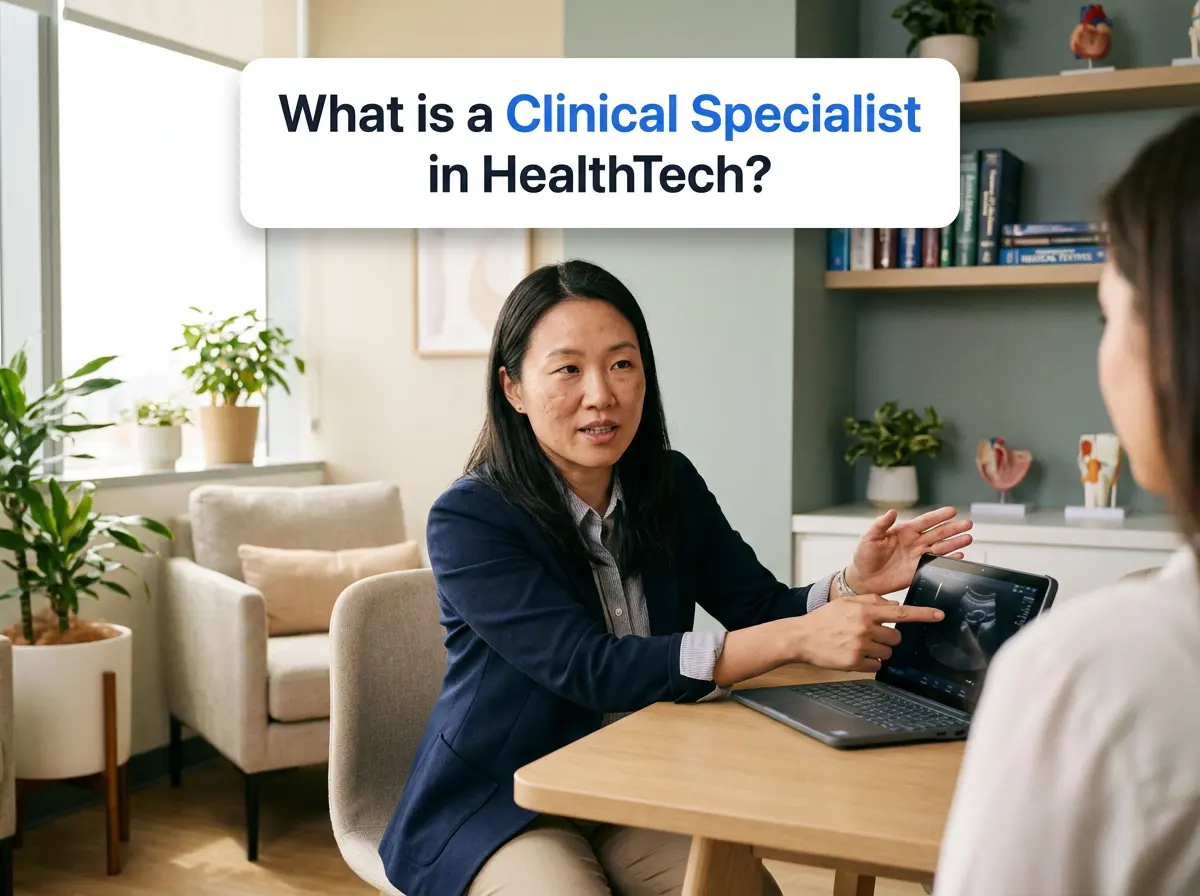
What is a Clinical Specialist in HealthTech?
A Clinical Specialist in HealthTech is the person accountable for safe, effective, real-world use of a clinical product once it leaves the slide deck and enters care delivery. They sit at the point where technology meets clinical practice, translating a device, digital workflow, or clinical platform into outcomes that clinicians can trust and patients can benefit from.
This role exists because HealthTech products don't succeed just by "working" in a technical sense; they must work in real clinical environments with time pressure, variable patient presentations, mixed levels of user confidence, and strict governance. A Clinical Specialist owns the adoption risk: ensuring the product is used correctly, that training and support are credible, and that issues are surfaced early enough to protect patients and preserve trust.
In most organisations, a Clinical Specialist is a field-facing or customer-facing clinical operator who carries responsibility for how the product behaves in practice, often bridging Clinical Affairs, Customer Success, and Commercial teams. The methods vary by company, but the ownership stays consistent: they are accountable for clinical confidence, safe usage, and a smooth path from "installed" to "embedded."
🔍 How this role differs in HealthTech
In many tech sectors, user impact is important but reversible: you can roll back a feature, change a pricing page, or re-run an onboarding flow. In HealthTech, errors can become patient safety incidents, clinical workflow failures, or reputational damage that a buyer won't "test and learn" their way through. Clinical Specialists operate in that higher-stakes reality.
Data sensitivity also changes the role's centre of gravity. Even when a Clinical Specialist isn't writing code, they routinely influence how data is captured, displayed, and acted on, knowing that clinical data is both sensitive and operationally consequential. Their judgement has to account for governance constraints, local operating procedures, and the practical reality of how clinicians actually work (not how process maps say they work).
Finally, the "customer" is rarely a single decision-maker. HealthTech adoption is multi-stakeholder by default: clinical champions, procurement, governance teams, IT, ward/theatre teams, and sometimes homecare or community services. A Clinical Specialist has to align these groups without overpromising, because credibility is the currency that keeps deployments alive.
🎯 Core responsibilities in HealthTech
Day to day, a Clinical Specialist is responsible for turning a product into a dependable clinical routine. That usually starts with building clinical trust: showing up prepared, understanding the care setting, and being precise about what the product can and cannot do. In many roles, that includes hands-on support in live clinical environments (for example during procedures, clinics, or service transitions) where the margin for error is small and the pace is non-negotiable.
They make constant trade-offs under constraints: the ideal workflow versus the workflow a team can realistically adopt this month; the "best practice" configuration versus what governance will approve; rapid issue resolution versus controlled change in a safety-critical setting. When something breaks, whether it's usability, training uptake, interoperability expectations, or a clinical misunderstanding, the Clinical Specialist is often the first accountable owner to stabilise the situation and coordinate the right internal fix.
A strong Clinical Specialist also carries feedback responsibility. They don't just report "what users want"; they translate clinical reality into actionable product and process decisions, separating preference from risk, and urgent safety concerns from optimisations. Over time, they become a key signal source for product strategy, because they see what actually happens when technology meets the messy middle of care delivery.
🧩 Skills and competencies for HealthTech
Core Skill | HealthTech specific requirement | Reason or Impact |
|---|---|---|
Clinical judgement | Ability to recognise when a usage pattern, workaround, or configuration drifts into clinical risk | Protects patients and prevents "successful adoption" from masking unsafe practice |
Credible training and education | Delivering training that fits real clinical constraints (shift patterns, theatre tempo, rotation of staff) | Drives safe, repeatable usage rather than one-off "demo competence" |
Stakeholder alignment | Navigating clinical, operational, and commercial expectations without eroding trust | Prevents rollout stalls caused by misaligned goals, governance friction, or unclear ownership |
Incident-minded communication | Clear escalation, documentation discipline, and calm communication when pressure is high | Reduces time-to-resolution and supports defensible decision-making in sensitive settings |
Workflow empathy | Understanding clinical workflow end-to-end, including handoffs and failure points | Avoids solutions that technically work but collapse under real operating conditions |
Boundary setting and integrity | Comfort saying "no" to unsafe requests or unrealistic clinical claims | Protects the organisation from clinical credibility loss and avoids risk-by-enthusiasm |
Commercial awareness | Understanding how adoption, retention, and account health tie to clinical outcomes | Helps prioritise the right support effort and prevents "support theatre" that doesn't move outcomes |
Systems thinking | Seeing product performance as part of a wider system (training, governance, device handling, data flow) | Improves root-cause accuracy and prevents recurring issues disguised as user error |
💷 Salary ranges in UK HealthTech
Compensation for Clinical Specialists in UK HealthTech is driven less by job title and more by where the risk and complexity sit: the clinical criticality of the product, the intensity of live clinical support (including evenings/weekends), the breadth of territory covered, and whether the role is closer to Clinical Operations, Clinical Affairs, or Commercial enablement. Location matters (especially London and South East), but so does scarcity of domain experience (for example theatre-heavy specialties or highly technical implanted systems).
Experience level | Estimated annual salary range | What drives compensation |
|---|---|---|
Junior | London & South East: £32,000–£42,000 | Entry path (clinical vs life sciences), training burden, travel footprint, and whether the role is hands-on in clinical environments |
Mid-level | London & South East: £42,000–£55,000 | Independent case support/training ownership, product complexity, territory size, and expectation to influence adoption outcomes |
Senior | London & South East: £55,000–£70,000 | Ownership of key accounts or regions, escalation responsibility, ability to stabilise difficult deployments, and credibility with senior clinicians |
Lead | London & South East: £70,000–£90,000 | Leading teams or programmes, standardising training/clinical processes, cross-functional influence, and higher exposure to risk and governance |
Head / Director | London & South East: £90,000–£130,000 | Organisational accountability (strategy, governance, performance), multi-team leadership, and ownership of clinical outcomes across a portfolio |
Beyond base salary, typical add-ons include performance bonus (often linked to company or territory outcomes), car allowance or company vehicle for field-heavy roles, and enhanced expenses policies where travel is substantial. Equity is more common in venture-backed HealthTech and tends to show up at Senior level and above, while larger medtech firms more often lean on bonus and car/benefits instead. Total compensation varies most with on-call intensity (evenings/weekends), product criticality (especially where procedure support is expected), and whether the role directly supports revenue-bearing adoption targets.
🚀 Career pathways
Common entry points include clinical practitioners moving into industry (for example roles that already involve training, specialist procedures, or pathway leadership) and life sciences graduates who build credibility through hands-on product and workflow exposure. In HealthTech, progression is rarely about collecting titles; it's about widening the radius of accountability, from supporting individual users, to owning clinical success across accounts, to shaping how the organisation delivers clinical value at scale.
As responsibility expands, a Clinical Specialist typically moves from "being present" to "being responsible": designing training standards, owning rollout playbooks, mentoring other specialists, and becoming the go-to escalation owner when things go wrong. From there, pathways diverge into Clinical Operations leadership, Clinical Affairs, Product (especially workflow-heavy product roles), or Commercial leadership where deep clinical credibility is a differentiator.
The most sustainable progression comes from repeatedly demonstrating three things: safe judgement under pressure, the ability to drive adoption without shortcuts, and the discipline to translate clinical reality into scalable organisational decisions.
❓ FAQ
Do I need to be a registered clinician to become a Clinical Specialist in HealthTech?
Not always, but you do need credible clinical context. Some employers strongly prefer registered clinicians for theatre- or procedure-heavy work, while others hire science graduates and train them into the environment. What matters most is whether you can safely support real-world use and earn trust quickly.
How much of the job is "support" versus influencing product and strategy?
Early on, it can be heavily support-led because credibility is built in the field. As you become more senior, you're expected to shape how support is delivered: standardising training, improving escalation loops, and feeding high-quality clinical insight into product decisions. The more clearly you can link your work to clinical outcomes, the more influence you gain.
Will I be expected to work evenings, weekends, or be on-call?
It depends on the product and care setting. Roles tied to live procedures, implants, or time-critical services can include out-of-hours expectations, sometimes formally and sometimes informally via escalation. If this matters to you, clarify the rota reality, coverage model, and how out-of-hours work is compensated before accepting an offer.
🔎 Find your next role
If you're ready to take ownership of real-world clinical adoption, search Clinical Specialist roles on Meeveem and compare scope, expectations, and packages before you apply.
You might also like