Published Date: December 17, 2025
Updated Date: December 17, 2025
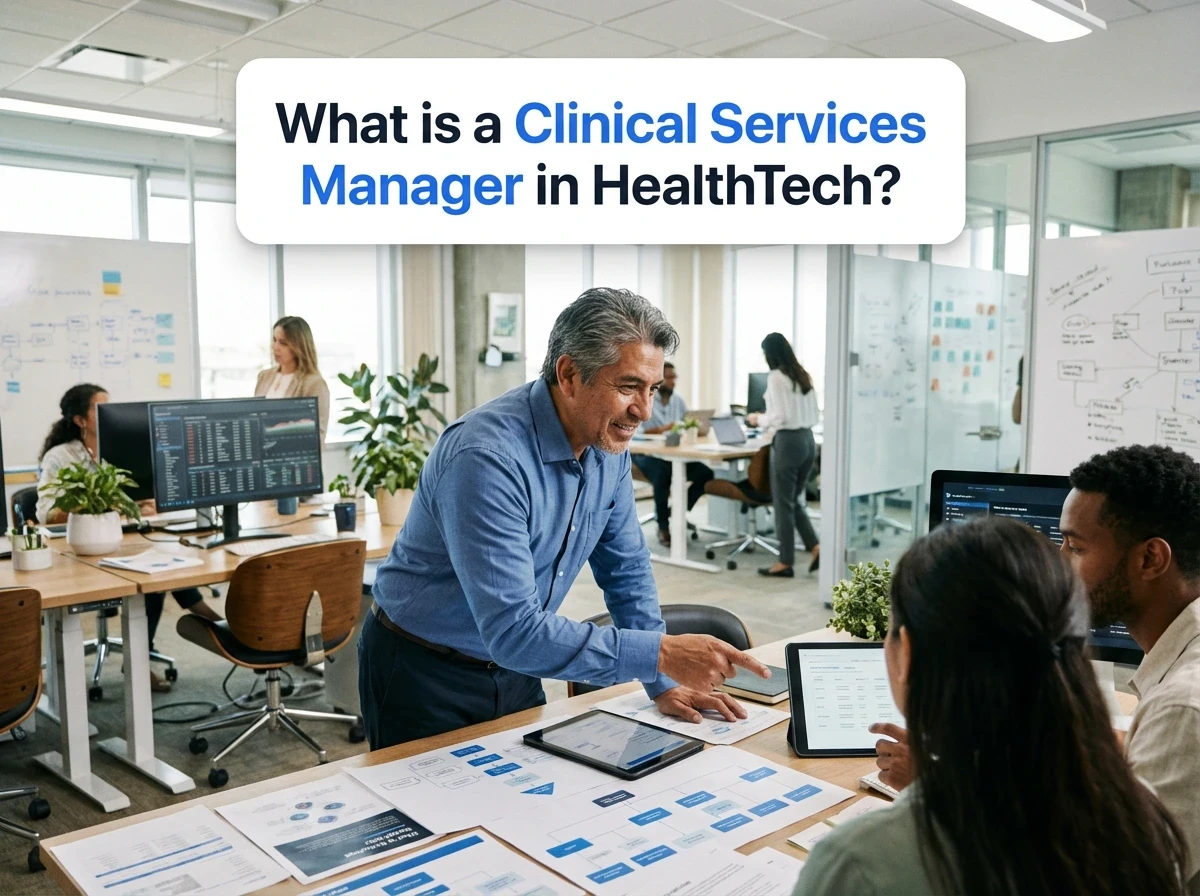
What is a Clinical Services Manager in HealthTech?
A Clinical Services Manager in HealthTech is the accountable owner of how clinical care (or clinically governed services) are delivered inside a technology-enabled healthcare business. They sit at the intersection where patient care meets operations and product, ensuring the organisation can scale access and efficiency without compromising safety, quality, or professional standards.
This role exists because HealthTech companies don't just ship software. They deliver real clinical services, clinical decisions, or clinically consequential workflows. Someone must hold end-to-end responsibility for how clinicians are recruited and supported, how pathways run day to day, how incidents and complaints are handled, how service performance is measured, and how the organisation stays inspection-ready. In many businesses, the Clinical Services Manager is also the person who makes sure operational reality matches what the company promises to patients, clinicians, and commissioners.
Above all, it's an ownership role: accountable for clinical operations outcomes, not just "managing a team" or "supporting the product".
🔍 How this role differs in HealthTech
In many tech sectors, operational leadership can optimise for speed, customer experience, and margin with relatively contained downside. In HealthTech, the same types of decisions (capacity planning, triage rules, response times, escalation paths, vendor selection) carry a different weight because they can affect patient safety, clinical outcomes, and regulatory exposure.
Data sensitivity is also structurally different. Clinical services are built on confidential health information, often across multiple systems and partners. A Clinical Services Manager has to make decisions that are workable for teams whilst still defensible under audit, complaint investigation, or external scrutiny.
Finally, HealthTech adds "translation pressure": clinicians, operations, and product/engineering often use different languages for risk, evidence, and urgency. The Clinical Services Manager is expected to translate between them and still remain accountable when trade-offs are tight.
🎯 Core responsibilities in HealthTech
Day to day, a Clinical Services Manager owns whether the service is safe, responsive, and deliverable at the capacity the business is selling, without burning out clinicians or cutting corners on governance. That usually means setting operating rhythms (handoffs, supervision, escalation routes), monitoring quality and performance signals (incidents, complaints, patient feedback, clinical outcomes where available), and deciding what gets fixed first when the service is under strain.
They make constrained decisions constantly: whether to pause intake for a pathway, how to redesign a triage step that is generating risk, when to require more clinician training versus changing the workflow, and how to balance access targets against clinical appropriateness. In practice, this person is often the "final responsible owner" for operational delivery in a clinical area, working closely with Medical Directors, Heads of Nursing, product teams, and customer operations, but not outsourcing accountability to them.
In HealthTech specifically, the job also tends to include building repeatable systems: standard operating procedures, audit trails, supervision models, incident response, vendor governance, and readiness for inspection or due diligence. When the company expands into new conditions or new delivery models, the Clinical Services Manager is frequently the one turning that strategic intent into a service that can actually run on Monday morning.
🧩 Skills and competencies for HealthTech
Core Skill | HealthTech specific requirement | Reason or Impact |
|---|---|---|
Clinical and operational accountability | Comfort owning service outcomes across safety, quality, access, and cost (even when decisions are cross-functional) | HealthTech failures are rarely "just operational"; they can become patient harm, reputational damage, and regulatory escalation |
Risk-based judgement | Ability to assess and act on clinical risk signals with imperfect information and time pressure | The role often involves deciding when to stop, slow, or redesign a pathway before problems become incidents |
Regulated-service mindset | Building processes that are auditable, consistent, and defensible without making delivery rigid | Services need to scale whilst still standing up to inspection, complaint investigation, and clinical scrutiny |
Clinical workforce leadership | Leading clinicians with credibility: supervision structures, scope of practice clarity, and psychologically safe escalation | Clinicians must feel safe to raise concerns early; otherwise risk surfaces late and expensively |
Cross-functional influence | Communicating clinical consequences to product/ops leaders in a way that changes priorities | Many safety and quality issues are created by workflow design; influence prevents repeat failures |
Data interpretation and signal detection | Turning operational and quality data into action, not dashboards | HealthTech generates lots of activity data, but the job is spotting the few indicators that predict patient or service failure |
Service design under constraints | Designing pathways that are clinically sound, operationally feasible, and financially sustainable | The role lives in trade-offs: capacity, clinician time, patient experience, and safe thresholds |
💷 Salary ranges in UK HealthTech
Pay is driven less by the job title alone and more by what the person is truly accountable for: size and seniority of the clinical workforce, number and complexity of pathways, patient risk profile, governance and inspection exposure, whether the role owns multi-site delivery, and whether there's on-call or incident escalation responsibility. Location still matters, but scope and regulatory burden often matter more in HealthTech than in many non-clinical tech roles.
Experience level | Estimated annual salary range | What drives compensation |
|---|---|---|
Junior | London & South East: £35,000–£45,000 | Team size is small; role focuses on coordination, delivery reliability, and supervised governance responsibilities |
Mid-level | London & South East: £45,000–£60,000 | Ownership of a pathway or service line; measurable targets (access, quality, incident management); increasing autonomy |
Senior | London & South East: £60,000–£80,000 | Multi-pathway delivery, complex clinical workforce management, higher-risk patient groups, and meaningful governance exposure |
Lead | London & South East: £80,000–£100,000 | Cross-functional authority, scaling services, owning operating model changes, leading managers, and higher incident/escalation load |
Head / Director | London & South East: £100,000–£140,000 | Organisational accountability for clinical operations performance, inspection readiness, budget responsibility, and strategic expansion risk |
Beyond base salary, typical add-ons include performance-related bonus (more common at senior levels), on-call or escalation allowances where the role carries out-of-hours incident responsibility, and equity in venture-backed businesses. Total compensation varies most with how close the role is to regulated accountability, whether it includes formal registered responsibilities in practice, how intense escalation expectations are, and whether the company is scaling rapidly (where operational risk and workload tend to spike).
🚀 Career pathways
Common entry points include clinical team leadership in provider settings, operational management roles in clinical services, or pathway management in digital providers. People often move into HealthTech by taking ownership of a single service line, where success is measured by dependable delivery and credible governance, not by how many initiatives they start.
As responsibility expands, the job shifts from "making today work" to building systems that keep working when volumes double: supervision models, incident learning loops, capacity planning, and pathway redesign. The strongest progression signal is repeated ownership of outcomes across multiple service lines, plus the ability to align clinicians, operations, and product around safe, scalable decisions.
At the top end, progression becomes less about clinical domain depth and more about organisational accountability: portfolio performance, inspection readiness, executive-level risk decisions, and building leadership layers that preserve quality at scale.
❓ FAQ
Do I need to be clinically registered to become a Clinical Services Manager in HealthTech?
Not always, but many HealthTech employers strongly prefer it when the role manages clinicians directly or owns governance-heavy decisions. If you're not registered, expect the interview to focus on how you ensure safe escalation, supervision, and policy compliance through clinical leadership partners.
What will the interview process test that's different from a standard operations manager role?
You'll usually be assessed on risk judgement: how you respond to incidents, redesign unsafe workflows, and make trade-offs between access and appropriateness. Expect scenario questions about capacity pressure, complaint handling, safeguarding-style escalation, or quality signals that don't neatly match KPI dashboards.
Will I be on-call, and how should I evaluate that expectation?
Some roles include formal on-call or escalation coverage, especially where the service runs extended hours or carries higher acuity. Clarify whether you're the decision-maker out of hours, what incident types trigger escalation, the frequency of calls, and whether there's an allowance or time back.
🔎 Find your next role
If you're ready to own clinical delivery in a scaling HealthTech business, search for Clinical Services Manager roles on Meeveem.
You might also like