Published Date: December 17, 2025
Updated Date: December 17, 2025
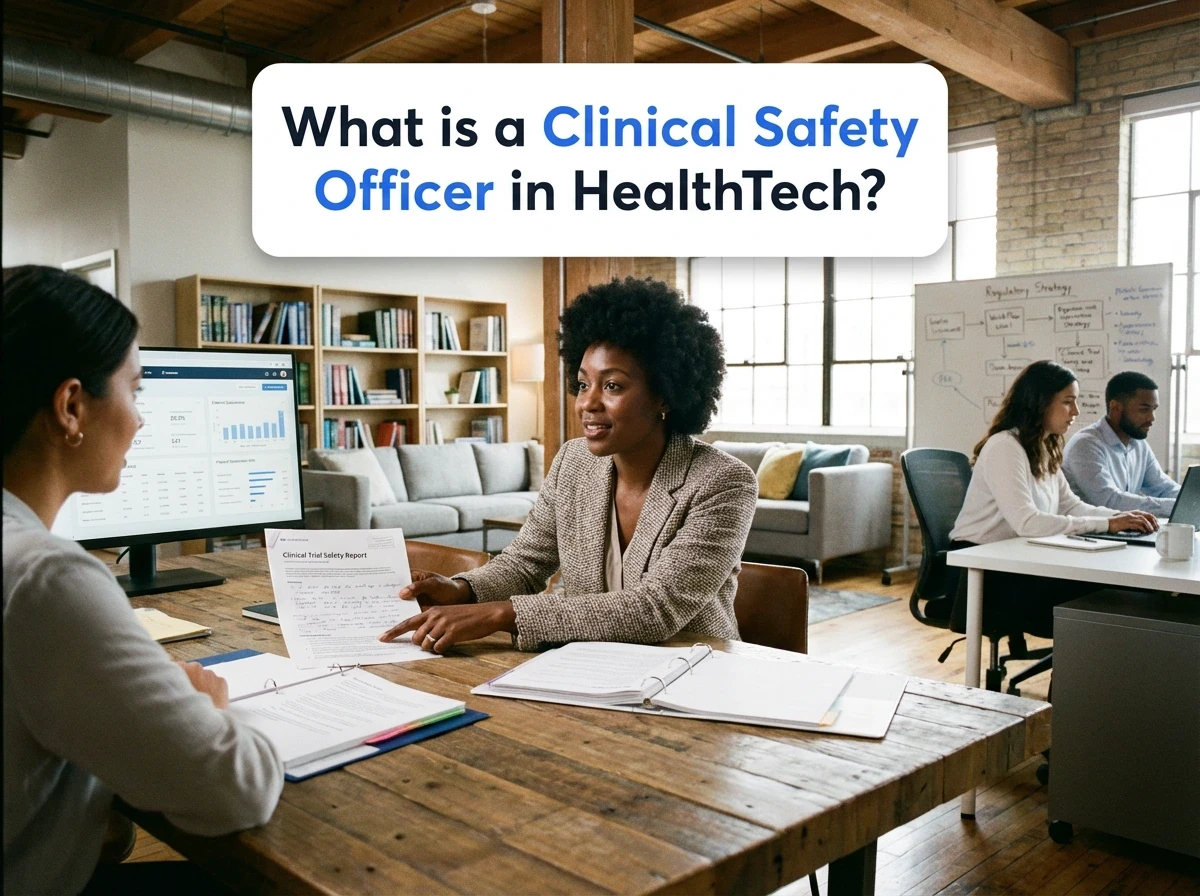
What is a Clinical Safety Officer in HealthTech?
A Clinical Safety Officer (CSO) in HealthTech is the named accountable clinical leader for how a digital product, system, or programme could affect patient safety, and for whether the organisation's clinical risk management is good enough to justify releasing, configuring, deploying, changing, or retiring that technology.
This role exists because software in healthcare doesn't just "enable workflows"; it can change decisions, timing, and outcomes. A subtle UI choice can delay escalation. A configuration change can alter who receives an alert. An integration failure can create dangerous gaps. The CSO is there to make sure those risks are identified, owned, reduced, and clearly accepted at the right level when they cannot be fully removed.
Before methods and documentation, the defining feature of the role is ownership: a CSO is expected to hold a line on safety, escalate when necessary, and be able to justify decisions in a way that stands up to scrutiny from clinical leadership, delivery teams, and external stakeholders.
🔍 How this role differs in HealthTech
In many tech sectors, safety is largely reputational and financial, with harm often indirect. In HealthTech, the impact is closer to the bedside: the "user" may be a clinician, but the person bearing consequences is a patient. That changes what "good enough" means, how uncertainty is handled, and how quickly teams can move without losing control of risk.
HealthTech also places the CSO in the middle of competing truths. Product teams want speed and iteration; clinical environments need stability, predictability, and clear operating conditions. Data is more sensitive, context is messier, and the cost of misinterpretation is higher. The CSO's work is therefore less about perfect prevention and more about disciplined assurance: knowing which risks are tolerable, which are not, and what evidence is required before a change is allowed into real clinical use.
🎯 Core responsibilities in HealthTech
A CSO's day-to-day accountability is to keep clinical risk visible and actionable whilst products evolve. That means shaping how teams define hazards, how they reason about severity and likelihood in real-world settings, and what mitigations are practical without breaking care delivery. In a typical week, they'll be pulled into product decisions that don't look like "safety work" on the surface: feature scope, default settings, rollout sequencing, downtime procedures, training depth. These are often where harm is either prevented or introduced.
They operate under constraints: incomplete information, variation in local workflows, differing risk appetites across stakeholders, and the reality that some safety controls cost time, money, and usability. The job is to navigate those trade-offs explicitly. A CSO is expected to make clear recommendations, sometimes uncomfortable ones, about delaying release, narrowing scope, requiring additional controls, or escalating risk acceptance to senior clinical leadership when residual risk remains.
Critically, the CSO is not a passive reviewer at the end. In strong HealthTech organisations, they sit close to delivery leadership and clinical leadership, acting as a clinical risk authority who can challenge assumptions, ensure safety evidence is coherent, and maintain a single accountable narrative of why the system is considered safe enough for its intended use.
🧩 Skills and competencies for HealthTech
Core Skill | HealthTech specific requirement | Reason or Impact |
|---|---|---|
Clinical risk judgement | Ability to reason about harm pathways created by digital workflows, not just clinical care itself | Prevents "paper-safe" decisions that fail in real environments where time pressure and workarounds are normal |
Accountability and escalation | Comfort being the named person who raises issues to senior clinical and delivery leadership when risk is unacceptable | Ensures safety is governed, not negotiated away in day-to-day delivery pressure |
Systems thinking | Understanding that safety emerges from the whole socio-technical system: people, process, configuration, integrations, and change management | Reduces the risk of focusing on a single feature whilst missing end-to-end failure modes |
Evidence-based assurance | Ability to define what evidence is sufficient for a safety position, proportionate to clinical criticality | Aligns product pace with defensible decision-making and reduces fragile "trust me" releases |
Influence across disciplines | Communicating clearly with clinicians, engineers, product managers, informatics, IG, and operations without losing clinical meaning | Avoids safety becoming a silo and makes mitigations implementable by the teams who own the work |
Incident leadership | Capability to run safety incident triage and investigation in a way that drives learning and corrective action | Minimises recurrence, supports transparency, and protects patients whilst systems continue to operate |
Operational pragmatism | Understanding real deployment conditions: downtime, training variance, staffing, and local workflow diversity | Produces controls that teams can actually follow, rather than idealised policies that get bypassed |
💷 Salary ranges in UK HealthTech
Pay for Clinical Safety Officers is driven less by "years in role" and more by the risk surface area they personally carry: the clinical criticality of the product, the scale of deployment, the strength of governance needed, and whether the CSO is the final internal clinical safety signatory. Location still matters, but so do on-call expectations, the number of concurrent product streams, and whether the work spans supplier and deployment obligations.
Experience level | Estimated annual salary range | What drives compensation |
Junior | London & South East: £45,000–£55,000 | Usually supporting a senior CSO; narrower product scope; more supervised sign-off and fewer high-stakes escalations |
Mid-level | London & South East: £55,000–£70,000 | Owning safety workstreams end-to-end for defined products; stronger independence; higher expectation to influence delivery trade-offs |
Senior | London & South East: £70,000–£90,000 | Acting as primary CSO for complex systems or programmes; higher clinical criticality; heavier stakeholder load; sharper accountability for risk acceptance |
Lead | London & South East: £90,000–£115,000 | Multi-product oversight; setting clinical safety approach and consistency; coaching other CSOs; frequent senior escalation and governance ownership |
Head / Director | London & South East: £115,000–£150,000 | Org-wide accountability for digital clinical safety; governance design; board-level reporting; ownership of how safety scales across products and partners |
Beyond base salary, total compensation often includes performance bonus (more common in private HealthTech than provider settings), pension and benefits, and occasionally equity for senior hires in venture-backed companies. On-call allowances are role-dependent: many CSOs are not routinely on-call, but roles tied to major go-lives, high-availability clinical platforms, or safety incident leadership can include an out-of-hours expectation, either formalised as an allowance or reflected in a higher base. Variation is most strongly driven by product criticality, deployment scale, level of signatory accountability, and the intensity of concurrent delivery work.
🚀 Career pathways
Common entry points include registered clinicians who have moved into digital, clinical governance, patient safety, or clinical informatics, and who then specialise in clinical risk management for digital systems. Another route is coming from HealthTech implementation or product roles with strong clinical exposure, then formalising safety ownership through progressively larger scopes of accountability.
Progression typically happens when the CSO moves from "supporting safety documentation" to "owning safety decisions." Early on, responsibility is about learning how hazards emerge through configuration, workflows, and change. At senior levels, the work expands into setting safety strategy across multiple products, defining governance that delivery teams can operate within, and being the person trusted to hold the boundary between acceptable and unacceptable residual risk. The biggest career step is not a title change. It's becoming the individual whose judgement is relied upon when the organisation is under delivery pressure.
❓ FAQ
Do I need to be a registered clinician to become a Clinical Safety Officer in HealthTech?
Many HealthTech CSO roles expect current clinical registration because the job includes clinical accountability and credibility with clinical governance. Some organisations will consider candidates with equivalent clinical risk expertise, but you should assume clinical background is a strong advantage, especially where sign-off authority is required.
What will an interview test for beyond "knowledge of standards"?
Expect scenario-based questions: how you'd handle a safety concern discovered late in a release cycle, how you'd escalate risk, and how you'd balance usability against mitigation. Strong candidates show clear decision-making, proportionality, and the ability to communicate risk in a way that changes delivery behaviour.
Will I be on-call, and how should I evaluate that expectation?
Many CSO roles are not formal on-call positions, but some include out-of-hours support during go-lives or for safety incident escalation. Ask directly how incidents are triaged, who is the escalation point, what response times are expected, and whether additional compensation applies or the expectation is absorbed into base pay.
🔎 Find your next role
Ready to step into clinical safety ownership? Search Clinical Safety Officer roles on Meeveem and find a team where safety is treated as a leadership responsibility, not a last-minute checklist.
You might also like