Published Date: December 31, 2025
Updated Date: December 31, 2025
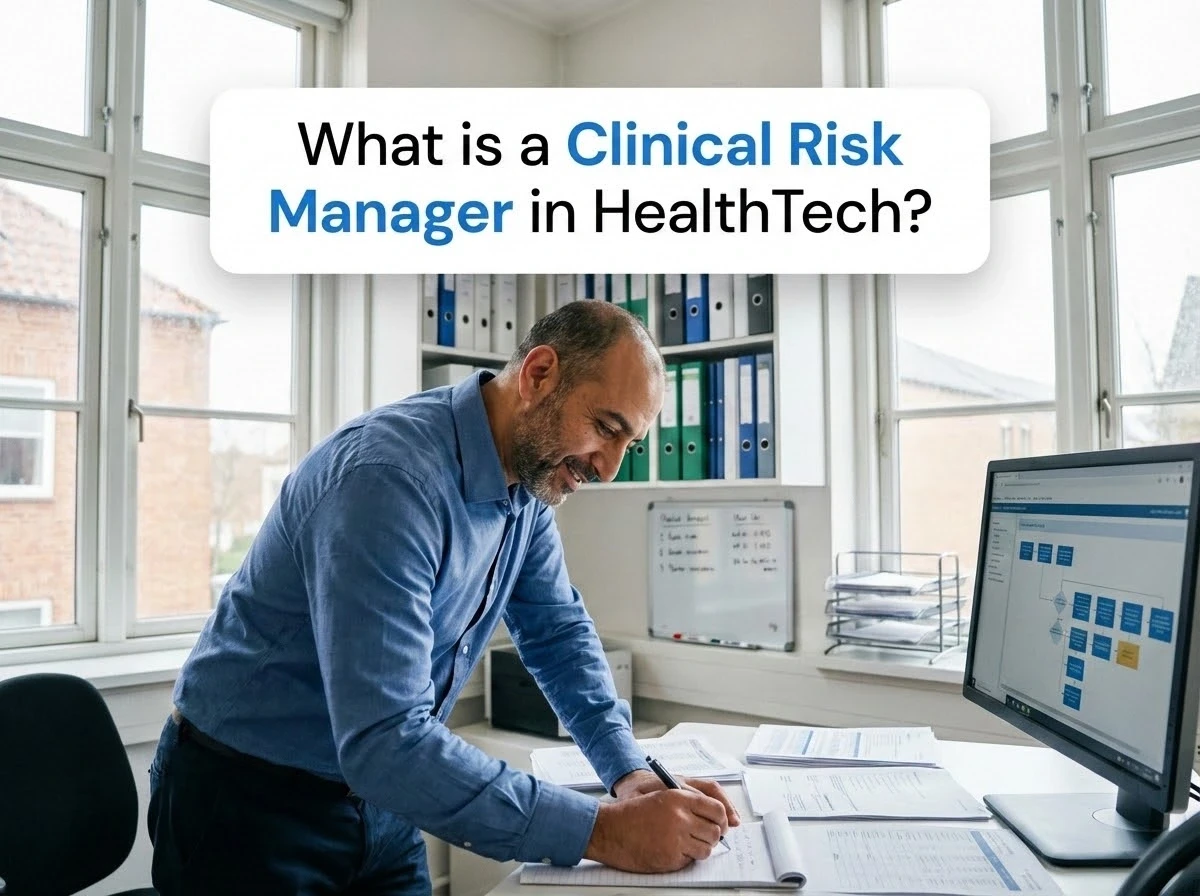
What is a Clinical Risk Manager in HealthTech?
A Clinical Risk Manager in HealthTech owns the clinical safety risk position of a digital health product or digital change programme. They are accountable for identifying, assessing, controlling, and escalating risks that could cause patient harm when software influences clinical decisions, workflows, triage, monitoring, or communication.
This role exists because HealthTech doesn't just "support users"; it can change the care a patient receives. A product can be clinically unsafe even if it's technically reliable, secure, and beautifully designed. Small design choices, missing edge cases, ambiguous wording, workflow mismatches, or data delays can create real-world harm. The Clinical Risk Manager makes sure those risks are owned, visible, and actively managed throughout the product lifecycle, not discovered after incidents occur.
At its core, this is an ownership role. The organisation needs a named person (or function) who can say, with evidence, what the residual risk is, what has been done to reduce it, what must be changed before release, and what must be escalated when risk is unacceptable.
🔍 How this role differs in HealthTech
In many tech sectors, "risk" is often framed around revenue leakage, churn, uptime, or brand damage. In HealthTech, the most important risks include patient harm, clinical miscommunication, inappropriate clinical action, missed deterioration, and unsafe workflows. That changes the decision-making culture. "Fast and iterative" still matters, but it must be paired with explicit safety rationale and controlled release decisions.
HealthTech also raises the stakes on data sensitivity and context. A small error in a consumer app might be an annoyance; in a clinical pathway it might alter prioritisation, delay care, or misinform a clinician or patient. The Clinical Risk Manager therefore works with a different bar for evidence and change control, and often has to reconcile competing constraints: speed versus assurance, usability versus safety controls, and clinical flexibility versus standardised pathways.
Finally, the role sits closer to formal accountability than in many other industries. In HealthTech, you are often expected to maintain a defensible clinical risk management system and safety artefacts that stand up to scrutiny from internal clinical leadership, customers, and procurement assurance processes.
🎯 Core responsibilities in HealthTech
Day to day, a Clinical Risk Manager is the person who keeps the organisation honest about what could go wrong clinically and what it is doing about it. They shape how hazards are identified (not just recorded), how severity and likelihood are judged in real clinical context, and how risk controls are chosen so that the product remains usable whilst safer in practice.
They spend a lot of time working across boundaries: translating clinical reality into product requirements, challenging ambiguous user stories, and helping engineering and product leaders understand when a "minor" change alters clinical meaning. When incidents or safety signals emerge (complaints, near-misses, support tickets that imply unsafe use), they coordinate triage and investigation, ensure learning is captured, and push for corrective actions that reduce recurrence rather than simply patching a symptom.
A key part of the job is making and enabling decisions under constraints. Releases still need to ship; customers still need features; clinicians still need workflows that fit. The Clinical Risk Manager's accountability is to ensure trade-offs are explicit: what risk is being accepted, what controls are in place, what monitoring exists post-release, and what must be stopped or escalated if safety is not adequately demonstrated.
🧩 Skills and competencies for HealthTech
Core Skill | HealthTech specific requirement | Reason or Impact |
|---|---|---|
Clinical safety judgement | Ability to interpret how software behaviour translates into patient harm pathways, including indirect harm through workflow, timing, or communication | Prevents "technically correct" features from creating clinically unsafe outcomes in real care settings |
Accountability and escalation | Confidence to halt or condition releases, and to escalate unacceptable risk to clinical and executive leadership with clear rationale | Protects patients and the organisation by ensuring risk ownership is real, not performative |
Systems thinking | Understanding that risk sits across product, users, clinical processes, training, and local configuration (not just in code) | Leads to controls that work in practice (e.g. safer defaults, constraints, monitoring), not only in documentation |
Risk-based prioritisation | Ability to prioritise mitigation work by clinical criticality, exposure, and detectability, not by noise or stakeholder pressure | Focuses limited time on the few risks most likely to cause harm or regulatory failure |
Stakeholder leadership without authority | Capability to align clinicians, engineers, product, support, and customer teams around a shared safety position | Enables coherent decisions and avoids fragmented "local fixes" that leave systemic hazards unresolved |
Evidence and documentation discipline | Producing clear, audit-ready safety reasoning (hazards, controls, residual risk, release rationale) without over-documenting | Makes safety defensible during procurement, assurance reviews, and incident scrutiny whilst keeping delivery practical |
Incident sense-making | Turning messy real-world signals (complaints, clinical feedback, near-misses) into structured learning and concrete corrective actions | Reduces recurrence and improves product safety maturity over time |
Ethical and human factors awareness | Awareness of how wording, nudges, defaults, alerts, and UI constraints influence behaviour in stressed clinical contexts | Prevents unsafe use patterns and reduces over-reliance, alert fatigue, or misinterpretation |
💷 Salary ranges in UK HealthTech
Compensation for Clinical Risk Managers in UK HealthTech is driven less by "years in role" and more by the clinical criticality of the product, the level of release authority, whether the person is the named safety owner for multiple products, and how exposed the company is to formal assurance expectations in procurement. Location still matters (especially London and the South East), but scope and accountability usually matter more. On-call expectations can also shift pay when the role is tied to safety incident response in live services.
Experience level | Estimated annual salary range | What drives compensation |
Junior | London & South East: £40,000–£55,000 | Often supporting a senior safety lead; pay varies by whether you're clinically registered, the complexity of the product domain, and how much independent risk sign-off you hold |
Mid-level | London & South East: £55,000–£75,000 | Ownership of risk activity for a product area; compensation rises with responsibility for safety artefacts, incident leadership, and influence over release decisions |
Senior | London & South East: £75,000–£95,000 | Acting as named clinical risk owner for major products or programmes; higher pay where the role is tightly coupled to commercial deployments and high patient exposure |
Lead | London & South East: £95,000–£120,000 | Leading the clinical risk management system across multiple teams; pay varies with organisational scale, customer scrutiny, and the level of independence from product leadership |
Head / Director | London & South East: £120,000–£160,000 | Executive accountability for clinical safety governance across the business; higher totals where the role owns strategy, audits, external assurance, and incident readiness across a portfolio |
Beyond base salary, typical add-ons include annual bonus (more common in venture-backed or larger private HealthTech), equity or share options (varies widely by stage), and enhanced pension/benefits. On-call allowances are less universal than in infrastructure roles, but can apply where clinical safety incident response is formalised, especially for live patient-facing services. When present, on-call intensity and escalation responsibility can materially change total compensation. Total pay is also influenced by whether the role is a named safety officer across products, the company's regulatory/procurement exposure, and the consequences of downtime or incorrect outputs.
🚀 Career pathways
Most people enter this role from clinically grounded routes (nursing, pharmacy, allied health, medicine) with exposure to digital change, governance, quality, or patient safety work, then specialise into digital clinical risk. Others come from health informatics, clinical operations, or safety/quality roles and build the clinical context through close work with clinicians and formal training.
Progression is typically not about managing bigger teams first; it's about owning a bigger safety surface area. Early on, you may support safety documentation and incident triage under supervision. As you grow, you become the person who sets the risk position for a product line, influences roadmap trade-offs, and is trusted to make go/no-go recommendations. Lead and Head levels are defined by system ownership: creating a scalable risk operating model, coaching delegated safety owners, and taking responsibility for external scrutiny, assurance expectations, and the organisation's overall safety posture.
❓ FAQ
Do I need to be a registered clinician to become a Clinical Risk Manager in HealthTech?
Many employers strongly prefer it because the role involves interpreting clinical impact and credibility with clinical stakeholders. Some organisations will hire non-registered candidates if they have deep digital clinical safety experience and a strong track record in patient safety risk work. If you're not registered, expect interviews to probe how you validate clinical assumptions and who signs off clinical judgements.
What will I be held accountable for if something goes wrong in a live product?
You're typically accountable for whether the clinical risks were identified, controlled, documented, and escalated appropriately, and whether monitoring and incident processes were in place. You're not expected to prevent every incident, but you are expected to ensure the organisation can show responsible risk ownership and timely corrective action. Candidates are often assessed on how they balance "residual risk" with real delivery constraints.
Will I be expected to be on-call for clinical safety incidents?
It depends on the company and how patient-facing the product is. Some teams run formal rota-based incident response for safety signals; others operate business-hours governance with escalation to a duty manager for urgent issues. In interviews, ask who triages safety incidents, what counts as a safety-critical event, and what "out of hours" actually means in practice.
🔎 Find your next role
Search Clinical Risk Manager roles on Meeveem to find HealthTech teams where clinical safety ownership is clear, supported, and properly resourced.
You might also like