Published Date: December 16, 2025
Updated Date: December 16, 2025
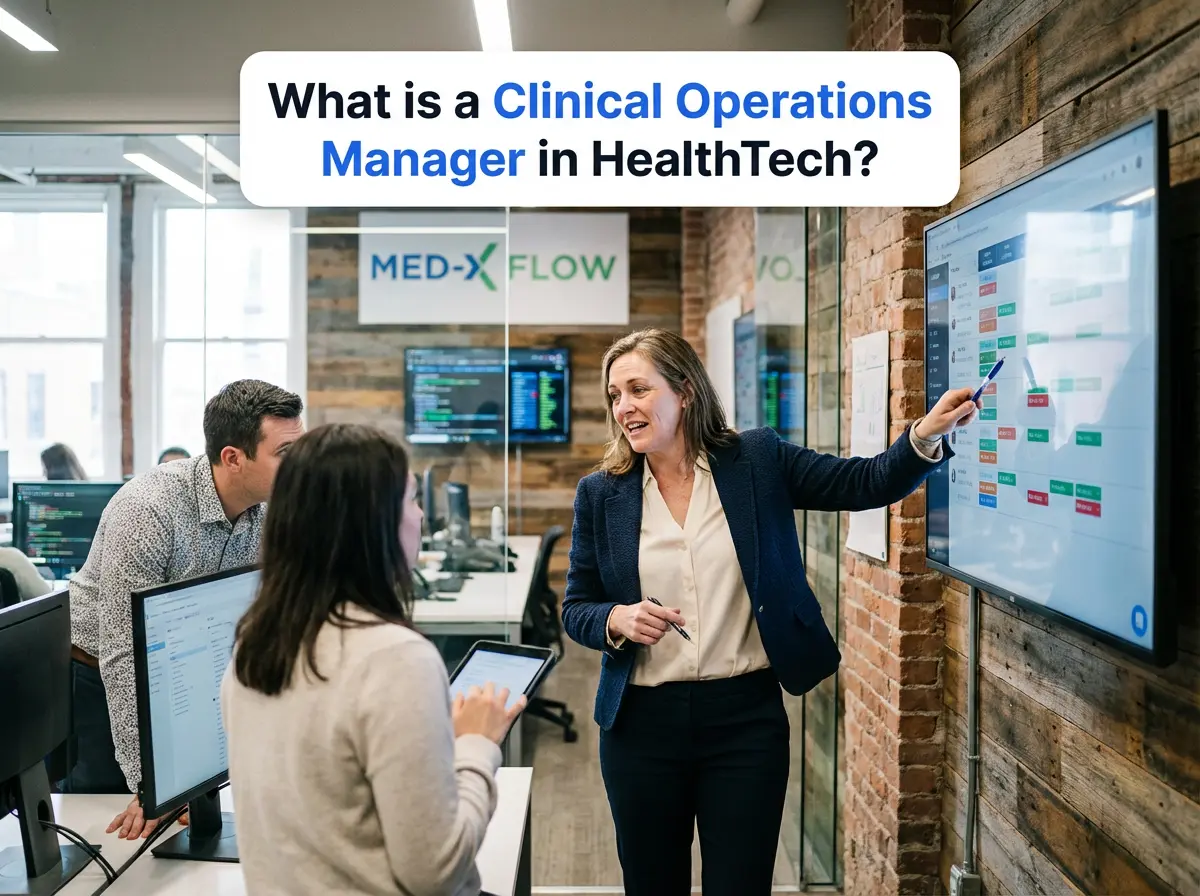
What is a Clinical Operations Manager in HealthTech?
A Clinical Operations Manager in HealthTech is the person accountable for making a clinically delivered product or service run safely, reliably, and at the right quality level, day in, day out. They sit at the intersection of clinical teams, operational delivery, and the wider product and business, ensuring that what the company promises clinically is what gets delivered in real life.
This role exists because HealthTech isn't just "software in production"; it's patient-facing work (directly or indirectly) where operational decisions can create clinical risk. Someone needs clear ownership for how clinical work is staffed, governed, monitored, escalated, and improved, without compromising safety, privacy, or regulatory obligations.
At its best, the Clinical Operations Manager is the operational owner of clinical performance: they carry responsibility for clinical service delivery outcomes, the control environment around those outcomes, and the operational decisions that protect patients while keeping the service viable.
🔍 How this role differs in HealthTech
In many tech industries, operational excellence is largely about efficiency, customer experience, and cost. These matter, but typically mistakes can be reversed if they happen. In HealthTech, operational choices can affect patient outcomes, clinician decision-making, and clinical risk exposure. That changes what "good" looks like: you don't optimise purely for speed or growth if it weakens safety controls or increases clinical variability.
HealthTech also raises the bar on data handling and auditability. Clinical operations often rely on sensitive health data, and the organisation may need to demonstrate how decisions were made, how incidents were handled, and how quality was assured. As a result, the role becomes less about "getting things done" and more about owning a defensible operating model: clear responsibilities, robust handovers, measurable service standards, and escalation routes that work under pressure.
Finally, the work is constrained by real-world clinical capacity. Unlike purely digital operations, clinical delivery depends on regulated professionals, supervision models, safe workloads, and a culture where clinicians can raise concerns without friction. That constraint is central to the job, not a side detail.
🎯 Core responsibilities in HealthTech
On a typical week, a Clinical Operations Manager is balancing service delivery with clinical safety and organisational risk. They are accountable for whether clinical workflows are being followed, whether service levels can be met with the clinicians available, and whether the operational setup still matches the clinical intent as the product evolves. When capacity is tight, they decide what gets prioritised, what must be paused, and what needs redesign, while protecting patient safety and clinician wellbeing.
They also act as the operational "glue" across clinical leadership, product, and compliance-minded functions. A new feature, pathway change, or partner rollout might look straightforward in a roadmap, but it can introduce clinical ambiguity, documentation gaps, or new failure modes. The Clinical Operations Manager's job is to surface those risks early, define workable controls, and ensure the clinical team can execute consistently, not just in ideal conditions, but on busy days with edge cases and exceptions.
When something goes wrong (an incident, a quality drift, a complaint trend, a near miss), they typically own the operational response: triage, containment, investigation coordination, corrective actions, and verification that changes actually stick. They are judged on whether the service is safe and dependable, not on how elegantly the process is described.
🧩 Skills and competencies for HealthTech
Core Skill | HealthTech specific requirement | Reason or Impact |
|---|---|---|
Clinical risk judgement | Ability to distinguish operational inconvenience from true patient-safety risk and act proportionately | Prevents overreacting to noise while ensuring genuine risk is escalated and controlled before harm occurs |
Accountability for service performance | Ownership of clinical SLAs, turnaround times, and quality metrics without compromising clinical standards | Keeps delivery reliable while avoiding "metric chasing" that can degrade care quality |
Governance mindset | Comfort operating with audits, incident management, change control, and evidence-based decision trails | Makes operations defensible under scrutiny and reduces organisational exposure when failures occur |
Cross-functional influence | Ability to align clinicians, product teams, and commercial leaders around constraints and trade-offs | Avoids building features or growth plans that are operationally or clinically unsafe to deliver |
Capacity and workforce planning | Understanding how clinician availability, supervision needs, and acuity affect throughput | Protects patients and clinicians by preventing unsafe workload assumptions and brittle staffing models |
Operational design under constraints | Designing pathways that work with variability, exceptions, and real-world patient behaviour | Reduces failure modes and makes care delivery consistent across clinicians and shifts |
Partner and vendor oversight | Managing third parties delivering clinical work or critical operational components | Maintains quality and accountability when outcomes depend on organisations outside your direct control |
Crisis handling and escalation | Calm leadership during incidents, spikes in demand, or operational breakdowns | Limits harm, restores safe service quickly, and builds trust with clinicians and leadership |
💷 Salary ranges in UK HealthTech
Compensation is shaped less by the job title and more by what you truly own: clinical risk exposure, the size and complexity of the service, whether you manage regulated clinicians, and how "live" the operation is (extended hours, rapid response expectations, incident intensity). Location matters, but so does the regulated burden and the maturity of the operating model. Early-stage teams often pay for ambiguity and breadth, while larger organisations pay for scale, governance depth, and leadership.
Experience level | Estimated annual salary range | What drives compensation |
Junior | London & South East: £40,000–£50,000 | Scope of ownership (single workflow vs multiple pathways), degree of autonomy, and how much decision-making sits with you versus clinical leadership |
Mid-level | London & South East: £50,000–£65,000 | Complexity of service operations, responsibility for forecasting and performance, and expectation to run cross-functional improvements end-to-end |
Senior | London & South East: £65,000–£85,000 | Accountability for clinical outcomes and quality systems, managing managers or senior clinicians, and operating in higher-risk or higher-volume services |
Lead | London & South East: £80,000–£105,000 | Multi-team leadership, ownership of operating model design, high-stakes incident leadership, and responsibility spanning multiple products/partners/regions |
Head / Director | London & South East: £100,000–£140,000 | Enterprise-level accountability, budget and strategy ownership, board-level risk posture, and responsibility for regulated frameworks across the organisation |
Typical add-ons vary by employer and service model. Bonus is most common where clinical operations is tied to commercial performance or delivery KPIs; equity is more common in venture-backed HealthTech and tends to increase with seniority and breadth of ownership. On-call or out-of-hours allowances are most likely where the clinical service runs extended hours and the role carries incident escalation responsibility; the more frequent and higher-stakes the escalation, the more total compensation tends to move upward.
🚀 Career pathways
Most people enter this role from one of three routes: clinical delivery (registered clinicians moving into operational leadership), clinical research/clinical project coordination (people experienced in structured delivery, vendors, and documentation), or healthcare operations (service managers stepping into digital-first models). What matters early is not domain perfection, but the ability to take ownership of a clinical workflow and make it consistently safe and measurable.
Progression tends to follow expanding ownership. You start by running a pathway, shift, or operational area; then you own multiple pathways, staffing and capacity planning, and cross-functional change delivery. Senior progression comes when you're trusted to lead through incidents, redesign operating models, and influence product and policy decisions, because you can explain risk, make trade-offs, and deliver stable outcomes.
At the top end, the move into Lead and Head/Director levels is less about doing more tasks and more about setting standards: defining governance, building teams, deciding what the company will and won't do clinically, and ensuring the organisation can prove it delivers safe care at scale.
❓ FAQ
Do I need to be a registered clinician to become a Clinical Operations Manager in HealthTech?
Not always. Some HealthTech companies prefer clinical registration, especially when the role includes direct oversight of clinical practice, governance, or escalation decisions. Others hire strong operators with healthcare or clinical research backgrounds, provided clinical leadership is clearly in place and responsibilities are well-defined.
What will I be assessed on in interviews beyond "operations experience"?
Expect to be tested on judgement under constraint: what you would pause, escalate, or redesign when safety, capacity, and growth goals conflict. Strong candidates can describe how they'd run incident response, create operational controls without bureaucracy, and maintain clinician trust while pushing for measurable performance.
Is on-call part of the job, and how should I evaluate that expectation?
It depends on whether the service runs beyond standard hours and whether clinical incidents require operational escalation. You should clarify escalation frequency, what constitutes an "on-call event," who shares the rota, and what authority you have to pause services or trigger safety actions. The best setups match accountability with decision rights and provide realistic cover.
🔎 Find your next role
If you're ready to own clinical delivery in a patient-impacting product, search Clinical Operations Manager roles on Meeveem.
You might also like