Published Date: December 15, 2025
Updated Date: December 15, 2025
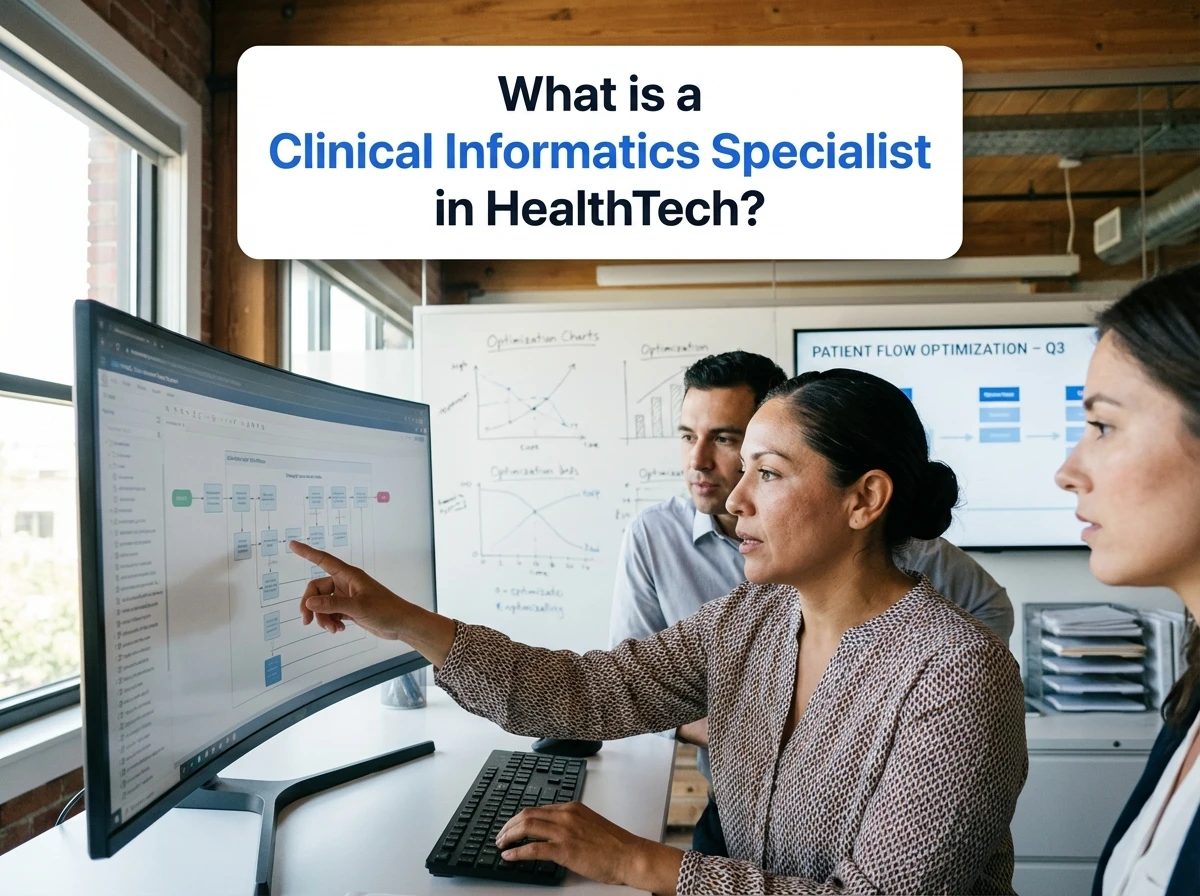
What is a Clinical Informatics Specialist in HealthTech?
A Clinical Informatics Specialist in HealthTech is the person accountable for making sure a digital health product or clinical system supports safe, effective care in the real world. They sit at the boundary between clinical practice and technology delivery, owning the clinical correctness of requirements, the safety and governance expectations around change, and the practical adoption of the solution in live services.
This role exists because healthcare technology doesn't just "enable users". It can change decisions, pathways, and outcomes. A Clinical Informatics Specialist reduces the gap between what software teams build and what clinicians must safely do under pressure, with incomplete information, and within strict operational constraints. In practice, they are often the clinical voice in product and delivery teams, and the person stakeholders rely on when trade-offs involve clinical risk, workflow disruption, or patient-facing harm.
In many HealthTech organisations, the role sits within Product, Clinical Governance, Implementation/Professional Services, or a dedicated Clinical Informatics function. Accountability is typically shared across clinical safety, clinical assurance, change impact, and the translation of clinical needs into testable, buildable product decisions.
🔍 How this role differs in HealthTech
In many tech sectors, the primary risk of a wrong decision is financial loss, churn, or reputational damage. In HealthTech, the same "small" design choice can alter clinical behaviour, delay escalation, introduce documentation errors, or create unsafe workarounds. That changes how a Clinical Informatics Specialist thinks: decisions are evaluated not only for usability and feasibility, but for downstream clinical risk, operational resilience, and how the system behaves in edge cases.
Health data is also intrinsically sensitive, and care delivery is highly interdependent. A solution that is "correct" in isolation can still fail when it meets handovers, community services, capacity constraints, or mixed digital maturity across sites. As a result, the Clinical Informatics Specialist spends more time on assurance, traceability, and controlled change than an equivalent role in less regulated industries. They are also expected to be comfortable saying "no" when delivery speed conflicts with safe adoption.
🎯 Core responsibilities in HealthTech
Day to day, the Clinical Informatics Specialist is responsible for turning clinical intent into operationally safe product decisions. That means shaping requirements so they are clinically unambiguous, defensible under scrutiny, and measurable in terms of outcomes and risk controls. They will often arbitrate between stakeholders who each have a valid perspective: clinicians who want safety and speed, operations teams who need throughput and consistency, and engineering teams who need clarity and scope boundaries.
A large part of the job is decision-making under constraints: legacy workflows, limited integration, variable data quality, and the reality that training time and change capacity are never unlimited. The specialist is expected to anticipate where a design will fail in practice (for example, under time pressure, during downtime, or when staff rotate), and to insist on mitigations that make the system safer even when perfect solutions aren't possible.
In many environments, they also carry explicit clinical governance responsibilities: supporting clinical assurance of features, contributing to clinical risk management activities, and helping the organisation demonstrate that clinical safety expectations have been met across the lifecycle of the product, especially when the product is used in settings where error can lead to harm.
🧩 Skills and competencies for HealthTech
Core Skill | HealthTech specific requirement | Reason or Impact |
|---|---|---|
Clinical judgement applied to digital change | Ability to interpret clinical intent and recognise when software behaviour could shift decision-making or escalation thresholds | Prevents "technically correct" features that create unsafe clinical behaviour or hidden failure modes |
Risk ownership and safety-by-design thinking | Comfort owning clinical risk trade-offs and insisting on mitigations, documentation, and controls proportionate to harm potential | Builds credible assurance and reduces the chance of patient harm from workflow or UI-induced errors |
Workflow realism and service empathy | Deep understanding of how care is delivered across roles, shifts, and settings, including interruptions and workarounds | Improves adoption and reduces the creation of parallel processes that undermine data quality and safety |
Requirements clarity under uncertainty | Translating complex, contested clinical needs into crisp decisions, constraints, and acceptance criteria | Enables engineering delivery without diluting clinical meaning or introducing ambiguity that later becomes risk |
Stakeholder leadership without formal authority | Influencing clinicians, product, engineering, and delivery teams (often across organisations) while holding firm on safety-critical points | Aligns multiple parties around safe, usable outcomes when incentives and priorities differ |
Data literacy with clinical context | Understanding what clinical data does and does not represent, and how coding, timing, and provenance affect reliability | Prevents unsafe automation, misleading dashboards, and inappropriate decision support driven by imperfect data |
Change governance and assurance mindset | Knowing when changes require more formal review, controlled rollout, monitoring, and rollback readiness | Reduces disruption and ensures the organisation can defend decisions when incidents, audits, or complaints occur |
💷 Salary ranges in UK HealthTech
Compensation in this role tends to track accountability more than time served. The biggest drivers are the criticality of the product (patient-facing decision support vs back-office workflows), the level of clinical safety and governance ownership expected, the complexity of deployment environments, and whether the role carries incident/on-call expectations. Location still matters, but role scope and regulated risk typically create wider variance than in many non-health sectors.
Experience level | Estimated annual salary range | What drives compensation |
Junior | London & South East: £35,000–£45,000 | Often supports senior informatics or implementation teams; narrower decision rights; expected to learn governance, workflow mapping, and requirements discipline |
Mid-level | London & South East: £45,000–£60,000 | Owns defined modules/pathways, contributes to clinical assurance, leads workshops, and is accountable for "what good looks like" in a bounded area |
Senior | London & South East: £60,000–£78,000 | Accountable for cross-cutting workflow decisions, higher-risk change, stakeholder alignment, and credible safety/governance input under delivery pressure |
Lead | London & South East: £78,000–£100,000 | Sets clinical informatics direction across product lines or major programmes; owns prioritisation trade-offs and assurance strategy; may manage a small team |
Head / Director | London & South East: £100,000–£140,000 | Organisation-level accountability for clinical informatics outcomes, clinical governance alignment, safety posture, and executive stakeholder management; often owns high-impact incident and escalation pathways |
Beyond base salary, total compensation commonly includes pension and standard benefits, and may include performance bonus. In some organisations, additional pay is linked to on-call/incident participation, particularly where clinical risk or service continuity requires rapid decision-making support. Equity is more common in venture-backed HealthTech than in provider environments, and varies sharply with company stage and hiring competitiveness. Total package typically moves up when the role is closer to safety-critical decisions, carries broader assurance accountability, or is tied to demanding deployment timelines across multiple sites.
🚀 Career pathways
People typically enter this role from two realistic directions: clinically trained professionals who move into digital and governance work, or HealthTech operators (implementation, product, analytics) who build deep clinical workflow credibility and then take on greater clinical accountability. Early progression is usually about moving from "supporting delivery" to owning a scoped clinical domain, where you are responsible for what the system must do, what it must not do, and how change will be introduced safely.
Over time, responsibility expands from individual features to pathways, then to portfolios: shaping standards for requirements quality, risk management expectations, roll-out governance, and how incidents are handled. The most durable progression comes from demonstrating you can make hard trade-offs transparently, defend them under scrutiny, and still ship outcomes that clinicians will use.
❓ FAQ
Do I need to be a registered clinician to become a Clinical Informatics Specialist in HealthTech?
Not always, but many roles strongly prefer it, especially where the job includes clinical assurance, clinical safety activities, or influencing clinical practice at scale. If you're not registered, you'll usually need to demonstrate exceptional workflow expertise, credibility with clinical stakeholders, and a clear understanding of safety and governance expectations.
What will the interview actually test for in this role?
Expect scenario-based evaluation: ambiguous requirements, conflicting stakeholder priorities, and a change that could increase clinical risk. Strong candidates show how they clarify intent, document trade-offs, propose mitigations, and decide what evidence is required before release, without hiding behind "it depends."
Will I be expected to join on-call or incident response?
It depends on how close the product is to time-critical care and whether clinical input is required during incidents. Even without formal on-call, many specialists are expected to support incident reviews, safety escalations, and urgent decisions during high-severity events, so you should ask about escalation expectations and rota structure early.
🔎 Find your next role
Ready to apply your clinical judgement to real-world product decisions? Search Clinical Informatics Specialist roles on Meeveem.
You might also like