Published Date: December 16, 2025
Updated Date: December 16, 2025
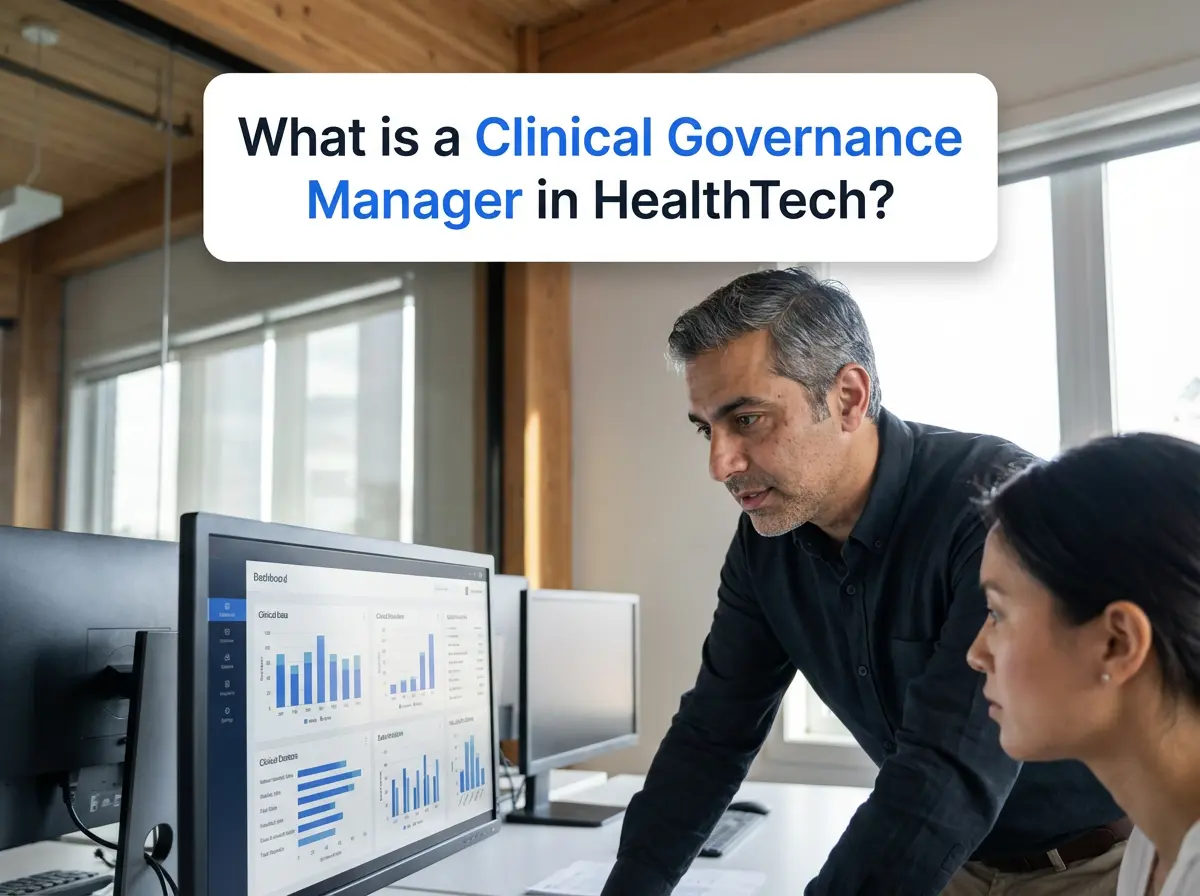
What is a Clinical Governance Manager in HealthTech?
A Clinical Governance Manager in HealthTech is the person accountable for proving, day in and day out, that a digital health service or product is being delivered safely, consistently, and to an acceptable clinical standard. They translate "we should be safe" into operational reality: clear governance routes, reliable assurance, and evidence that the organisation learns from risk rather than repeating it.
This role exists because HealthTech sits uncomfortably between two worlds: the pace and ambiguity of technology delivery, and the non-negotiable expectations of healthcare. Patients can be harmed by seemingly small failures: mis-triage, delayed escalation, poor handover, unsafe pathway design, weak incident learning, or inadequate oversight of complaints and clinical outcomes. The Clinical Governance Manager owns the mechanisms that prevent those failures becoming "normal," and ensures leaders cannot look away from the hard bits: risk, quality, and accountability.
At its core, the job is ownership. You are responsible for the integrity of clinical governance across the service: how incidents are handled, how risks are controlled, how quality is measured, how learning is embedded, and how the organisation demonstrates it is safe to operate at scale.
🔍 How this role differs in HealthTech
In many tech sectors, "governance" can drift into policy, controls, or internal process. In HealthTech, it is inseparable from real-world care delivery and patient outcomes. Decisions are constrained by clinical risk tolerance, regulatory scrutiny, and the fact that data and workflows may directly influence diagnosis, treatment, escalation, and safeguarding.
Compared with typical SaaS, the Clinical Governance Manager has to treat operational reality as part of the product: the pathway, the staffing model, the triage logic, the handoffs, the monitoring, the documentation, and the audit trail. Compared with FinTech, the risk isn't only financial or fraud-based. It includes clinical deterioration, missed warning signs, inappropriate clinical decisions, and reputational harm that can quickly become organisational survival risk.
HealthTech also adds a scaling challenge: what feels safe in a pilot can become unsafe at volume unless governance is designed to hold under load. This role exists to ensure the organisation scales with control, not optimism.
🎯 Core responsibilities in HealthTech
On a typical week, you sit at the centre of competing priorities: growth targets, product releases, operational capacity, and clinical safety. Your job is to keep decision-making honest. When something goes wrong (an incident, a complaint, a near miss), you are accountable for ensuring it is captured correctly, investigated to an appropriate depth, escalated to the right level, and converted into meaningful learning that changes practice (not just paperwork). You also create the reporting that allows senior leaders to see trends clearly, not selectively.
You'll spend significant time making trade-offs under constraint. For example: how quickly can the organisation safely launch a new pathway? What evidence is "enough" to expand a service into a higher-risk cohort? What must be standardised, and where can teams adapt locally without creating hidden risk? You'll often be the person who says "yes, if..." by setting conditions, mitigations, monitoring, and exit criteria that make innovation safe rather than blocked.
In HealthTech, governance is rarely confined to clinical teams. You'll work across clinical operations, product, data, engineering, and customer success to ensure risks are owned, controls are practical, and quality is measurable. The credibility of the role comes from being able to hold a firm safety line whilst still enabling delivery.
🧩 Skills and competencies for HealthTech
Core Skill | HealthTech specific requirement | Reason or Impact |
|---|---|---|
Clinical risk judgement | Ability to interpret clinical risk in digitally-enabled pathways (including remote delivery and escalation dependencies) | Prevents "paper-safe" governance that fails in real conditions and protects patients when the service scales |
Incident and complaint leadership | Confidence running proportionate investigations, learning cycles, and executive-ready narratives under time pressure | Ensures the organisation learns fast, reduces recurrence, and maintains trust with partners and patients |
Assurance and evidence thinking | Turning messy operational signals into defensible assurance (what you know, what you don't, and what you're doing about it) | Enables leaders to make decisions with clear risk visibility rather than optimism or incomplete reporting |
Influence without authority | Ability to change behaviour across product and operations even when teams don't "report to governance" | Governance fails if it's only a function; influence makes safety a shared operational reality |
Regulatory and standards fluency | Understanding how regulated expectations translate into day-to-day controls, monitoring, and documentation | Reduces surprises during scrutiny and prevents last-minute "compliance theatre" that distracts from real safety |
Systems thinking | Seeing the whole system: staffing, training, tooling, handovers, patient comms, data capture, and feedback loops | Helps identify upstream causes, not just downstream errors, and leads to sustainable fixes |
💷 Salary ranges in UK HealthTech
Pay for Clinical Governance Managers in HealthTech is shaped less by job title and more by the clinical risk profile of the service, how regulated the operating environment is, and how much accountability sits with the role. Salary moves up when you own governance for multi-site delivery, higher-acuity pathways, complex incident investigation, or when you are the key link between clinical operations and product teams. Expectations around out-of-hours responsiveness, incident escalation, and travel can also materially affect compensation, as can location and company maturity.
Experience level | Estimated annual salary range | What drives compensation |
Junior | London & South East: £30,000–£38,000 | Often governance support with defined scope (logging, coordination, reporting); pay rises with exposure to investigations and ownership of a small governance domain |
Mid-level | London & South East: £38,000–£50,000 | Ownership of core governance processes (incidents, complaints, risk registers, audit cycles) and the ability to run work independently across teams |
Senior | London & South East: £50,000–£65,000 | Higher-risk services, stronger accountability for assurance, deeper investigation capability, and responsibility for governance reporting into senior leadership |
Lead | London & South East: £60,000–£80,000 | Leading governance strategy across products/services, shaping controls and monitoring, mentoring others, and owning outcomes across multiple workstreams or regions |
Head / Director | London & South East: £80,000–£110,000 | Organisation-wide accountability, executive-level assurance, governance operating model design, oversight of high-impact incidents, and leadership across multi-disciplinary teams |
Typical add-ons vary by employer. Larger providers may offer performance-related bonuses and stronger pension/benefits; scale-ups are more likely to add equity/options, sometimes trading off against cash. On-call is not universal for this title, but some roles expect out-of-hours incident escalation cover. Where that exists, allowances (or enhanced pay via broader seniority) are more common when the service is high-acuity, runs extended hours, or has contractual response requirements. Total compensation also shifts with the intensity of regulatory scrutiny, the size of the clinical operation, and how directly the role is accountable for outcomes rather than coordination.
🚀 Career pathways
Most people enter HealthTech clinical governance from regulated care settings where governance is part of daily practice: clinical quality, patient safety, complaints, audit, or operational management roles. Others come from digitally-enabled services (telehealth, remote monitoring, triage) where they have seen how incidents emerge from process and product interaction, not just frontline clinical decisions.
Progression is driven by expanding ownership. Early on, you may own the mechanics: running governance cycles, maintaining registers, coordinating investigations. Over time, you become accountable for judgement: defining what "safe enough" means for a service change, setting monitoring thresholds, and challenging leaders when growth outpaces control. At senior levels, the role becomes more strategic: designing the governance operating model, building a culture that reports and learns, and creating executive assurance that can withstand scrutiny whilst still enabling innovation.
❓ FAQ
Do I need to be clinically registered to work as a Clinical Governance Manager in HealthTech?
Not always, but many HealthTech employers prefer registration where the role includes clinical judgement, investigation leadership, or direct accountability for pathway safety. If you're not registered, you'll typically need strong governance credentials and clear evidence you can operate confidently with senior clinicians and regulated expectations.
What will interviewers look for beyond "I know governance processes"?
They will test whether you can make proportionate decisions under pressure: what you escalate, what you accept with mitigations, and how you turn incidents into measurable change. Strong candidates can explain trade-offs clearly, show how they influence product and operations, and demonstrate a track record of closing the loop on learning.
Is out-of-hours work common for this role in HealthTech?
It depends on the service model. If the company delivers time-sensitive pathways or operates extended hours, you may be expected to support incident escalation or urgent risk decisions outside standard hours, even if it's not labelled as formal on-call. Clarify expectations early: frequency, response time, rota coverage, and whether compensation reflects that responsibility.
🔎 Find your next role
Ready to take ownership of safety and quality in digital care? Search Clinical Governance Manager roles on Meeveem and find a HealthTech team where governance is treated as a core capability, not a checkbox.
You might also like