Published Date: December 16, 2025
Updated Date: December 16, 2025
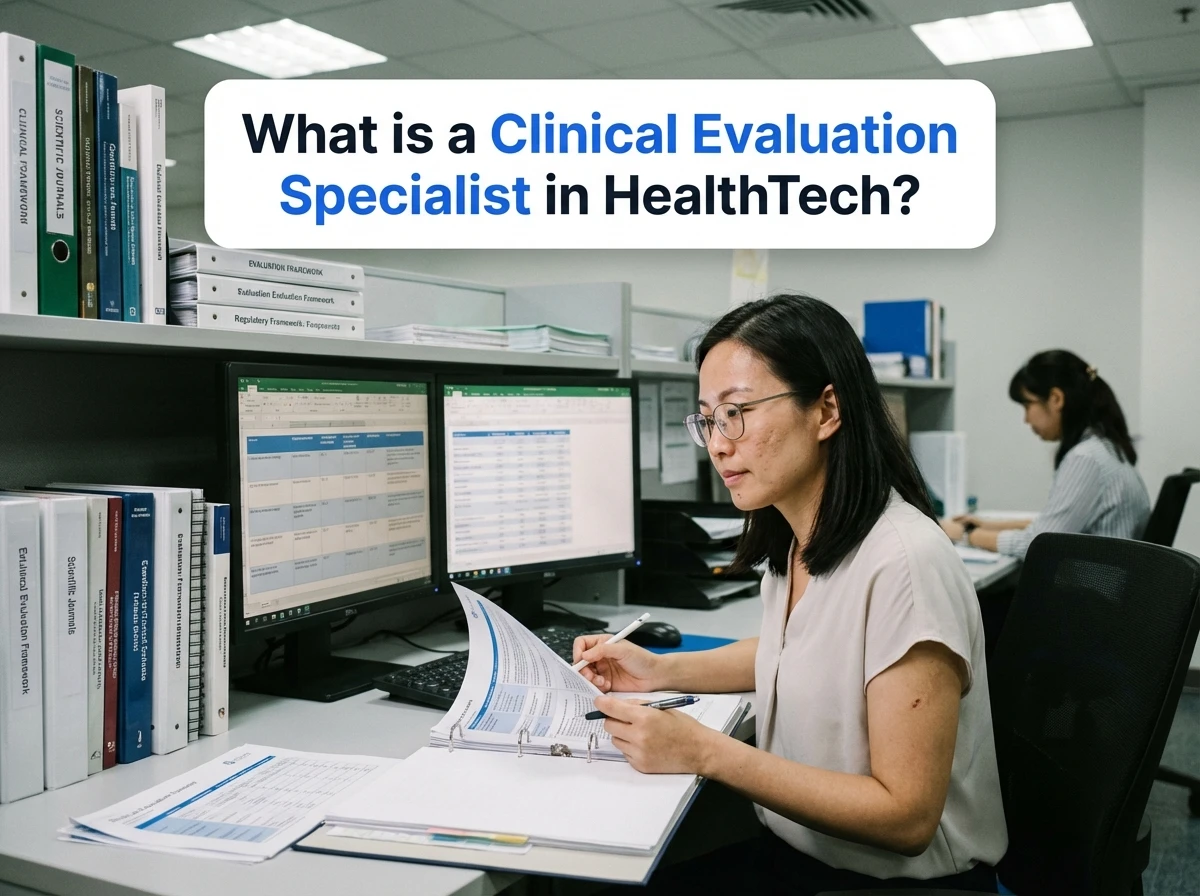
What is a Clinical Evaluation Specialist in HealthTech?
A Clinical Evaluation Specialist in HealthTech is responsible for proving, through structured clinical evidence, that a digital health product or medical device is safe, works as intended, and can credibly support its clinical claims throughout its lifecycle. In practice, this means owning the clinical evidence story that underpins market access, regulatory submissions, and ongoing post-market confidence: what the product claims, what the evidence shows, where the uncertainties lie, and what needs to happen next.
This role exists because HealthTech products make real-world decisions and recommendations in clinical settings, often using sensitive patient data and interacting with established care pathways. A credible clinical evaluation is what transforms a promising product into something that can be trusted by regulators, buyers, clinicians, and safety teams, without over-claiming, under-evidencing, or creating avoidable patient risk.
The emphasis is less on writing documents and more on ownership: owning the clinical evidence plan, the defensibility of conclusions, the traceability from claim to evidence, and the alignment between clinical benefit, risk management, and post-market obligations. When the organisation wants speed, the Clinical Evaluation Specialist ensures that speed doesn't become fragility.
🔍 How this role differs in HealthTech
In many tech industries, evaluation is primarily about usability, conversion, or commercial outcomes, and a product can iterate quickly even if evidence is incomplete. In HealthTech, iteration still matters, but the tolerance for ambiguous outcomes is far lower because the product's impact can be clinical, not just behavioural. The Clinical Evaluation Specialist operates in an environment where the cost of a wrong conclusion can be patient harm, regulatory action, loss of clinical trust, or withdrawal from market.
HealthTech also changes the decision surface for evidence. Data is sensitive, often incomplete, and shaped by clinical workflows; a neat A/B test mindset rarely transfers cleanly. The role must reconcile clinical reality (heterogeneous populations, confounding, care pathway variability) with product reality (versioning, model drift, continuous deployment, and changing integrations). And because stakeholders span clinical, regulatory, quality, product, and commercial functions, the Clinical Evaluation Specialist becomes a translator of risk and evidence, not just a producer of analysis.
🎯 Core responsibilities in HealthTech
Day to day, the Clinical Evaluation Specialist is the person who holds the line on what can responsibly be claimed, what must be demonstrated, and what evidence gaps are acceptable (if any) given the product's intended use and risk profile. They shape how the organisation frames clinical value: defining the clinical questions that matter, agreeing acceptance criteria, and making sure clinical evaluation stays connected to the product's actual use in the field rather than an idealised scenario.
Much of the work is decision-making under constraint. Timelines are fixed by commercial pressure, but evidence takes time; product teams want flexibility, but clinical conclusions require stability and traceability; safety signals can be rare, but consequences are severe. The role navigates these trade-offs by setting a defensible approach to evidence synthesis, aligning stakeholders early, and building evaluations that can withstand scrutiny, internally from risk and quality teams, and externally from assessors, auditors, and clinical buyers.
In mature organisations, the role often sits within Regulatory Affairs, Clinical Affairs, Quality, or a cross-functional evidence function, with strong links to Product and Data/Science. In earlier-stage HealthTech, it may be one of the few roles capable of connecting clinical claims, real-world performance, and regulatory expectations into a single, coherent storyline the company can stand behind.
🧩 Skills and competencies for HealthTech
Core Skill | HealthTech specific requirement | Reason or Impact |
|---|---|---|
Clinical judgement | Ability to interpret evidence in the context of real clinical workflows, not just study design elegance | Prevents "technically true" conclusions that fail in practice, protecting patient safety and credibility |
Evidence ownership | Comfort being accountable for what the organisation claims, what it cannot claim, and why | Reduces regulatory and commercial risk by avoiding overreach and building trust with clinical stakeholders |
Risk-based thinking | Framing evaluation effort proportional to intended use, patient impact, and uncertainty | Ensures limited time and data are spent where harm or misleading claims are most likely |
Stakeholder leadership | Aligning clinical, product, regulatory, and quality leaders on evidence thresholds and timelines | Avoids late-stage conflict where teams discover too late that evidence is insufficient or misaligned |
Scientific writing with defensibility | Producing clear, auditable rationale from claim to evidence to conclusion, with traceability | Makes clinical evaluation resilient under review, audit, and procurement scrutiny |
Critical appraisal | Assessing bias, relevance, and generalisability across heterogeneous clinical data sources | Prevents false confidence from weak studies, non-comparable populations, or optimistic endpoints |
Lifecycle mindset | Treating clinical evaluation as ongoing: updates, surveillance inputs, and change impact | Maintains confidence as products evolve, datasets shift, and new safety/performance signals emerge |
Ethics and data sensitivity | Handling patient data and clinical insights with confidentiality and appropriate governance | Protects patients and the organisation, and supports adoption in privacy- and safety-conscious environments |
💷 Salary ranges in UK HealthTech
Compensation is primarily driven by where the role sits in the accountability chain: who signs off clinical claims, how directly the work influences market access, how exposed the organisation is to scrutiny, and how much ambiguity the specialist is expected to resolve. Salaries also vary with product risk level, evidence complexity (multiple indications, multi-site evidence, AI/ML change management), stakeholder breadth (regulatory/quality leadership expectations), and location. On-call is uncommon for this role, but some organisations expect responsiveness around safety issues, field actions, or submission deadlines.
Experience level | Estimated annual salary range | What drives compensation |
Junior | London & South East: £35,000–£45,000 | Limited autonomy; supports evidence gathering and sections of evaluation under supervision; narrower product scope |
Mid-level | London & South East: £45,000–£60,000 | Owns evaluations for defined products/modules; increasing independence in evidence appraisal and claim alignment |
Senior | London & South East: £60,000–£78,000 | Leads complex evaluations, manages cross-functional alignment, handles higher-risk claims and challenging evidence gaps |
Lead | London & South East: £78,000–£95,000 | Sets evaluation strategy across a portfolio, coaches others, interfaces with senior risk/quality/regulatory leadership |
Head / Director | London & South East: £95,000–£130,000 | Accountable for organisational evidence posture, governance, external readiness, and prioritisation across products and markets |
Typical add-ons beyond base include a performance bonus (often tied to delivery milestones and quality outcomes), pension and benefits, and, more commonly in venture-backed HealthTech, equity options. On-call allowances are not typical, but total compensation can rise when the role carries high external scrutiny, tight submission timelines, or operational responsibility for urgent evidence updates tied to safety signals or field actions.
🚀 Career pathways
Entry points are often from clinical research, clinical operations, medical writing, regulatory/quality roles in medical devices, or clinical backgrounds where the candidate has learnt to translate clinical reality into structured evidence. Some HealthTech professionals also transition from data or product-adjacent roles after building strong competence in clinical risk and evidence interpretation, but they usually need to demonstrate credibility with clinical stakeholders.
Progression is mainly about expanding ownership. Early on, the focus is executing parts of an evaluation well; later, it becomes owning the end-to-end argument for a product's clinical value and safety, anticipating reviewer concerns, and shaping what "good evidence" looks like for the organisation. At senior levels, the role broadens into portfolio strategy, governance, mentoring, and being the person the business trusts to say "yes, with conditions" or "not yet" when clinical claims and evidence don't match.
❓ FAQ
Do I need a clinical qualification to be credible as a Clinical Evaluation Specialist in HealthTech?
Not always, but you do need demonstrable clinical reasoning and strong evidence appraisal skills. Many teams value advanced life sciences training or significant medical device/digital health evidence experience, especially when claims are complex. What matters most is whether you can defend conclusions and communicate risk clearly to both clinical and product stakeholders.
What will I be judged on in the first 90 days in this role?
Typically: whether you can map product claims to evidence without over-claiming, identify and prioritise evidence gaps, and create alignment across product, regulatory, and quality teams. Hiring managers also look for how you handle ambiguity, being pragmatic without compromising defensibility.
Is this role likely to involve on-call or out-of-hours work?
Routine on-call is uncommon, but deadlines and safety-driven updates can create occasional peaks. The higher the product risk and the closer the role sits to external submissions or post-market safety response, the more you should expect time-sensitive requests and short-notice prioritisation.
🔎 Find your next role
Ready to apply your clinical judgement to real product decisions? Search Clinical Evaluation Specialist roles on Meeveem.
You might also like