Published Date: December 30, 2025
Updated Date: December 30, 2025
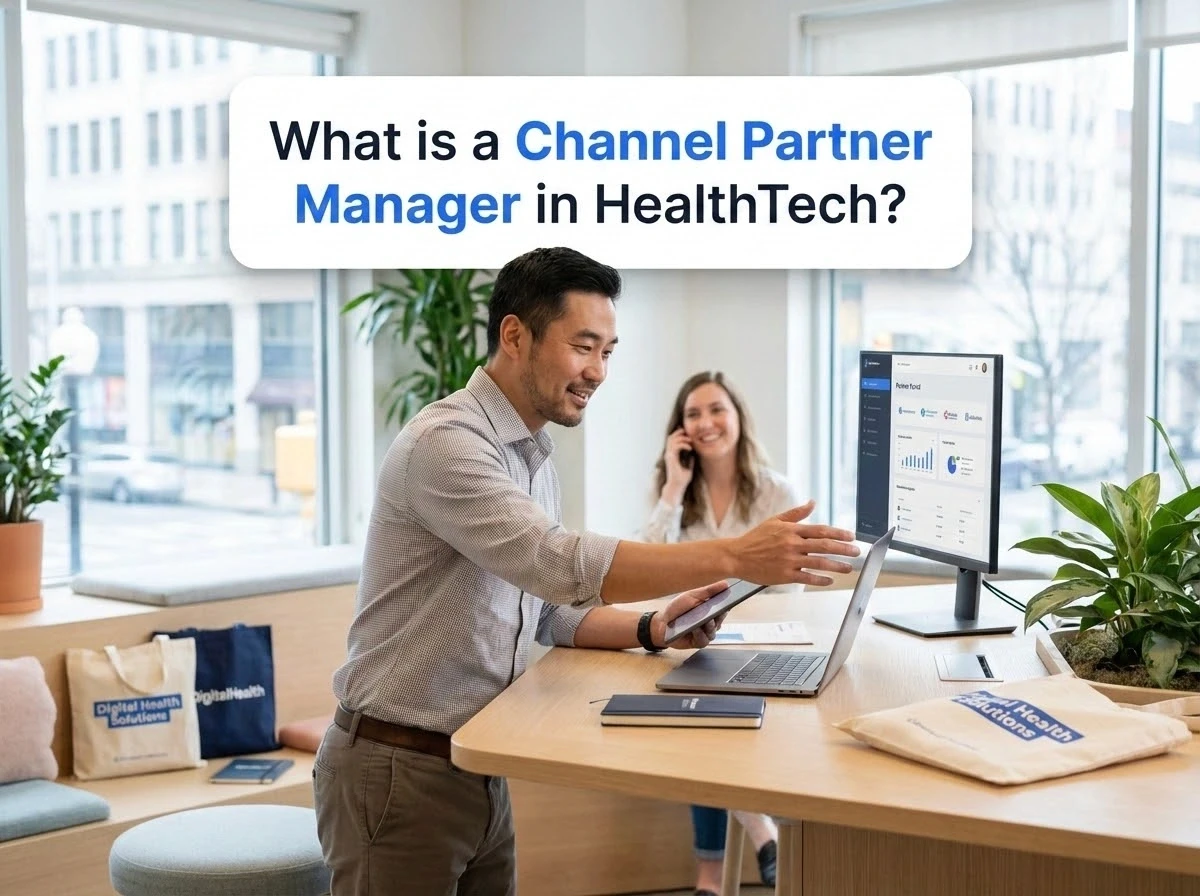
What is a Channel Partner Manager in HealthTech?
A Channel Partner Manager in HealthTech is responsible for revenue and adoption that comes through third parties such as resellers, systems integrators, implementation partners, referral partners, device distributors, or platform alliances rather than through a purely direct sales motion. Their job isn't about "being friendly with partners"; it's about owning the commercial outcomes of a partner route to market and making that route reliable, scalable, and governable.
This role exists because many HealthTech buyers don't purchase or deploy technology in a straight line. Procurement can be complex, stakeholders are fragmented across clinical, operational, digital, and finance teams, and delivery often relies on partners who already hold trust, framework access, service capacity, or an existing footprint. A Channel Partner Manager is responsible for turning that reality into repeatable growth without compromising patient safety, data protection, or delivery quality.
In most organisations, the role sits in Sales/Commercial (often alongside Partnerships/Alliances) and works day to day with Product, Security/Compliance, Customer Success, and Implementation. In smaller HealthTech companies it can be a "full-stack" partnerships role; in larger ones it is more likely to be specialised, with separate functions for partner marketing, partner operations, and alliances.
🔍 How this role differs in HealthTech
In many SaaS and consumer tech contexts, channel is primarily an efficiency play: lower CAC, broader reach, faster expansion. In HealthTech those goals still matter, but they sit underneath a tougher constraint: you are scaling real world outcomes and regulated risk at the same time as you scale revenue.
That changes what "good" looks like. A partner that can generate pipeline but repeatedly causes implementation delays, weak clinical adoption, poor information governance, or misaligned claims becomes a liability, both commercially and reputationally. HealthTech channel management therefore leans more heavily on governance, clear accountability boundaries, and disciplined enablement. The Channel Partner Manager is often the person who must make trade-offs explicit: where to standardise the partner motion, where to allow flexibility for local care settings, and when to pause growth because the delivery model isn't safe or robust enough yet.
You also tend to see more scrutiny on messaging, proof points, and contractual structure. Partners frequently want freedom in how they sell; HealthTech buyers often demand precision in what is being promised, how data is handled, and how service continuity works. The Channel Partner Manager lives in that tension.
🎯 Core responsibilities in HealthTech
On a normal week, the Channel Partner Manager is balancing three accountabilities that constantly pull against each other: partner-sourced revenue, partner-delivered customer experience, and organisational risk control.
They set the shape of the partner ecosystem (who the business should work with, why, and on what terms) and then they own the partner lifecycle end to end. That means deciding which partners are worth enabling deeply versus which should remain opportunistic, defining joint business plans and targets, and ensuring pipeline and forecasting are credible rather than optimistic. When performance slips, they are the person expected to diagnose whether the issue is partner capability, product fit, positioning, pricing/margin, procurement friction, or delivery constraints, and then act.
In HealthTech, "acting" often means coordinating trade-offs across teams. A partner may push for a bespoke workflow to win a deal; the product team may be protecting a roadmap; implementation may be at capacity; security may require a different architecture; and the customer may need rapid deployment. The Channel Partner Manager's responsibility is to make a commercial decision that the business can stand behind, often by tightening enablement, redefining what the partner can sell, changing commercial incentives, or gating access to certain deployments until quality thresholds are met.
They are also responsible for operational discipline: clear rules of engagement (who owns what in the sales cycle), escalation paths, partner training cadence, co-selling motions, and clean handovers to implementation and support. When those mechanics are weak, channel becomes chaos; in HealthTech, chaos becomes risk.
🧩 Skills and competencies for HealthTech
Core Skill | HealthTech specific requirement | Reason or Impact |
|---|---|---|
Commercial judgement | Ability to weigh partner-driven revenue against delivery capacity, patient impact sensitivity, and buyer risk tolerance | Prevents "winning" deals that create downstream failures, escalations, or reputational harm |
Partner governance | Defining clear engagement rules, accountability boundaries, and escalation routes across partner, vendor, and customer teams | HealthTech projects fail when ownership is ambiguous; governance protects outcomes and reduces costly rework |
Negotiation | Structuring terms that balance margin, implementation effort, service responsibilities, and compliance obligations | Deals must be sellable and deliverable; poor terms can lock the business into unprofitable or risky commitments |
Stakeholder leadership | Influencing Security, Product, Clinical/Implementation, and Sales without formal authority | Channel success depends on cross-functional decisions; HealthTech constraints make alignment non-optional |
Risk-aware communication | Precision in what is promised, how claims are evidenced, and how limitations are stated | Reduces mis-selling, protects trust, and supports procurement processes that demand clarity |
Enablement design | Building repeatable partner training that reflects real procurement and deployment pathways in healthcare settings | Partners need more than a pitch deck; they need a safe, accurate, and operationally realistic route to value |
Forecasting discipline | Interpreting partner pipelines with healthy scepticism and clear stage definitions | Partner pipelines are often inflated; disciplined forecasting protects hiring, delivery planning, and cashflow decisions |
Conflict resolution | Managing channel conflict (direct vs partner), account ownership disputes, and delivery escalations | HealthTech sales cycles are long and multi-party; unresolved conflict can stall adoption and damage relationships |
💷 Salary ranges in UK HealthTech
Compensation for Channel Partner Managers in UK HealthTech typically reflects: the size and maturity of the partner ecosystem, quota/target ownership, the complexity of procurement pathways, delivery and regulatory risk exposure, and how directly the role carries a number (revenue, pipeline, or partner-sourced bookings). Location still matters (London & South East often pays more) but the biggest variation usually comes from scope (one strategic alliance vs a national ecosystem), seniority, and whether the role is closer to "partner sales" (higher variable pay) or "partner operations/enablement" (higher base, lower variable).
Experience level | Estimated annual salary range | What drives compensation |
Junior | London & South East: £35,000–£45,000 | Often supports a partner manager or runs smaller partners; limited quota ownership; emphasis on coordination and enablement execution |
Mid-level | London & South East: £45,000–£65,000 | Manages a portfolio with measurable targets; more autonomy in partner planning and deal progression; stronger expectation of forecasting accuracy |
Senior | London & South East: £65,000–£90,000 | Owns strategic partners, complex co-sell, and higher-stakes negotiations; typically accountable for a meaningful share of revenue or pipeline |
Lead | London & South East: £90,000–£120,000 | Defines partner strategy for a segment/region; shapes commercial frameworks and governance; often manages partner managers and carries a larger target |
Head / Director | London & South East: £120,000–£170,000 | Owns ecosystem strategy and executive partner relationships; sets operating model, coverage, targets, and risk controls; accountable for channel as a growth engine |
Beyond base salary, total compensation commonly includes variable pay tied to partner-sourced bookings, pipeline, or strategic milestones (often structured as bonus or OTE). Equity is more common in venture-backed HealthTech and tends to increase with seniority and breadth of responsibility. On-call allowances are uncommon for this role, but compensation can be higher where the role carries heavy escalation responsibility during critical deployments, high-severity incidents, or time-sensitive go-lives, especially if the partner model makes the Channel Partner Manager the default "commercial owner" for urgent issues. The biggest drivers of total compensation variation are quota size, partner mix (strategic vs long-tail), deal size, and how much delivery risk the role is expected to personally absorb.
🚀 Career pathways
Common entry points include commercial account management, business development, customer success in partner-led businesses, or implementation-facing roles where someone has learnt how healthcare deployments really succeed (and fail). Some people move in from distribution, reseller management, or public-sector procurement environments, bringing credibility with how buying decisions are actually made.
Progression typically happens when ownership expands from "running a partner book" to "designing the partner motion." Early on, you prove you can make a small set of partners productive without creating delivery chaos. At senior levels, you're trusted to handle complex negotiations, shape joint go-to-market, and protect quality at scale. Lead and Head roles are less about being the best closer and more about building a system: partner segmentation, enablement standards, rules of engagement, forecasting discipline, and cross-functional operating rhythm that makes channel predictable.
❓ FAQ
1) Will I be judged on partner relationships or partner-sourced revenue in HealthTech?
Usually both, but revenue (or pipeline) is the deciding metric. In HealthTech, relationship quality matters because weak relationships show up as delivery friction, escalations, and stalled adoption. Expect assessment on measurable outcomes plus evidence you can run governance under pressure.
2) How do HealthTech employers test whether I can manage partner risk, not just partner sales?
They'll probe how you prevent overpromising, handle conflicts in accountability, and decide when to slow down or say no to protect delivery quality. Strong candidates describe how they set rules of engagement, stage gates, and escalation paths, then enforce them consistently.
3) If I'm moving from SaaS channel, what's the biggest adjustment I should expect?
The pace of procurement and deployment is often slower, and the cost of a bad handover is higher. You'll need to show you can operate with precision (what's promised, what's evidenced, and what's deliverable) whilst still keeping partners motivated and commercially effective.
🔎 Find your next role
If you're ready to build and scale partner ecosystems that hold up in real healthcare settings, search Channel Partner Manager roles on Meeveem.
You might also like