Published Date: December 30, 2025
Updated Date: December 30, 2025
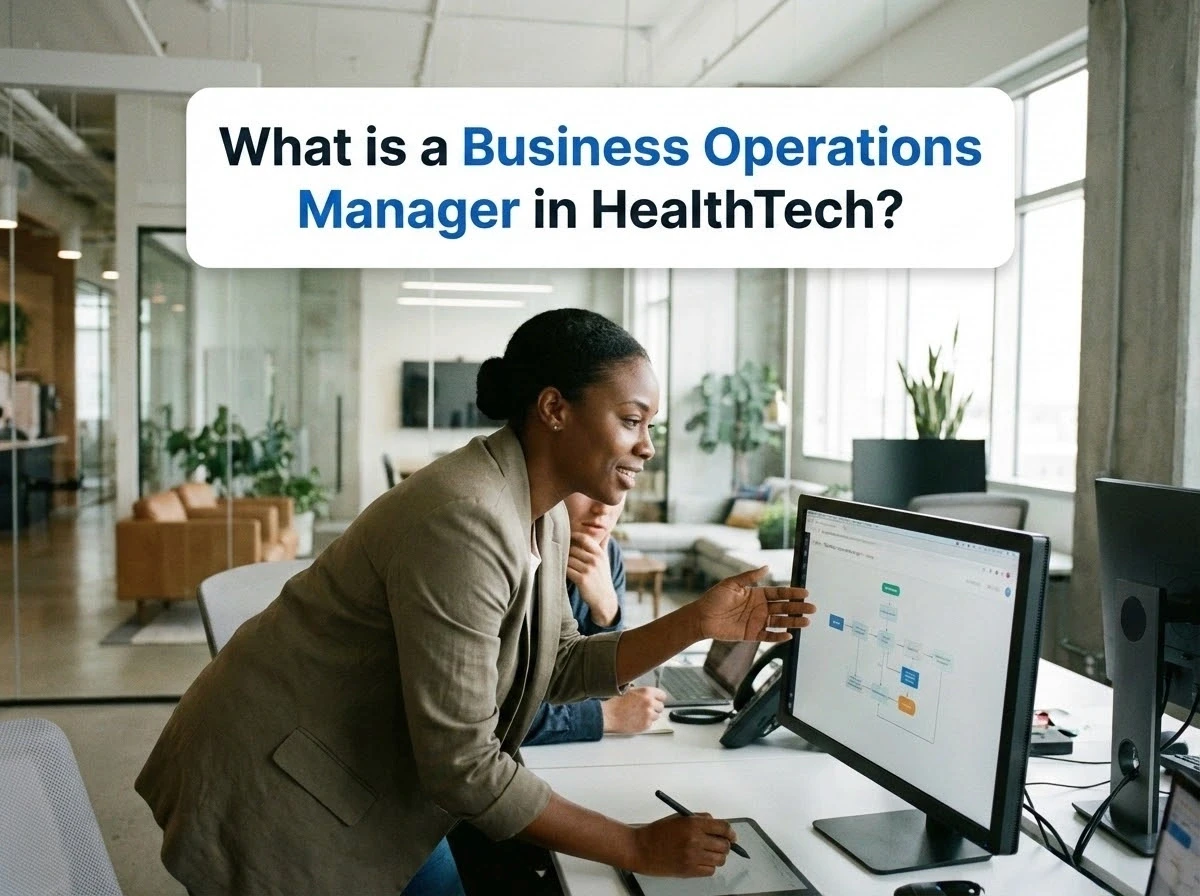
What is a Business Operations Manager in HealthTech?
A Business Operations Manager in HealthTech is the person accountable for making the company run predictably as it grows: turning strategy into repeatable operations, tightening execution across teams, and ensuring the business can deliver outcomes safely, compliantly, and at scale.
This role exists because HealthTech companies operate with more "real-world friction" than many other tech businesses: sensitive data, complex service delivery, clinical and commercial constraints, and higher expectations for auditability and reliability. As product and revenue scale, decisions stop being purely about shipping features and start being about running a system, one where small operational weaknesses can become patient risk, regulatory exposure, or expensive delivery failure.
The centre of gravity is ownership: owning how work flows across functions, owning clarity when priorities collide, owning operational controls that keep delivery stable, and owning the escalation path when reality diverges from the plan.
🔍 How this role differs in HealthTech
In many SaaS or consumer-tech settings, business operations is often optimised around speed, unit economics, and internal productivity. In HealthTech, those still matter, but they sit alongside a higher duty of care for privacy, safety, and traceability, and a lower tolerance for "we'll fix it later" operating habits.
A Business Operations Manager in HealthTech typically makes decisions with heavier constraints: data sensitivity changes how information moves through the organisation; regulated or quasi-regulated environments raise the bar on documentation and control; and real-world impact changes the acceptable risk profile for process shortcuts. Even where the role isn't formally "compliance", the operational decisions they make can either strengthen or weaken the organisation's governance posture.
The result is a role that often sits closer to the executive "control plane" of the business, working across product, commercial, clinical/medical, service delivery, finance, and people operations to keep decisions consistent, auditable, and implementable.
🎯 Core responsibilities in HealthTech
Day to day, this role is accountable for translating leadership intent into operating reality. That might mean shaping how priorities are set, how capacity is allocated, how cross-functional work is sequenced, and how performance is measured, then intervening when the system starts to wobble. In HealthTech, the work is rarely "just process"; it's about preventing predictable failure modes in delivery, quality, and customer outcomes.
A typical week involves resolving trade-offs that have no perfect answer: pushing growth without breaking service standards; tightening controls without stalling teams; standardising workflows without ignoring clinical nuance; and escalating risks early without creating unnecessary bureaucracy. The Business Operations Manager is often the person who notices that the organisation is making incompatible promises, and then forces a decision, sets the operating rule, and ensures it actually lands.
They also tend to carry accountability for governance mechanics that keep the company defensible: decision logs, policy ownership, audit readiness, vendor and partner operational due diligence, incident learnings translating into operational change, and ensuring leadership has reliable information to steer the business. The output is not documents for their own sake; it's operational stability and credible execution under constraint.
🧩 Skills and competencies for HealthTech
Core Skill | HealthTech specific requirement | Reason or Impact |
|---|---|---|
Operational ownership | Owning outcomes across functions that may include clinical, technical, and commercial stakeholders with different definitions of "done" | Prevents gaps where safety, privacy, or delivery quality falls between teams |
Risk-based judgement | Comfort deciding when to accept, mitigate, transfer, or stop risk in environments with sensitive data and real-world consequences | Improves reliability and reduces costly incidents, churn, and governance failures |
Governance and policy stewardship | Turning policies into operating behaviours (not shelfware) whilst keeping documentation usable and proportionate | Creates auditability without paralysing execution |
Stakeholder influence | Influencing senior leaders and specialists without formal authority, including challenging decisions that increase operational or compliance exposure | Enables consistent decisions and reduces "shadow operations" workarounds |
Systems thinking | Seeing how incentives, metrics, capacity, and process interact across product delivery and service delivery | Prevents local optimisations that damage end-to-end outcomes |
Commercial and financial fluency | Linking operational choices to margin, cash, and customer commitments whilst respecting care/quality constraints | Keeps growth sustainable and reduces firefighting driven by unrealistic promises |
Incident and escalation leadership | Running calm escalations, coordinating response, and converting lessons into durable operational change | Shortens time-to-recovery and increases organisational resilience |
Clear communication | Producing decision-ready updates, trade-off framing, and crisp operating guidance for mixed audiences | Speeds alignment and reduces costly rework and misinterpretation |
💷 Salary ranges in UK HealthTech
Compensation is driven less by the title and more by the scope of what you "carry": operational criticality (does revenue or delivery fail without you), degree of regulated constraint, complexity of service delivery, senior stakeholder exposure, and whether you're expected to operate in high-trust environments (governance, audit readiness, sensitive data handling). Location still matters, especially for London and the South East, whilst some HealthTech employers price roles nationally if they are fully remote.
Experience level | Estimated annual salary range | What drives compensation |
Junior | London & South East: £35,000–£45,000 | Role is often closer to operations execution and coordination, with limited ownership of governance, budgets, or cross-functional prioritisation |
Mid-level | London & South East: £45,000–£60,000 | Increased responsibility for cross-team delivery, KPI ownership, process design, and running operational cadences with measurable outcomes |
Senior | London & South East: £60,000–£80,000 | Accountability expands into decision-making under constraint, risk management, governance ownership, and higher-impact stakeholder management |
Lead | London & South East: £75,000–£95,000 | Leading an operating domain (or multiple), shaping operating model, owning critical cross-functional programmes, and being accountable for reliability of execution |
Head / Director | London & South East: £95,000–£130,000 | Organisation-wide operational accountability, executive partnership, higher exposure to regulatory and reputational risk, and responsibility for scaling teams and controls |
Beyond base salary, typical add-ons include an annual performance bonus (often modest at junior/mid levels and more meaningful at senior leadership), and equity in many venture-backed HealthTechs (more common and more material as seniority increases). On-call allowance is not a standard expectation for this role, but can appear where business operations directly supports time-critical service delivery, incident coordination, or operational response; where it exists, total compensation varies with the frequency and intensity of coverage. Total comp also shifts based on company stage (startup vs scale-up), whether the role includes line management, and how directly the role is tied to revenue protection, compliance posture, or delivery continuity.
🚀 Career pathways
Common entry points include operations analyst roles, project/programme coordination, customer operations in regulated environments, implementation delivery, governance support, or finance/strategy-adjacent roles that move closer to execution. In HealthTech, candidates who have operated around sensitive data, quality systems, or service delivery constraints often transition faster because they already understand the cost of operational ambiguity.
Progression tends to follow expansion of ownership: first owning a workflow, then owning an operating cadence, then owning a cross-functional system (for example, capacity planning linked to customer commitments), and eventually owning an operating model across domains. The people who advance are those who can keep execution reliable whilst simplifying the organisation: reducing noise, clarifying decisions, and making good trade-offs visible and repeatable.
Longer-term pathways often include Head of Business Operations, Head of Operations, Chief of Staff (in some companies), or moving into general management where the operational system becomes part of owning a full business line.
❓ FAQ
1) Will I be expected to "own compliance" as a Business Operations Manager in HealthTech?
Often you'll own how compliance is operationalised rather than being the formal compliance function. You may be responsible for policy lifecycle, governance routines, audit readiness evidence, and making sure teams actually follow agreed controls. Clarify early whether you're accountable for the compliance programme itself or accountable for making it real in day-to-day operations.
2) How do HealthTech employers assess Business Operations Manager candidates at interview?
They typically look for evidence you can run cross-functional work without hiding behind process: clear decision framing, strong prioritisation under constraint, and a record of preventing repeated operational failure modes. Expect questions on messy scenarios: competing priorities, incidents, stakeholder conflict, and situations where documentation and controls matter.
3) Is on-call part of the job for Business Operations Managers in HealthTech?
Not always, but it can be, especially where the company runs a live service with time-sensitive operational incidents. If on-call exists, ask what you're expected to do when paged (coordinate, decide, communicate, or execute), how often it occurs, and whether there's an allowance or time off in lieu. The intensity of on-call, more than its mere presence, tends to be the real differentiator for role fit and total compensation.
🔎 Find your next role
Ready to apply? Search for Business Operations Manager roles in HealthTech on Meeveem and filter by location, seniority, and operating scope.
You might also like