Published Date: January 6, 2026
Updated Date: January 6, 2026
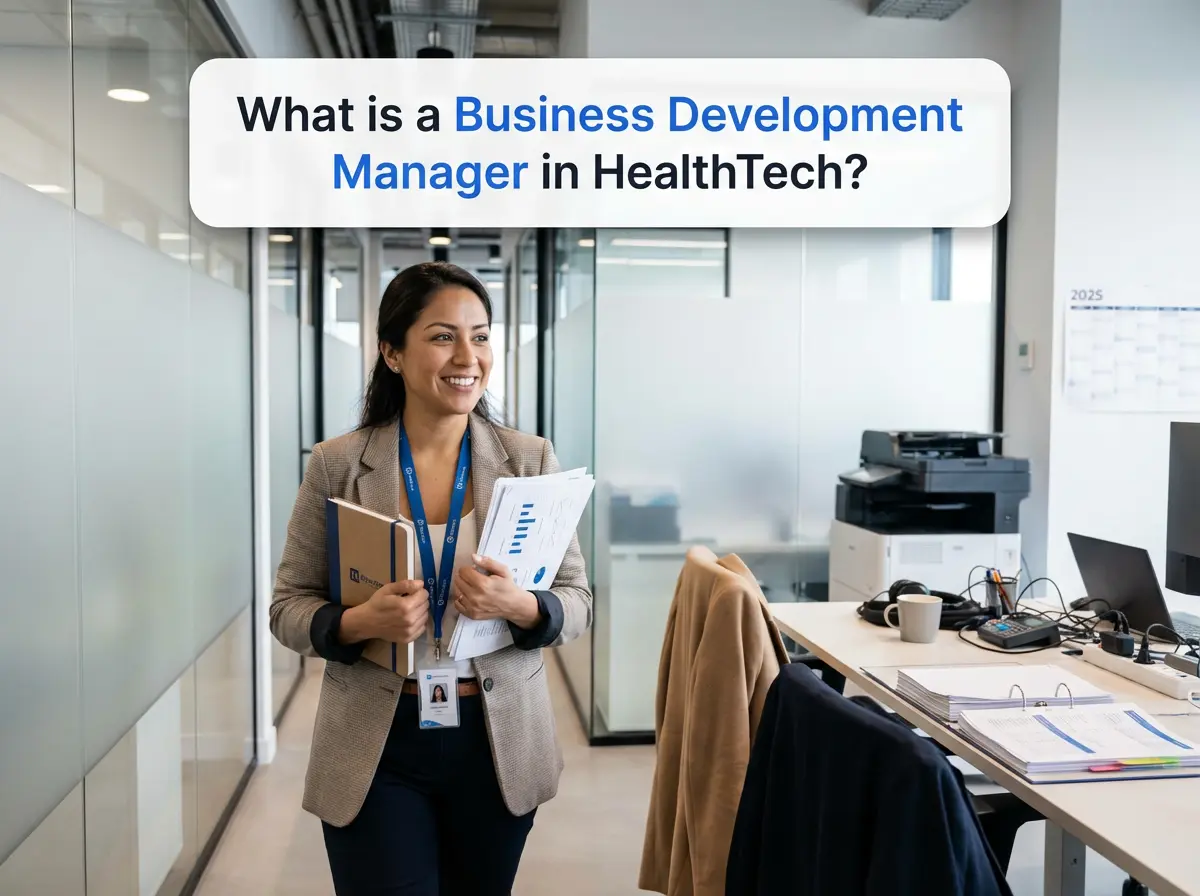
What is a Business Development Manager in HealthTech?
A Business Development Manager in HealthTech owns the commercial growth of a product or service that touches healthcare delivery. Their job is to create, qualify, and convert revenue opportunities while protecting the company from the avoidable risks that come with clinical environments, sensitive data, and complex buying structures.
This role exists because HealthTech rarely "sells itself". Even when a product is excellent, adoption requires trust, evidence, internal alignment, and a route through procurement, governance, and operational constraints. The Business Development Manager is accountable for turning market potential into signed agreements (and renewals or expansions where relevant), without creating downstream delivery obligations the organisation cannot safely meet.
In most HealthTech organisations, this role sits in the commercial function and is measured on outcomes: pipeline quality, win rates, contract value, time-to-close, and the health of strategic relationships. The methods vary by company, but the ownership is consistent: bring in the right customers on the right terms, and do it in a way that keeps delivery, compliance, and reputation intact.
🔍 How this role differs in HealthTech
In many tech sectors, business development can be largely about speed: generate demand, iterate the pitch, close quickly, and let the product prove value after purchase. HealthTech changes that operating model. The stakes are higher, the data is more sensitive, and the cost of a poor-fit customer is rarely just churn. It can be operational disruption, reputational damage, and prolonged governance work.
HealthTech buying decisions also tend to be multi-threaded. A "yes" usually requires more than an enthusiastic end user: it needs clinical confidence, operational feasibility, information governance comfort, and a procurement route that stands up to scrutiny. That means business development is less about persuasion in the moment and more about building a credible case, aligning stakeholders, and choosing the opportunities that the product and organisation can genuinely support.
As a result, strong HealthTech Business Development Managers are conservative in the right places. They know when to slow down a deal to avoid hidden obligations, and when to accelerate because the internal and external conditions are aligned.
🎯 Core responsibilities in HealthTech
Day to day, a Business Development Manager in HealthTech is accountable for shaping a pipeline that the company can actually deliver against. They spend time with prospective customers to understand clinical workflows, operational pressures, and constraints that would break a standard "tech sales" approach. Discovery is not a formality. It is where they decide whether the problem is real, whether the organisation can adopt, and whether the solution will be considered safe and credible.
They also make constant trade-offs between speed and certainty. Pushing a deal forward without the right approvals can create stalled procurement cycles and wasted senior time; over-engineering the process can lose momentum and budget. The best operators manage this by setting clear mutual plans, surfacing risks early (integration, resourcing, governance, change management), and negotiating terms that reflect the true scope of delivery.
Internally, they carry the commercial narrative into the organisation. They translate market feedback into product and delivery implications, they align with clinical, security, and implementation stakeholders on what can be promised, and they protect teams from "commercial optimism" that turns into rushed, risky deployments. In smaller HealthTechs, they may also own partner strategy and co-selling motions; in larger ones, they tend to specialise by segment, region, or product line while still being held to measurable revenue outcomes.
🧩 Skills and competencies for HealthTech
Core Skill | HealthTech specific requirement | Reason or Impact |
|---|---|---|
Stakeholder judgement | Ability to map influence across clinical, operational, governance, and procurement stakeholders without relying on a single champion | Reduces deals that "feel agreed" but later fail in governance or procurement, improving win rate and forecast reliability |
Discovery discipline | Comfort running detailed conversations about workflows, risk tolerance, and constraints, not just feature-fit | Prevents mis-selling and avoids implementation failures that damage retention, references, and regulatory confidence |
Commercial ownership | Willingness to say no, re-scope, or delay when the customer ask creates unsafe delivery or unrealistic timelines | Protects margin, delivery capacity, and reputation, which are harder to rebuild in healthcare markets |
Evidence-led positioning | Ability to communicate value using outcomes, evaluation plans, and credible assumptions rather than hype | Builds trust in conservative buying environments where proof, auditability, and patient impact matter |
Contract and procurement literacy | Understanding how purchasing routes, frameworks, and contracting terms shape what can be sold and when | Shortens time-to-close by anticipating blockers and structuring deals that can pass scrutiny |
Risk-aware negotiation | Skill in trading concessions for clarity on scope, responsibilities, and implementation dependencies | Avoids "free work" commitments and reduces delivery risk while keeping the deal commercially viable |
Cross-functional leadership | Capacity to align product, clinical, security, and delivery teams around what's being sold and why | Creates predictable handovers and reduces internal friction that can derail late-stage opportunities |
💷 Salary ranges in UK HealthTech
HealthTech Business Development Manager pay is driven less by the title and more by what the person owns: deal size, complexity of the buying environment, how regulated or safety-critical the product context is, and whether the role is expected to create net-new revenue versus manage and expand existing accounts. Location still matters, but variation is often explained by scope (territory vs national), seniority (IC vs team leadership), and commercial design (commission-heavy roles vs higher base for longer cycles).
Typical add-ons are where HealthTech compensation diverges. Many roles include commission or performance bonus tied to bookings, revenue, or qualified pipeline, and it's common for total earnings to vary significantly based on quota size and sales cycle length. Equity is more common in earlier-stage HealthTechs or where the role is expected to unlock strategic growth; larger organisations tend to weight cash incentives more heavily. On-call allowances are uncommon for business development, but travel expenses, car allowance (especially in field-based roles), and enhanced benefits are frequent, particularly when the territory is wide or customer engagement is in-person.
🚀 Career pathways
Many HealthTech Business Development Managers enter from adjacent commercial roles: sales development, account management, healthcare consulting, or supplier-side roles that already required navigating clinical stakeholders and procurement. Others transition from non-healthcare B2B sales but tend to succeed faster when they treat healthcare as a new domain to learn deeply rather than a new vertical to "pitch into".
Experience level | Estimated annual salary range | What drives compensation |
Junior | London & South East: £35,000–£50,000 | Usually closer to SDR/BD hybrid scope, smaller deal ownership, tighter enablement, and less autonomy in pricing and terms |
Mid-level | London & South East: £50,000–£70,000 | Ownership of a defined segment or patch, clearer quota responsibility, stronger expectation of self-sourced pipeline and independent deal management |
Senior | London & South East: £70,000–£90,000 | Larger contract sizes, more complex stakeholders, higher expectation to navigate governance and procurement, and stronger influence on commercial strategy |
Lead | London & South East: £85,000–£110,000 | Portfolio-level ownership, strategic partnerships, mentoring other sellers, and responsibility for deal quality and forecasting (not just individual closes) |
Head / Director | London & South East: £105,000–£150,000 | Function leadership, revenue strategy, pricing and packaging influence, executive-level relationships, and accountability for team performance and revenue predictability |
Progression is usually earned through broader ownership: moving from supporting or sharing deals to independently owning complex opportunities, then to shaping commercial strategy across a segment, and eventually to leading multi-person motions or a function. The most credible signal of readiness is not tenure; it's whether the individual can consistently bring in well-scoped deals that deliver value, protect the organisation's delivery capacity, and create referenceable outcomes that compound future growth.
❓ FAQ
How do I prove I can sell into healthcare if I haven't sold into healthcare before?
Show that you can run rigorous discovery, manage long buying cycles, and navigate multi-stakeholder decisions without losing momentum. Be ready to explain how you've handled risk, governed expectations, and protected delivery teams from over-promising. Hiring teams often prefer strong commercial judgement over superficial healthcare buzzwords.
Will I be expected to "do everything" from lead-gen to closing in HealthTech?
It depends on company stage and team design. In smaller HealthTechs, Business Development Managers often self-source heavily and own the full cycle; in larger teams, you may inherit inbound demand or work alongside SDRs and specialists. You should ask what percentage of pipeline is expected to be self-generated and how implementation capacity affects what can be sold.
What does success look like beyond hitting quota in a HealthTech Business Development Manager role?
HealthTech teams usually care about deal quality as much as deal volume: contracts that can pass governance, deliver safely, and become reference sites. Expect to be evaluated on forecast accuracy, stakeholder mapping, and how cleanly deals hand over into delivery. If incentives are heavily commission-based, clarify how longer procurement cycles and delayed go-lives affect payout timing.
🔎 Find your next role
Ready to take ownership of growth in healthcare? Search Business Development Manager roles on Meeveem and filter for HealthTech teams, commercial scope, and the level of autonomy you want.
You might also like