Published Date: January 6, 2026
Updated Date: January 6, 2026
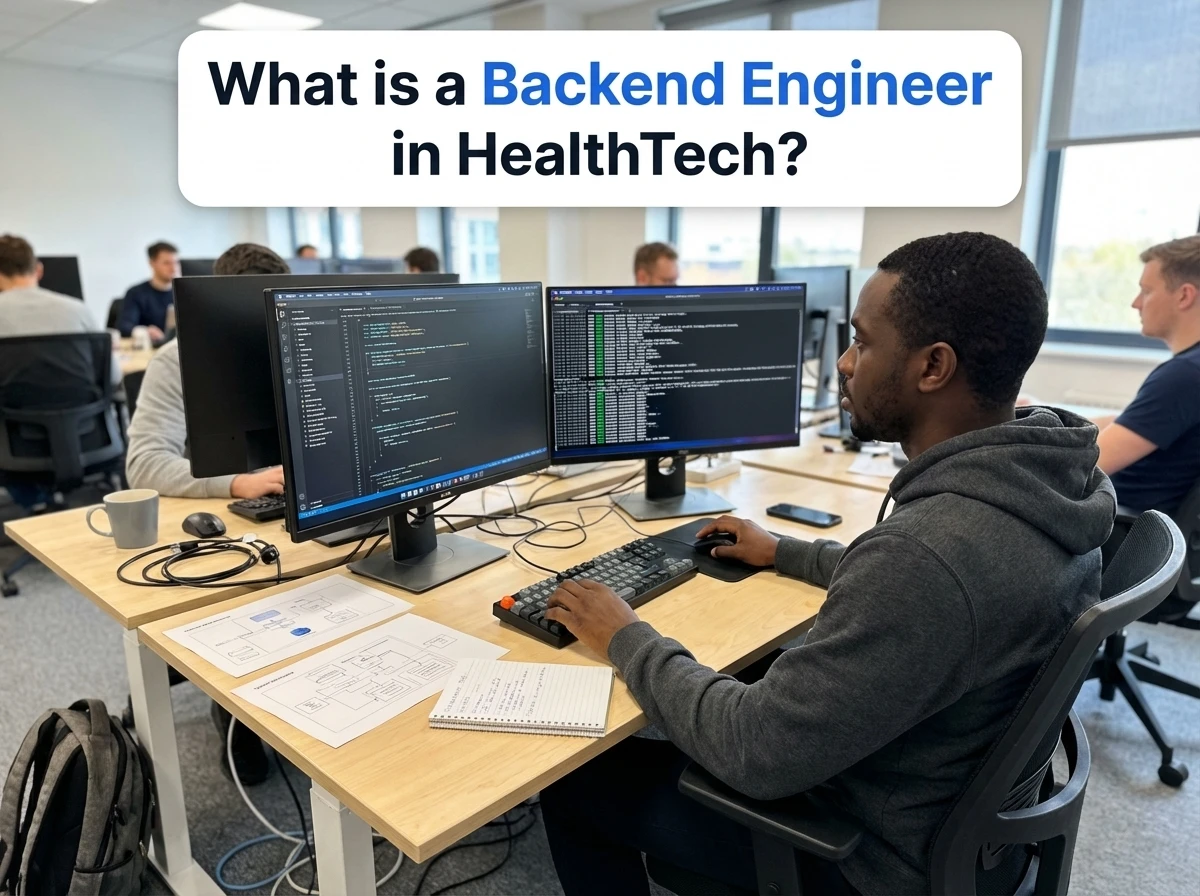
What is a Backend Engineer in HealthTech?
A Backend Engineer in HealthTech is responsible for the server-side systems that make health products reliable, safe, and usable at scale: the APIs, services, data flows, and integrations that store, transform, and deliver information to clinicians, patients, operators, and partner systems. Their work sits behind apps and clinical workflows, but it directly determines whether the product behaves correctly under real-world pressure during peaks in demand, partial outages, data discrepancies, or high-stakes operational moments.
This role exists because HealthTech products need a dependable core: patient and care-related data must be captured, processed, reconciled, and served with high integrity. Someone has to own the rules and guarantees behind the interface, including what the system considers "true", how it handles missing or conflicting inputs, how it traces decisions, and how it stays available when it cannot fail quietly.
In practice, the job is defined less by frameworks and more by accountability. A Backend Engineer is often the person who makes and defends decisions about data models, service boundaries, failure handling, auditability, and operational readiness. In HealthTech, "it works on my machine" is not an acceptable end state.
🔍 How this role differs in HealthTech
In many software sectors, backend work is optimised around growth, speed of iteration, and user engagement. In HealthTech, the same engineering fundamentals apply, but the constraints are sharper: data is more sensitive, mistakes can have real-world consequences, and systems often have to interoperate with complex external environments rather than living inside one company's stack.
A Backend Engineer in HealthTech typically designs for conservative correctness: clear data lineage, explicit states, robust validation, and careful handling of edge cases. Decisions that might be "good enough" elsewhere (loose consistency, limited audit trails, opaque business rules, "retry until it works") can become unacceptable when records must be trusted, actions must be explainable, and failures must be detectable and recoverable.
HealthTech also tends to magnify operational responsibility. Integrations are common, requirements can be more documentation-heavy, and on-call expectations can be more serious because incidents are not just technical inconveniences. They can interrupt clinical or care-adjacent workflows and trigger formal incident processes.
🎯 Core responsibilities in HealthTech
Day to day, a Backend Engineer is accountable for the behaviour of critical services in production: how data enters the system, how it is validated, what gets persisted, what is derived, and what is exposed to other parts of the product. They spend a lot of time clarifying ambiguous requirements into implementable rules, especially where "correct" depends on context, timing, or incomplete information.
A core part of the role is navigating trade-offs without breaking trust. That might mean choosing a safer, more auditable approach over a faster one; introducing explicit workflow states to prevent silent misclassification; or adding constraints and checks that slow down development but reduce risk. In HealthTech, backend engineers frequently have to decide how to fail: what the system should do when a dependency is down, when an integration sends malformed data, or when two sources disagree.
They are also expected to engineer for reality: partial adoption, messy partner data, operational exceptions, and the need to explain outcomes to non-engineers. The strongest backend engineers in HealthTech don't just ship features. They protect the integrity and reliability of the product as a system that other people depend on.
🧩 Skills and competencies for HealthTech
Core Skill | HealthTech specific requirement | Reason or Impact |
|---|---|---|
Systems thinking | Model workflows as end-to-end outcomes across services, integrations, and humans-in-the-loop | Prevents "locally correct" changes that create downstream safety, reporting, or operational failures |
Data integrity judgement | Treat patient and care-related data as a long-lived asset with traceable provenance | Reduces the chance of silent corruption and supports audits, investigations, and reconciliation |
API contract discipline | Design interfaces that are explicit about validation, errors, and versioning | Protects clinical and operational workflows from breaking changes and ambiguous behaviour |
Operational ownership | Assume responsibility for monitoring, incident response, and post-incident fixes | Increases reliability and shortens time-to-recovery when failures affect real users and services |
Risk-based decision-making | Calibrate engineering choices to potential harm, not just developer convenience | Aligns build decisions with real-world impact and reduces preventable high-severity incidents |
Communication under constraints | Explain trade-offs, failure modes, and "what we know vs what we assume" clearly | Enables better decisions with product, clinical, and compliance stakeholders without false certainty |
Security and privacy mindset | Default to least privilege, strong access controls, and careful data handling patterns | Minimises exposure of sensitive data and supports trust with users and partners |
Change management | Ship safely with migrations, rollbacks, and backwards compatibility as first-class concerns | Avoids outages and data issues that can be hard to unwind once they reach production |
💷 Salary ranges in UK HealthTech
Backend Engineer pay in UK HealthTech is driven less by language choice and more by scope and risk. The biggest levers are: how critical the system is to core workflows, how much production ownership you carry (including on-call), the complexity of integrations and data models, the degree of regulated or safety-adjacent constraints, and the level at which you influence architecture and delivery. Location still matters, especially for London and South East roles, but remote-friendly hiring can compress differences when companies benchmark nationally.
Experience level | Estimated annual salary range | What drives compensation |
Junior | London & South East: £35,000–£48,000 | Breadth of responsibility, support needs, and whether you're building core services or working on internal tooling/low-risk components |
Mid-level | London & South East: £50,000–£75,000 | Ownership of services end-to-end, ability to ship safely, integration complexity, and reliability expectations |
Senior | London & South East: £75,000–£105,000 | Leading design decisions, reducing incident risk, mentoring, handling ambiguous requirements, and carrying heavier on-call/operational accountability |
Lead | London & South East: £95,000–£130,000Rest of UK: £80,000–£115,000 | Cross-team technical leadership, setting standards, coordinating delivery for critical systems, and owning larger reliability/security outcomes |
Head / Director | London & South East: £120,000–£175,000 | Organisation-level accountability: platform strategy, governance, hiring, delivery reliability, stakeholder management, and risk ownership across multiple domains |
Beyond base salary, UK HealthTech compensation often includes some combination of annual bonus, equity (more common in venture-backed companies), and on-call payments where out-of-hours coverage is expected. On-call can be a meaningful differentiator when the rota is frequent, incidents are high-severity, or the role includes direct responsibility for clinically or operationally critical services. Total compensation varies most with company stage, the business criticality of the product, and how much "production ownership" sits with engineering versus a dedicated operations function.
🚀 Career pathways
Common entry points include graduate roles, junior backend positions in general software teams, or transitions from adjacent disciplines such as data engineering, platform engineering, or full-stack roles where you already own APIs and persistence layers. Many HealthTech backend engineers also arrive from non-health sectors, then build domain competence by working close to real workflows and learning how risk and privacy shape decisions.
Progression is typically earned through ownership rather than title: moving from implementing well-scoped tickets to owning a service, then owning a set of services, then owning a domain with clear reliability and integrity guarantees. Over time, responsibility expands from "building" to "ensuring": ensuring data is trustworthy, ensuring changes are safe, ensuring incidents are handled well, and ensuring teams can operate the system without heroics.
At the most senior levels, the path splits. Some engineers remain deeply technical (architecting platforms, defining service boundaries, and setting engineering standards) whilst others move into leadership where their primary responsibility becomes building teams and systems that consistently deliver safe, dependable outcomes.
❓ FAQ
Do I need prior healthcare experience to be hired as a backend engineer in HealthTech?
Not always, but you do need to show you can learn domain constraints quickly and engineer for correctness. Interviewers often look for how you handle ambiguity, data integrity, and operational responsibility rather than whether you already know the domain. Demonstrating strong habits around validation, auditability, and safe delivery helps.
How should I talk about reliability and incidents in a HealthTech backend interview?
Be concrete about what you owned in production: monitoring, alerting, incident response, and what you changed afterwards to prevent recurrence. HealthTech teams tend to value engineers who reduce risk systematically (clear failure modes, safe rollouts, and pragmatic mitigations) more than dramatic "saved the day" stories.
Will I be expected to do on-call, and how intense is it?
Many HealthTech backend roles include on-call, but intensity varies widely depending on product criticality, maturity, and team size. Ask about rota frequency, expected response times, how incidents are triaged, and what "good" looks like during an incident. A healthy setup includes clear runbooks, blameless reviews, and time allocated to reliability work.
🔎 Find your next role
Browse Backend Engineer opportunities in HealthTech and find your next role on Meeveem.
You might also like