Published Date: January 2, 2026
Updated Date: January 2, 2026
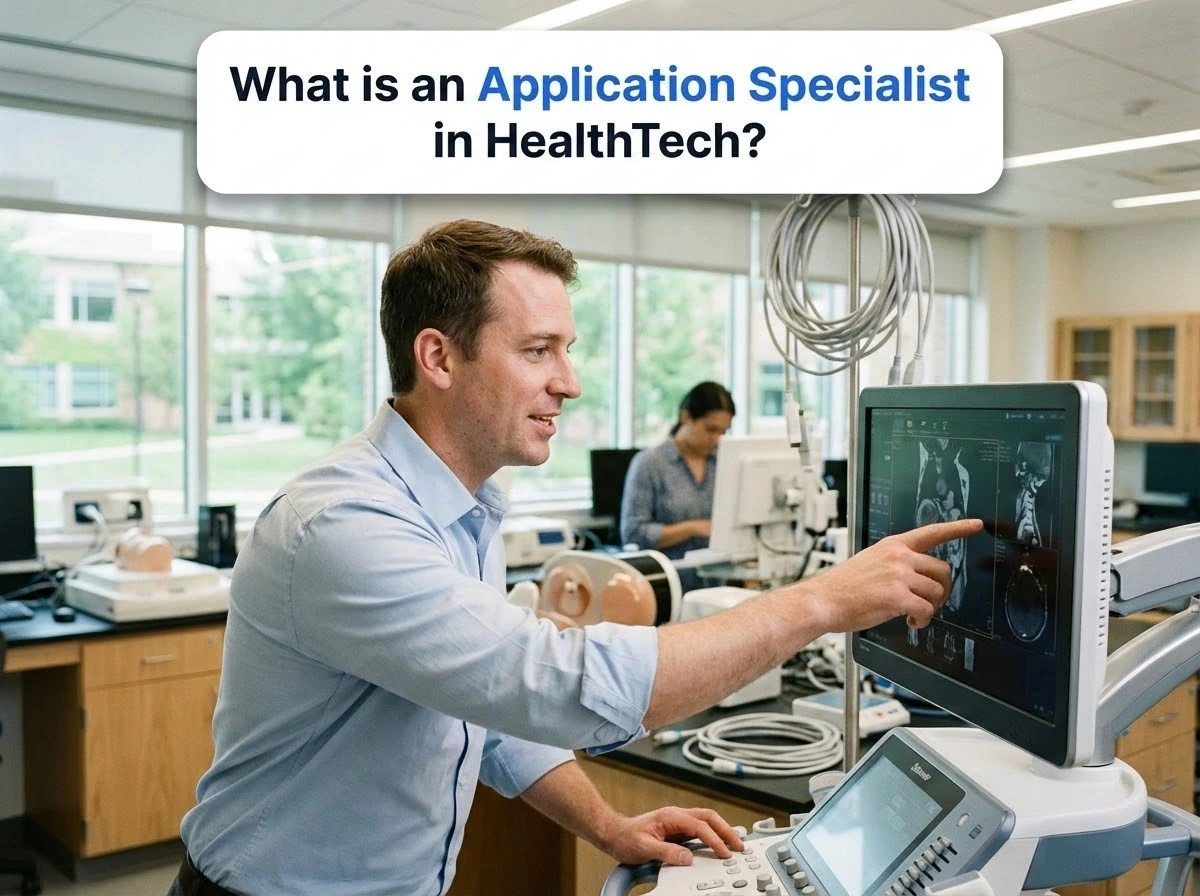
What is an Application Specialist in HealthTech?
An Application Specialist in HealthTech is the person accountable for making a clinical or operational software product work safely, reliably, and usefully in real healthcare settings. They sit at the intersection of end users (clinicians, administrators, and service teams), the supplier's product and engineering organisation, and often local digital, data, and governance functions. The role exists because "shipping software" is not the same as "running software that care teams depend on," especially when workflows are complex, uptime matters, and mistakes create real-world harm.
In practice, the Application Specialist owns the quality of adoption and day-to-day performance for a defined application or product area: how it is configured, how it is supported, how changes are validated, how incidents are handled, and how users are enabled to do their jobs with confidence. They are responsible for outcomes (service continuity, safe usage, and dependable change) before they are responsible for any particular method, tool, or process.
🔍 How this role differs in HealthTech
In many industries, an Application Specialist can focus primarily on enablement and customer satisfaction: getting teams onboarded, answering questions, and escalating technical issues. In HealthTech, that "enablement" is inseparable from safety, governance, and controlled change. Decisions aren't just about convenience or speed; they're shaped by clinical risk, information security, data sensitivity, and the operational reality of front-line services that cannot simply pause when a system misbehaves.
That changes what "good" looks like. The Application Specialist is expected to be more conservative with change, more rigorous in validation, and more disciplined about access, auditability, and escalation. Even when the role is vendor-side and commercially aligned, credibility in HealthTech is built by showing sound judgement: knowing when to push adoption, when to slow down, and how to keep both patient impact and service impact front of mind.
🎯 Core responsibilities in HealthTech
Day to day, an Application Specialist is accountable for a defined slice of the application landscape: often a clinical system, a workflow module, or a product deployed across multiple sites. They take ownership of the "whole loop": user needs become configuration decisions; configuration decisions become change requests; changes are tested and validated; releases are introduced with the right communications and training; and incidents are handled with clear triage, calm prioritisation, and disciplined follow-up.
A typical week includes a constant series of trade-offs. You may have a feature that would help users immediately, but it increases operational complexity or needs stricter validation before rollout. You may have a workaround that restores service fast, but it increases long-term risk if it becomes a hidden dependency. You may need to balance competing stakeholders: clinical teams pushing for speed, digital teams pushing for standardisation, and governance teams pushing for proof. The Application Specialist is the person expected to make these calls responsibly, document them clearly, and keep services stable while change continues.
Where the application is mission-critical, the role can also involve structured out-of-hours support, careful incident leadership, and strong supplier management: ensuring escalation routes work, fixes are verified, and the organisation learns rather than repeats the same failures.
🧩 Skills and competencies for HealthTech
Core Skill | HealthTech specific requirement | Reason or Impact |
|---|---|---|
Ownership under pressure | Stay accountable during service disruption, including ambiguous faults across integrations, devices, and workflows | Clinical and operational teams need a single, reliable owner to drive resolution and prevent unsafe "local fixes" from spreading |
Risk-based decision making | Judge when to prioritise speed vs assurance, especially for changes that affect clinical workflows or records | Small configuration choices can create downstream safety, compliance, or billing consequences that are expensive to unwind |
Stakeholder alignment | Translate between clinical intent, operational constraints, and technical reality without losing meaning | Adoption succeeds when users feel heard and the delivered configuration reflects real practice rather than theory |
Change control discipline | Apply rigorous validation, clear release comms, and controlled rollout patterns even when stakeholders want immediacy | HealthTech environments punish untested changes with outages, data quality issues, and loss of confidence in the system |
Incident leadership | Triage, escalate, and coordinate response across teams, while keeping communications accurate and calm | Good incident handling protects patient-facing services, reduces downtime, and strengthens trust in the digital function |
Data stewardship mindset | Treat access, audit trails, and data quality as first-class responsibilities, not "someone else's job" | Mismanaged access or poor data quality can lead to clinical risk, regulatory exposure, and long-term analytics damage |
Vendor and partner management | Hold external suppliers to standards on SLAs, root-cause quality, and verification of fixes | Many HealthTech stacks depend on third parties; strong supplier control reduces recurrence and protects service continuity |
💷 Salary ranges in UK HealthTech
Compensation for Application Specialists in UK HealthTech is driven less by the job title and more by what you "own": how mission-critical the application is, how complex the environment is (multi-site, integrated systems, high change volume), how much governance you must operate within, and whether you carry on-call expectations. Location still matters, but the biggest swings tend to come from seniority, system criticality, and the breadth of applications you are accountable for.
Experience level | Estimated annual salary range | What drives compensation |
Junior | London & South East: £30,000–£40,000 | Early ownership of support queues, supervised configuration, and user enablement; compensation rises with domain familiarity and reliability in incident handling |
Mid-level | London & South East: £40,000–£55,000 | Independent ownership of a system/module, stronger change and release responsibility, deeper stakeholder management, and measurable service improvement |
Senior | London & South East: £55,000–£72,000 | Accountability for complex applications and integrations, higher-risk change, incident leadership, supplier management, and coaching others |
Lead | London & South East: £70,000–£90,000 | Ownership across multiple applications or a major programme area, standard-setting for support/change practices, and stronger governance accountability |
Head / Director | London & South East: £90,000–£125,000 | Portfolio accountability, budget and people leadership, service performance targets, executive stakeholder management, and risk ownership across critical systems |
Beyond base salary, typical add-ons include on-call or out-of-hours payments (where the system is clinically or operationally critical), performance bonus (more common in vendor-side HealthTech roles), car allowance for field-based clinical applications roles, and equity (more common in venture-backed companies, typically at senior and leadership levels). Total compensation varies most with on-call intensity, whether the role is tied to revenue/adoption outcomes, and the level of responsibility for regulated change, data access, and service continuity.
🚀 Career pathways
Many Application Specialists enter HealthTech from clinical operations, NHS digital teams, service desks, implementation roles, or vendor-side training and support. The earliest progression usually comes from moving beyond "responding" into "owning": taking responsibility for a system area end-to-end, building trust with users, and delivering changes that improve outcomes without destabilising services.
Over time, responsibility expands across three dimensions: breadth (more applications, more sites, more integrations), depth (harder incidents, higher-risk change, stricter governance), and leadership (coaching others, designing support and change standards, owning supplier performance). The strongest career moves typically come from demonstrating judgement in high-stakes moments: incidents, go-lives, and complex change, where safe delivery matters more than speed or visibility.
❓ FAQ
Do I need a clinical background to become an Application Specialist in HealthTech?
Not always. Clinical experience can be a strong advantage for workflow credibility, but many successful candidates come from IT support, implementation, or operations. What matters is your ability to understand real workflows quickly and take accountable ownership for safe, reliable system use.
What will I be assessed on in interviews beyond technical knowledge of the application?
Expect scenario-based questions: how you would handle incidents, prioritise competing requests, manage change validation, and communicate risk. Interviewers typically look for calm decision-making, clarity of escalation, and evidence you can balance user needs with governance and stability.
How common is on-call, and how should I evaluate it before accepting an offer?
On-call is more common when the application supports time-critical services or when the team owns a broad clinical systems estate. Ask how often you're on rota, what the escalation path looks like, what "good" response times are, and whether the organisation invests in preventing repeat incidents, not just reacting to them.
🔎 Find your next role
If you want a role with real ownership in systems that matter, search Application Specialist opportunities on Meeveem.
You might also like