Published Date: December 29, 2025
Updated Date: December 29, 2025
What is an Account Executive in HealthTech?
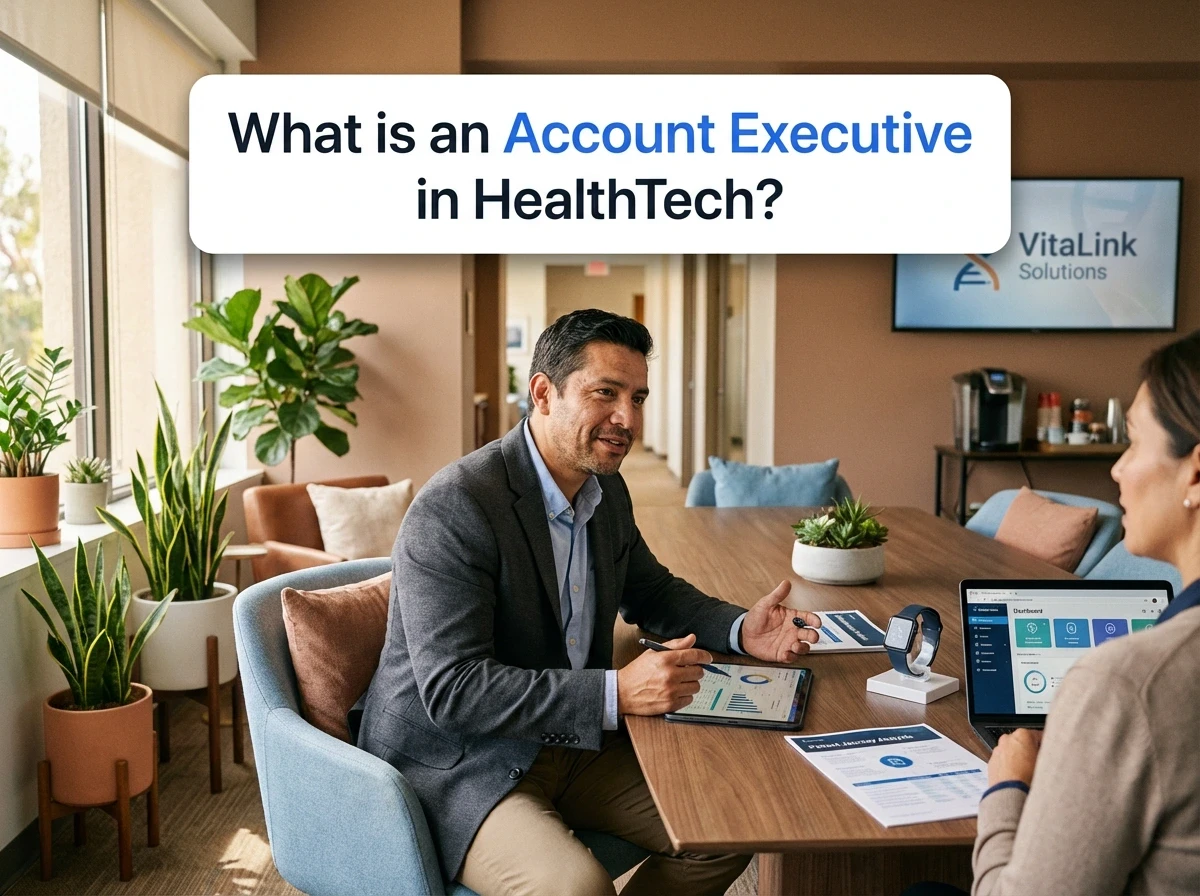
An Account Executive (AE) in HealthTech is a commercial owner responsible for winning new customers (and, in many organisations, expanding revenue within existing accounts) by taking a product from first serious conversation through to a signed contract and a clean handover for delivery and adoption. In practical terms, the AE is accountable for revenue outcomes: pipeline quality, forecast accuracy, deal execution, and closing business that the company can successfully implement and support.
This role exists because HealthTech sales are rarely "one-call closes". Buyers often include clinical leaders, operational managers, finance, IT, information governance, and procurement, each with different success criteria and risk thresholds. The AE owns the work of aligning those stakeholders around a problem worth solving, proving value credibly, navigating the buying process, and ensuring what's sold is deliverable in a real care environment. The job is measured by outcomes (revenue, retention/expansion where applicable, and predictable forecasting), not by activity.
🔍 How this role differs in HealthTech
In many SaaS sectors, an AE can focus primarily on business value, speed of rollout, and competitive differentiation. In HealthTech, those factors still matter, but they sit alongside higher stakes around patient impact, sensitive data, and operational continuity. Decision-makers may be more cautious, evidence-seeking, and process-driven, especially where a product influences clinical workflows, triage, documentation, or patient communication.
HealthTech buying processes also tend to involve more "non-commercial" constraints: information security reviews, data protection considerations, integration realities, and operational approvals that can slow cycles and reshape deal structure. As a result, HealthTech AEs are often judged not just on charisma and closing ability, but on judgement: selling the right scope to the right customer with fewer surprises, and building trust with stakeholders who are trained to manage risk.
🎯 Core responsibilities in HealthTech
Day to day, the AE is accountable for progressing complex opportunities without losing the thread of what the customer actually needs. That starts with discovery that distinguishes between a "nice-to-have" and a problem that has operational urgency, budget credibility, and stakeholder sponsorship. The AE must translate product capability into outcomes that resonate in healthcare settings (time back for clinicians, reduced administrative burden, safer handovers, improved access, better utilisation) while being careful not to over-claim.
As deals progress, the AE becomes the conductor of a multi-track process: aligning clinical champions with operational owners, ensuring procurement steps are anticipated, and keeping security and data questions from derailing late. Trade-offs are constant: pushing for speed versus respecting governance, expanding scope versus protecting delivery, discounting to win versus protecting long-term viability. The best HealthTech AEs make those trade-offs explicitly, document assumptions, and hold a firm line on what must be true for a deal to succeed after signature. Their credibility is built as much on what they decline to promise as on what they can sell.
🧩 Skills and competencies for HealthTech
Core Skill | HealthTech specific requirement | Reason or Impact |
|---|---|---|
Consultative discovery | Ability to run discovery across clinical, operational, IT, and finance lenses without flattening nuance | Healthcare stakeholders define "value" differently; good discovery prevents mis-selling and reduces late-stage blockers |
Risk-based judgement | Comfort articulating and managing risk (data, workflow disruption, safety perceptions) in plain language | Buyers often prioritise risk management; demonstrating mature judgement accelerates trust and approvals |
Stakeholder orchestration | Skill in mapping decision-makers, influencers, and gatekeepers across complex organisations | Deals stall when the "real" approval chain is misunderstood; orchestration keeps momentum without burning goodwill |
Value communication | Ability to quantify outcomes credibly and tie them to operational constraints | HealthTech buyers are wary of hype; clear value cases support sponsorship and procurement justification |
Procurement fluency | Practical understanding of formal buying steps, documentation expectations, and long-cycle dynamics | Many healthcare sales cycles are process-led; procurement fluency reduces timeline risk and improves forecast accuracy |
Delivery-aware selling | Knowing how implementation, integration, and change management affect what should be sold | Selling a scope the organisation can't implement damages retention and reputation; delivery-aware selling protects long-term revenue |
Forecast discipline | Structured qualification and honest stage management, even under pressure | Leadership decisions depend on forecast quality; in HealthTech, late-stage "surprises" are common without discipline |
Ethical commercial instincts | Ability to balance growth targets with appropriate claims and customer suitability | Trust is a strategic asset in healthcare; ethical selling reduces churn, escalations, and reputational risk |
💷 Salary ranges in UK HealthTech
Account Executive compensation in UK HealthTech is driven less by the job title and more by commercial scope: deal size, complexity of stakeholders, whether you're closing new logos or expanding strategic accounts, and how much risk sits in the sale (e.g. workflow-critical deployments, high scrutiny around data, or complex integrations). Location still matters (London and the South East typically pay more) but remote hiring and national territories can blur the lines. On-call expectations are usually uncommon for pure AEs; where a business expects commercial cover for go-lives or incident communications, this can influence the package, but it's not a standard AE norm.
Experience level | Estimated annual salary range | What drives compensation |
Junior | London & South East: £30,000–£45,000 | Often closer to SMB selling or supporting a senior seller; compensation varies by training investment, inbound lead quality, and whether you carry a quota |
Mid-level | London & South East: £45,000–£65,000 | Ownership of a defined territory or segment; higher pay where you run full-cycle deals independently and forecast reliably |
Senior | London & South East: £65,000–£90,000 | Larger deal sizes, longer cycles, more governance steps, and heavier multi-stakeholder selling; often includes strategic accounts or enterprise motions |
Lead | London & South East: £85,000–£110,000 | Not just bigger numbers, often added accountability: mentoring, deal coaching, owning a vertical, rescuing late-stage opportunities, and shaping process |
Head / Director | London & South East: £105,000–£140,000 | Leadership scope (team targets, hiring, territories, pricing discipline, forecasting cadence) and responsibility for predictable revenue delivery |
Beyond base pay, many HealthTech AEs are compensated with commission tied to on-target earnings (OTE), typically driven by quota attainment and deal quality metrics (e.g. retention-adjusted performance in some businesses). Equity is common in scale-ups and can materially change total compensation, especially at Senior/Lead and above. Total package variation is usually explained by segment (SMB vs enterprise), average contract value, sales cycle length, territory maturity, and whether the company expects the AE to also do significant outbound prospecting versus working qualified demand.
🚀 Career pathways
Common entry points include moving from SDR/BDR roles into a quota-carrying AE position, switching from adjacent B2B SaaS into HealthTech with a strong consultative sales foundation, or joining a HealthTech company in partnerships/customer success and later moving into commercial ownership. The earliest progression is typically defined by how reliably you can qualify and close without creating delivery problems. Ownership shows up as clean handovers, realistic commitments, and predictable forecasting.
Over time, responsibility expands from smaller, faster deals to complex multi-stakeholder sales where the AE becomes the "single throat to choke" for aligning buyers and internal teams. Senior progression is less about title inflation and more about the size and ambiguity of what you can carry: enterprise accounts, new verticals, or ambiguous product categories where the buyer needs education. Lead and Head/Director pathways usually emerge once you're not only closing personally, but improving how others close (raising standards, stabilising revenue predictability, and shaping how the organisation sells responsibly into healthcare).
❓ FAQ
Do I need prior NHS-selling experience to be hired as a HealthTech Account Executive?
It helps, especially for roles selling into complex public-sector buying environments, but it's not always required. Many employers prioritise consultative selling fundamentals, strong discovery, and evidence of closing complex deals. If you lack sector experience, be ready to demonstrate how you learn regulated contexts quickly and how you handle multi-stakeholder risk.
What will I be assessed on in a HealthTech AE interview beyond "can you sell"?
Expect deep probing on qualification, stakeholder mapping, and how you avoid overpromising. You may be asked to run a discovery role-play with clinical and operational constraints, or to build a value case that stands up to scrutiny. Forecast discipline and how you handle late-stage procurement/security blockers often matter as much as your closing story.
Is on-call part of an Account Executive role in HealthTech?
It's not typical in the way it can be for engineering or operations roles. However, some companies expect AEs to be available during critical deal moments, go-lives, or escalations where commercial context matters. Clarify expectations early: what "availability" means, how often it happens, and whether it's recognised in compensation or workload.
🔎 Find your next role
If you're ready to own outcomes in a sector where trust and impact matter, search Account Executive roles on Meeveem and compare scope, segment, and compensation structure before you commit.
You might also like