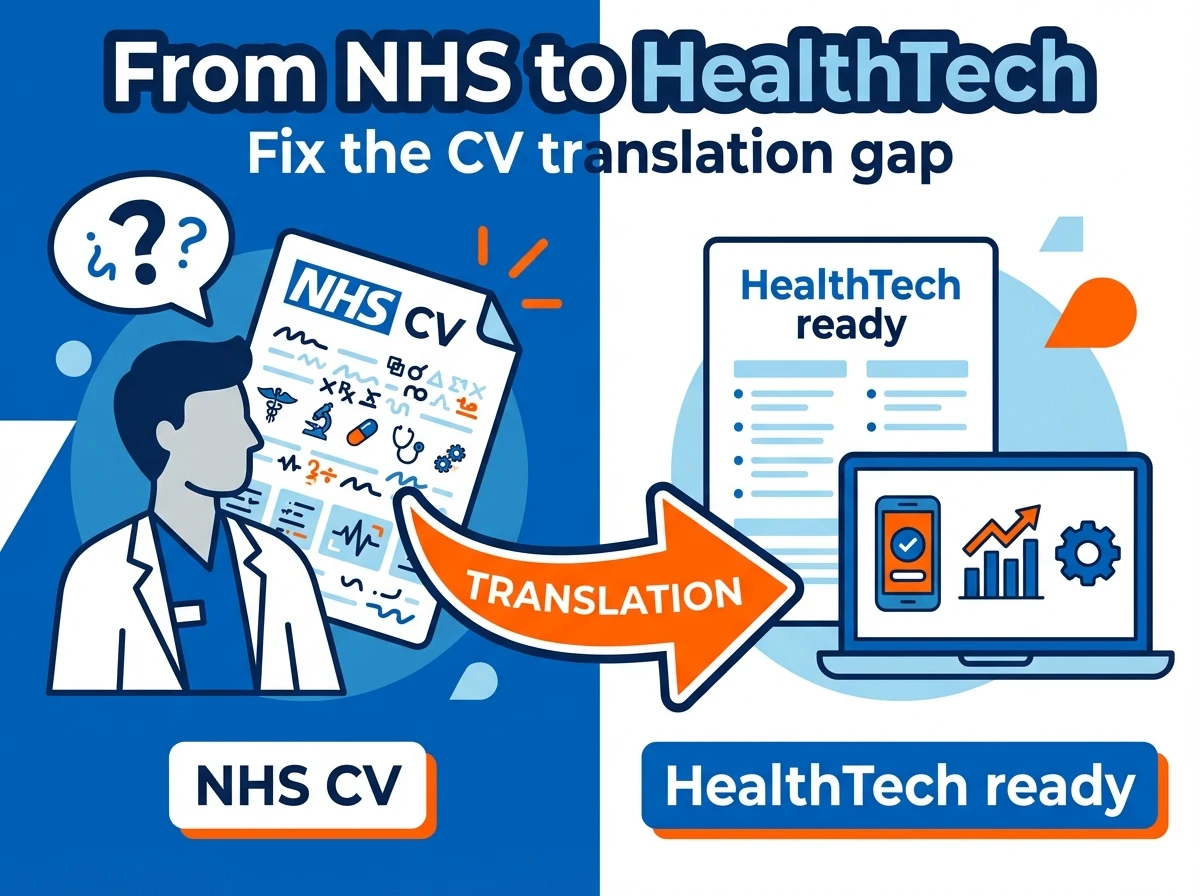
The HealthTech Interview Decoder: 10 Questions Every Hiring Manager Asks

Maxence Jutel
Co-Founder
@
Meeveem
Before co founding Meeveem, I worked in recruitment and talent across startups and corporate environments, and I developed a strong connection to healthcare through my partner who is a GP. This combination shaped my focus on helping the wider HealthTech industry recognise and unlock the value of clinical and non clinical talent.
Hiring process
Updated: November 18, 2025
Summary
Decode 10 essential HealthTech interview questions and learn how to answer them with impact, whatever your role across Health Technology.

HealthTech or Health Technology, is not just “healthcare jobs”.
Whether you are building digital health software, shipping a medical device, selling into hospitals, or scaling a remote monitoring platform, the stakes are different. You are dealing with patients, regulators and real risk, not just engagement and churn graphs.
Because of this, hiring managers across the industry, from Engineering and Product to Sales and Operations, test for the same mindset. They want to know if you can operate inside the HealthTech triangle: innovation, regulation and safety.
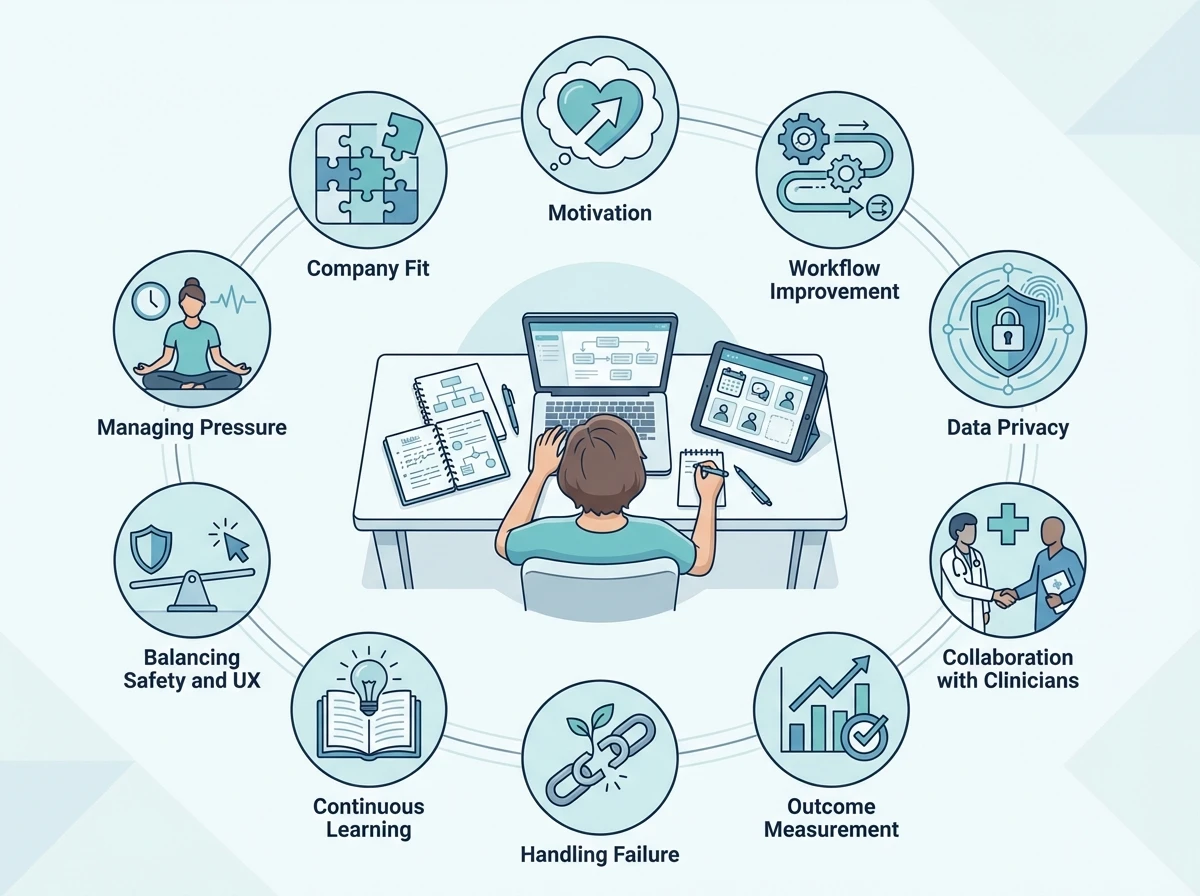
This guide decodes the 10 most common interview questions in HealthTech and how to answer them, whatever your role.
1. “Why HealthTech? Why choose this sector specifically?”
What they are really checking
They want to know if you are chasing a trendy sector or if you actually have the resilience for a hard industry. HealthTech is slow, regulated and political. If you crumble when a regulator or hospital delays your launch, you are a bad hire.
How to answer
Skip the generic lines like “I want to help people”. Use a simple Origin - Insight - Decision structure:
Origin: One sentence on where it started. A personal experience, a broken process you saw in a hospital or clinic, a previous job where the system obviously failed people.
Insight: Name a specific frustration. Fragmented data. Unsafe workarounds. Terrible UX in clinical tools. Devices nobody uses as intended.
Decision: Explain why HealthTech is the space you picked to fix this. Maybe because software scales, because you like working at the intersection of tech and care delivery, or because you know you can execute better than what you have seen.
If they hear “Origin, clear problem, conscious decision”, you are already ahead of 90 percent of candidates.
2. “Tell me about a project where you improved a workflow or outcome”
What they are really checking
Can you do more than ship features or decks. In HealthTech, a project only counts if it survives messy reality: busy clinicians, tired patients, legacy systems and political layers.
How to answer
Use the STAR method, but make the Result carry most of the weight.
Situation: Who was involved and what was the context. For example, outpatient clinic, pharmacies, home monitoring, imaging, device deployment.
Task: The concrete friction. Manual data entry errors, slow device readings, low adherence, long queues, missing alerts.
Action: What you did, not “we”. Technical work, process redesign, training, stakeholder alignment, integration, documentation.
Result: Non negotiable. Quantify the impact if you can. Time saved, errors reduced, adherence improved, higher usage, fewer incidents. If you cannot give numbers, describe the behaviour change you observed.
If your answer stops at “we built X”, you fail this question.
3. “How do you approach data security and patient privacy?”
What they are really checking
They want to see if you treat compliance as a box to tick or as part of your daily thinking. In HealthTech, every role needs a basic security and privacy reflex. Not just legal, not just IT.
How to answer
Start with principles, then go to practice, then prove it with an example.
Principles: Mention ideas like “privacy by design” and “minimum necessary access”. Say clearly that health related data is the most sensitive data you can touch.
Applied to your role:
Developers and data roles: Encryption, role based access, audit logs, anonymisation or pseudonymisation, no production data in lower environments, secure logging, code reviews with security in mind.
Product and design: Clean consent flows, clear explanations of what is collected and why, sensible defaults, early alignment with legal and privacy, no “dark patterns” around data.
Sales, ops, customer support: Using approved tools only, never sharing screenshots with identifiers, controlling who joins calls, knowing when to say “I cannot see this data”.
Example: Give a one line story of a time you spotted risk or something that felt “off”, raised it, and helped fix it.
You want them to leave with the idea that you do not wait for someone else to think about security.
4. “How do you collaborate with clinicians or non technical stakeholders?”
What they are really checking
They are testing your ability to translate between “tech language” and the reality of people who care about patients, risk, time and regulation. These people do not care about your architecture diagram or your sales commission.
How to answer
Anchor your answer on empathy and translation.
Pick a specific example where you worked with clinicians, operations, or another subject matter expert.
Explain how you gathered input. Shadowing, interviews, workshops, joint testing, pilots.
Name their constraints explicitly. Time pressure, burnout, strict protocols, fear of extra admin work, accountability.
Show what you changed as a result. You simplified a flow, changed a device behaviour, adjusted a rollout plan, cut a feature, or reframed the pitch.
Close with adoption. The point is not that people “liked” it but that they actually used it.
If you cannot describe their constraints better than they can, you are not ready for HealthTech.
5. “How do you measure impact, both for the business and the user?”
What they are really checking
They want to know if you think in outcomes or in tasks. In HealthTech, a product that makes money but harms patients is a disaster. A product that helps people but has no path to revenue is unsustainable.
How to answer
Show you operate with a double bottom line.
Clinical or human metrics: Error reduction, time to diagnosis, adherence, missed appointments, symptom scores, user satisfaction.
Business metrics: Cost to serve, retention, recurring revenue, licence or device utilisation, efficiency gains, support load.
Add one line that you use data to decide what not to build. Most candidates never say this. It signals focus.
Illustrate this with a project where you agreed metrics at the start, tracked them and made a decision based on the numbers.
6. “Tell me about a failure or a serious issue and what you learnt”
What they are really checking
HealthTech is high risk. Things will go wrong. They want to see if you delete evidence and hide, or if you surface problems and then make sure they do not happen again.
How to answer
Be honest: Pick a real issue. A bug in a critical flow, a missed integration detail, a misaligned expectation with a client, a delayed launch because of something you owned.
No drama: State what happened in plain language. No blame game, no excuses.
Resolution and system fix: Spend most of your answer on what you did afterwards. How you helped recover, how you communicated, and then what you changed. New tests. A better checklist. A clearer sign off process. A change in release process. A different way of working with clinicians or customers.
The message is simple. You do not promise perfection, but you do not repeat the same mistake twice.
7. “How do you stay current with regulation and technology?”
What they are really checking
The landscape moves. AI rules shift, reimbursement models change, new privacy expectations appear. They want to know if you treat learning as part of the job or as an optional extra.
How to answer
Give them your information diet.
Technology: How you keep up with new standards, architectures, tools and methods that affect HealthTech. For example interoperability standards, device connectivity, AI models, security practices.
Regulation: How you stay aware of data protection rules, device or software regulation, clinical evidence expectations, reimbursement changes, whatever is relevant in your markets.
Context: A couple of specific newsletters, communities, podcasts, conferences or internal forums you follow.
Then add one concrete example of something you learnt that changed your decision making, design or implementation.
8. “Describe a time you balanced user experience with safety or compliance”
What they are really checking
This is the standard HealthTech trade off. A product that is too easy can be unsafe. A product that is too locked down never gets used. They want to see how you navigate that tension.
How to answer
Describe a real situation where a frictionless experience would have been dangerous, confusing or non compliant. For example skipping checks, hiding warnings, or oversimplifying a clinical decision.
Explain the options you considered. What was fast, what was safe, what would annoy users, what would worry regulators.
Show your trade off. Maybe you added one extra step, a clear confirmation screen, better defaults, or an alert for specific cases.
Make it clear that safety and compliance are non negotiable, and that your job is to keep the user experience as smooth as possible inside those hard constraints.
The wrong answer here is “I just do what legal says” or “I always prioritise UX”. They want to see judgement, not blind allegiance.
9. “How do you handle pressure and uncertainty?”
What they are really checking
Between audits, incidents, tight go live dates and funding cycles, HealthTech is not a calm environment. They need to know if you can make clear decisions when the stakes are high.
How to answer
Pick one high stakes moment. A go live, a critical bug, a regulatory demand, an angry customer with live patients on the platform.
Walk through three things:
Triage: How you assessed severity and impact, and how you decided what to do first.
Communication: Who you kept in the loop, how often, and how transparent you were about unknowns and risks.
Behaviour: How you stayed calm enough to make decisions. Maybe you used a runbook, split the work, designated a clear incident lead.
Do not tell a hero story where you single handedly saved the day. They want controlled, repeatable behaviour, not chaos.
10. “Why this role, and why this company?”
What they are really checking
Basic filter. Have you done the work to understand what they do, or are you spraying CVs at anything with “HealthTech” in the title.
How to answer
Connect your past to their future in three steps.
Their problem: One sentence on what you think they are really trying to fix. For example, triage in emergency care, chronic disease management, imaging backlogs, clinical documentation, medication adherence, lab automation.
Your fit: One or two elements from your background that plug straight into that problem. You have seen the same workflow. You know the same type of user. You built or sold something similar. You understand their buyer.
The mission: Why you care about attacking that specific problem with this type of product. Keep it grounded. If you used a platform like Meeveem to read founder interviews or culture notes before applying, say so. It shows you did real research, not just a skim of the job description.
A precise answer here often decides the offer.
Summary: How to prepare
You do not need scripts. You need a story bank.
Prepare 5 to 7 solid examples from your career that show impact, collaboration and problem solving. Write them down. For each, make sure you can explain the context, the problem, your actions and the outcome.
Then map these stories to the questions above. Most stories can work for more than one question if you frame them correctly.
If you can talk about your work through the lens of patient or user outcomes and business viability, you will stand out in any HealthTech interview, regardless of your exact role.