Skills You Need to Succeed in HealthTech

Michael Thushyan
Co-Founder
@
Meeveem
Before co founding Meeveem, I spent over fifteen years in recruitment, building teams and supporting companies as they scaled around the world. My family’s deep ties to the NHS shaped my passion for the fast growing HealthTech sector. Now I use that experience to champion the movement of talent into HealthTech and help the sector grow, innovate and drive its mission forward.
Skill & Upskilling
Updated: February 18, 2026
Summary
Build a successful HealthTech career in the UK by developing key skills in product thinking, digital literacy, clinical insight, data, communication and collaboration.

Working in HealthTech is one of the most exciting career paths in the UK today. The sector is growing quickly, the work feels meaningful and the problems we are solving genuinely matter. Whether you come from a clinical background, a technical background or a completely different industry, there is a place for you in this space. Success in HealthTech depends on a combination of technical and non technical skills, and in this article I will walk you through the most important ones.
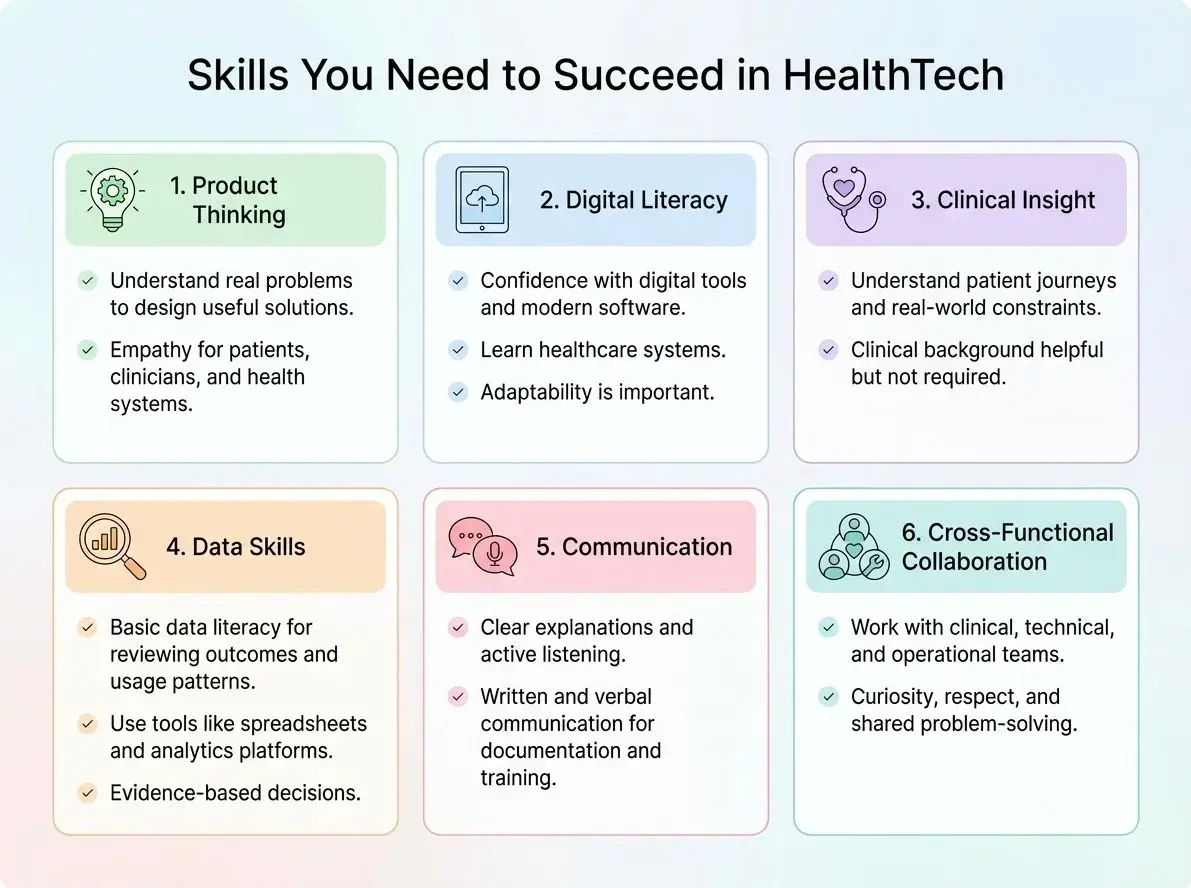
Product Thinking
Product thinking is the ability to understand a problem deeply and design solutions that genuinely help the people who will use them. In HealthTech, this usually means patients, clinicians or NHS teams. If you can focus on real needs rather than simply following trends, you will already be ahead.
Good product thinking starts with empathy. You need to understand what frustrates a GP, how a patient manages a chronic condition or how long a task takes on a hospital ward. You do not need to be a product manager to think like one. Engineers, designers, clinicians and analysts can all apply this mindset. If you can ask the right questions and think practically about value and usability, you will stand out.
Digital Literacy
Digital literacy means being comfortable working with modern digital tools. It is one of the most important skills in HealthTech because nearly every part of healthcare in the UK now uses technology. Electronic patient records are becoming standard, the NHS App is used by millions and remote consultations are part of everyday care.
If you come from a non technical background, digital literacy might mean developing confidence with software platforms, data dashboards or communication tools. If you are already technical, it might mean learning how healthcare specific systems work, or understanding NHS data standards. HealthTech moves quickly, so being able to learn new tools is essential.
Clinical Insight
Clinical insight is incredibly valuable. You do not need to be a doctor or a nurse to succeed in HealthTech, but you must understand the reality of healthcare. If you have worked in a clinical setting, you already have an advantage because you understand patient journeys, clinical risks and real world constraints.
If you have not worked in healthcare, you can still build this insight. Speak to clinicians, observe care pathways, learn NHS terminology and understand why safety and regulation matter. In the UK, HealthTech products must fit into existing NHS systems, so knowing how the NHS works will make your ideas more realistic and far more valuable.
Data Skills
HealthTech is powered by data. Whether you are analysing patient outcomes, reviewing usage patterns in an app or working with clinical datasets, you need to be comfortable with numbers. You do not need to be a data scientist to be effective. Basic data literacy is enough for many roles. This includes understanding simple statistics, being able to interpret charts and knowing how to use tools such as spreadsheets, analytics dashboards or basic query systems.
If you want to deepen your skills, learning introductory data analysis or taking a course in healthcare analytics will give you a strong advantage. The NHS and most UK HealthTech companies rely heavily on evidence based decision making, so being confident with data always helps your career progress.
Communication Skills
Communication is one of the most important skills in HealthTech. You will often be working with people who think very differently. A software engineer, a clinician and a project manager may each see a problem from their own perspective. Clear communication helps everyone stay aligned.
Good communication in HealthTech means explaining technical ideas in plain English, listening carefully to clinical concerns and translating information between different teams. Written communication also matters. You may need to write documentation, create training materials or summarise insights for stakeholders. People who can communicate simply and clearly are always valued.
Cross Functional Collaboration
HealthTech is a team sport. Successful products are built by collaborative teams that combine technical, clinical and operational expertise. You will need to work closely with people who have skills that are very different from your own. This requires curiosity, patience and respect.
To build strong collaboration skills, ask questions, invite feedback and learn how each team works. If you can help clinicians understand software decisions or help engineers understand clinical reasoning, you become a bridge between worlds. Collaboration is at the heart of innovation, especially in the UK where HealthTech often works directly with NHS partners.
Final Thoughts
The skills you need to succeed in HealthTech are a blend of product thinking, digital confidence, clinical understanding, data literacy, communication and collaboration. You do not need to master everything immediately. What matters most is your willingness to learn and your curiosity about how technology can genuinely improve healthcare.
The UK HealthTech sector is full of opportunities for people from many backgrounds. If you invest in these skills, you will be well placed to build a meaningful and successful career in this fast growing and purpose driven industry.