From NHS to HealthTech: 7 Clinical Skills That Scale Into Corporate Roles
Maxence Jutel
Co-Founder
@
Meeveem
Before co founding Meeveem, I worked in recruitment and talent across startups and corporate environments, and I developed a strong connection to healthcare through my partner who is a GP. This combination shaped my focus on helping the wider HealthTech industry recognise and unlock the value of clinical and non clinical talent.
Career Change
Updated: February 18, 2026
Summary
NHS clinicians have skills HealthTech companies need. Learn how to translate clinical experience into corporate roles.
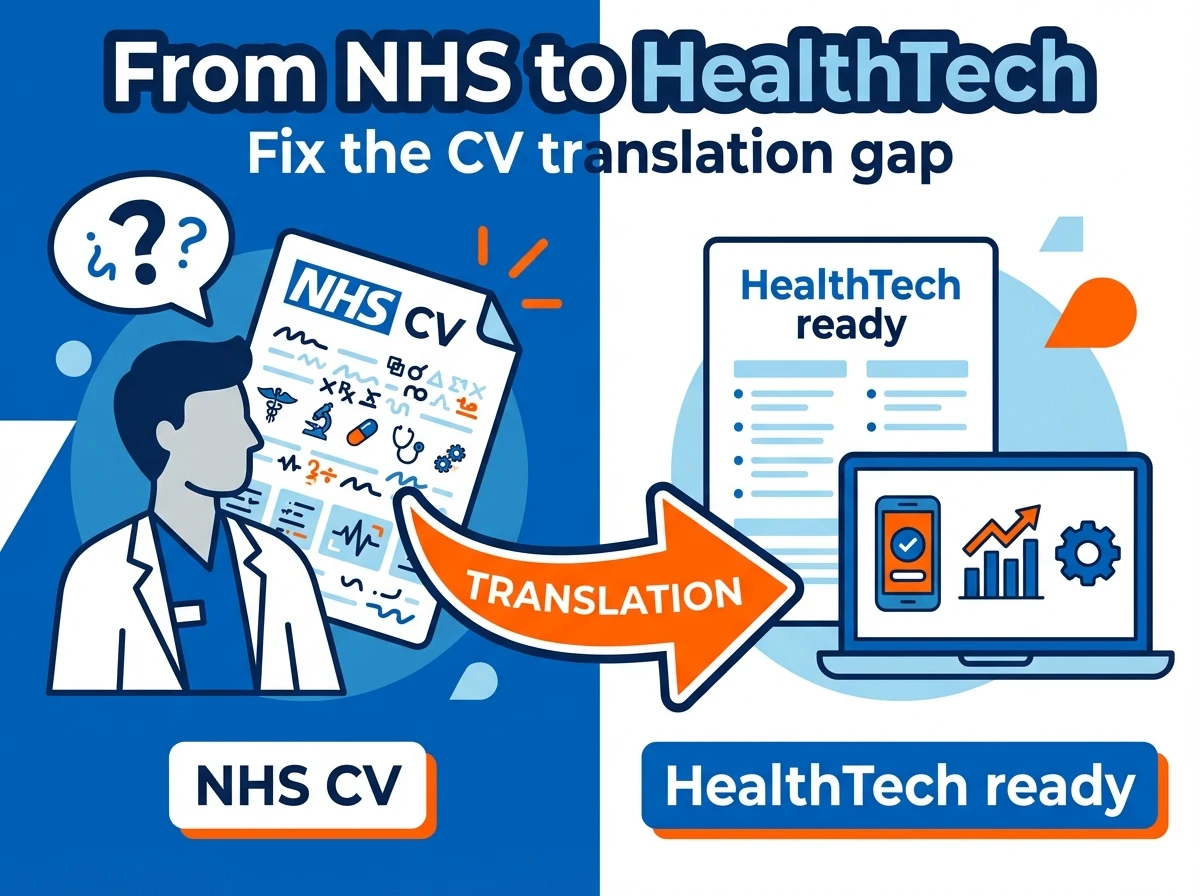
The Translation Problem: Why Qualified Clinicians Are Not Getting HealthTech Interviews
Every week I watch the same tragedy play out.
A GP with ten years of experience applies for a Clinical Product Manager role. On paper, they are perfect. They have run quality improvement projects, led complex teams, and navigated impossible NHS workflows.
They get rejected at the CV screening stage.
Not because they lack the skills. Not because the role is not right. But because their CV says "managed acute medical admissions" and the recruiter, who has likely never set foot in a hospital, has absolutely no idea what that means or why it matters to a tech company.
The NHS employs hundreds of thousands of clinicians who could walk into HealthTech and solve problems that have been blocking product teams for months. Meanwhile, those same companies complain they cannot find enough people who understand healthcare and corporate functions.
It is absurd. And it is fixable.
The issue is not talent. It is translation.
Most NHS CVs read like discharge summaries written for other clinicians. They are packed with clinical competence that makes perfect sense to you but looks like nonsense to a hiring manager.
This guide fixes that gap. We are going to cover:
The Translation Layer: The 7 specific NHS skills HealthTech companies are desperate for.
The CV Makeover: How to rewrite your bullet points so recruiters understand your value.
The Matrix: Realistic pathways from specific clinical roles to tech positions.
Why HealthTech Desperately Needs You
HealthTech in the UK, covering medical devices, diagnostics, digital health, and AI, depends on the NHS for validation, safety assurance, and adoption.
Three major problems keep killing startups. Clinicians solve all of them. But because companies often hire non clinical people, they act surprised when their products fail in real healthcare settings.
1. Regulatory Complexity is Eating Them Alive
Medical devices must meet rigorous safety standards. Most startups have compliance officers who have never made a 3am escalation call. They write risk assessments that look fine on paper but fall apart in a real clinical environment.
Your Value: You instinctively think in terms of harm probability, severity, and detectability. That is the foundation of every risk analysis.
2. Clinical Validation is Consistently Weak
I have watched too many validation studies designed by engineers who thought "accuracy" was a clinical outcome. It is not. Clinical outcomes are "fewer strokes," "earlier discharge," or "reduced readmission."
Your Value: You know that a 99% accurate algorithm is useless if it flags 500 patients a day who do not need treatment. You bring the context that data scientists lack.
3. Adoption Fails for Non Technical Reasons
When HealthTech fails in the NHS, the technology is rarely the problem. The blockers are workflow disruption, unclear governance, or simply adding "one more click" to an exhausted nurse's day.
Your Value: You have lived through enough bad IT rollouts to spot these mistakes before they are built.
The 7 Clinical Skills HealthTech Companies Are Hiring For
You do not need to go do an MBA. You need to reframe what you already do.
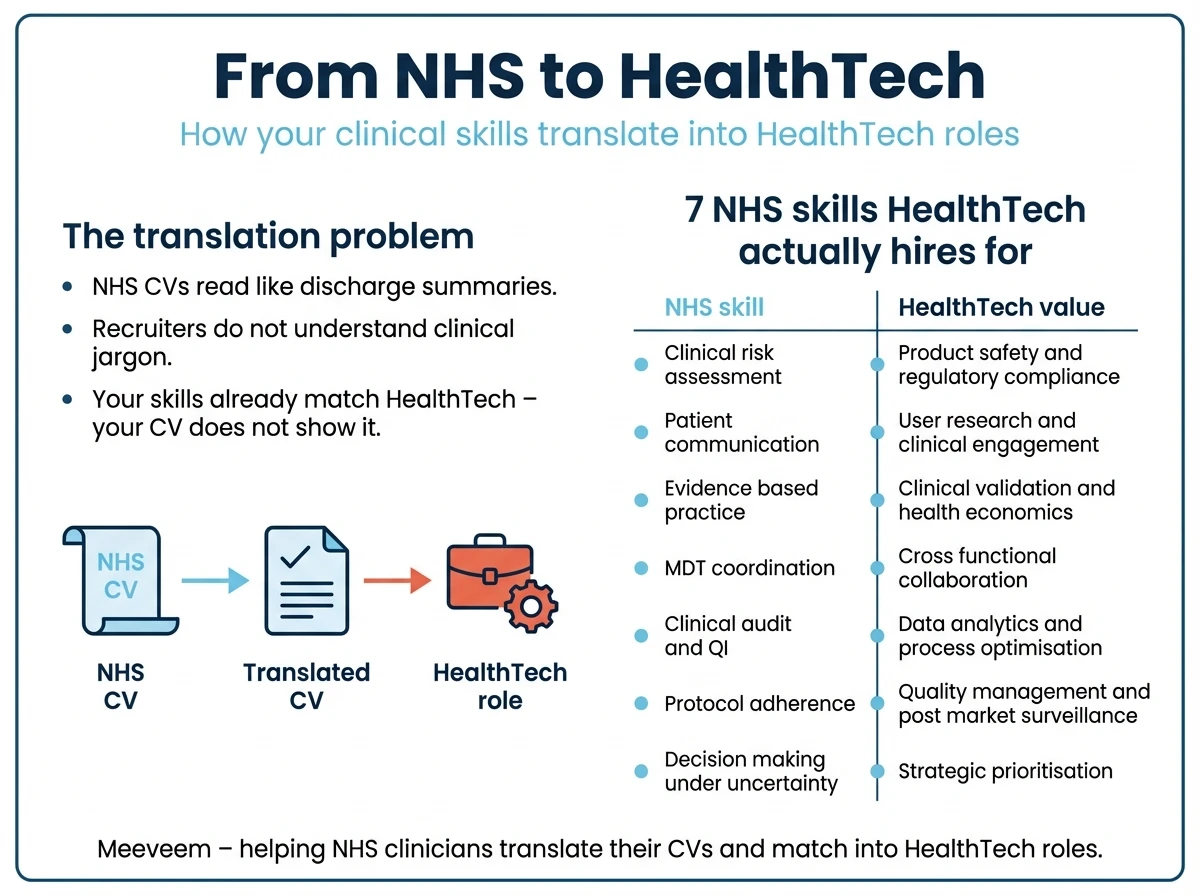
Skill 1: Clinical Risk Assessment → Product Safety & Regulatory Compliance
What you did in the NHS:
You assessed patient deterioration using national early warning scores. You balanced speed against accuracy under time pressure. You decided who needed the ICU bed and who could wait.
Why HealthTech needs it:
Every regulated product must demonstrate that risks have been identified, analysed, and controlled. Companies need to design alert thresholds that are clinically credible, not just mathematically correct.
The CV Translation:
❌ Weak (Clinical Speak):
"Assessed patient deterioration using early warning scores and sepsis pathways."
✅ Strong (HealthTech Speak):
"Applied clinical risk protocols to 500+ acute cases monthly, making rapid escalation decisions to mitigate safety risks and improve early detection metrics."
Skill 2: Patient Communication → User Research & UX
What you did in the NHS:
You had difficult conversations within tight time limits. You simplified complex diagnoses for diverse patients. You obtained informed consent from anxious families.
Why HealthTech needs it:
Product teams need people who can interview users, extract insights, and explain workflows. Most "user research" is engineers asking leading questions. You have spent years explaining complex data to people who do not speak your language. That is high level User Experience (UX) research.
The CV Translation:
❌ Weak (Clinical Speak):
"Communicated treatment plans to patients and families."
✅ Strong (HealthTech Speak):
"Delivered 25+ consultations daily, translating complex technical information into clear, actionable explanations tailored to varying levels of health literacy."
Skill 3: Evidence Based Practice → Clinical Validation
What you did in the NHS:
You critically appraised research. You applied guidelines (NICE) with clinical judgement. You interpreted diagnostic test performance.
Why HealthTech needs it:
Startups often think statistical significance equals clinical relevance. You know the difference. You understand why a "95% accurate" tool might be clinically useless if the specificity is low in the target population.
The CV Translation:
❌ Weak (Clinical Speak):
"Used evidence based medicine in daily clinical decisions."
✅ Strong (HealthTech Speak):
"Synthesised clinical trial data, real world evidence, and national guidelines to drive decision making under uncertainty."
Skill 4: Multidisciplinary Team Coordination → Cross Functional Leadership
What you did in the NHS:
You coordinated ward rounds. You balanced competing input from nursing, pharmacy, and social care to get a patient discharged.
Why HealthTech needs it:
Product teams are "multidisciplinary" by design (Engineers + Designers + Sales). You have spent years getting a physiotherapist, a pharmacist, and an anxious family to agree on a plan. That is Product Management in all but name.
The CV Translation:
❌ Weak (Clinical Speak):
"Participated in weekly multidisciplinary team meetings."
✅ Strong (HealthTech Speak):
"Led daily cross functional coordination with nursing, pharmacy, and allied health stakeholders, aligning conflicting priorities to deliver safe, operational plans."
Skill 5: Audit & Improvement → Data Analytics & Process Optimisation
What you did in the NHS:
You designed audits. You measured a baseline, implemented a change, and re measured.
Why HealthTech needs it:
That quality improvement project you did on reducing "door to needle" time is a product effectiveness study. You selected an outcome metric, analysed variation, and presented findings. This is exactly how companies measure product success.
The CV Translation:
❌ Weak (Clinical Speak):
"Completed a clinical audit on antibiotic prescribing."
✅ Strong (HealthTech Speak):
"Led a process improvement initiative for 200+ patients, analysing workflow data to reduce time to treatment by 18%, presenting findings to senior governance stakeholders."
Skill 6: Protocol Adherence → Quality Assurance (QA)
What you did in the NHS:
You followed standard operating procedures. You reported safety incidents via digital systems. You participated in safety review meetings.
Why HealthTech needs it:
Medical device companies live or die by their Quality Management Systems. They need people who understand why protocols matter. Every incident form you have written is essentially "Post Market Surveillance."
The CV Translation:
❌ Weak (Clinical Speak):
"Followed hospital policies and reported incidents."
✅ Strong (HealthTech Speak):
"Managed adherence to 20+ clinical protocols in a high acuity environment, documenting deviations and contributing to root cause analysis for safety incidents."
Skill 7: Triage & Prioritisation → Strategic Product Strategy
What you did in the NHS:
You made rapid decisions with incomplete information. You managed one empty ICU bed with three patients needing it.
Why HealthTech needs it:
Startups operate in chaos. They need people who can prioritise features and strategic moves with limited data. Triage is the ultimate strategic prioritisation framework.
The CV Translation:
❌ Weak (Clinical Speak):
"Made clinical decisions in high pressure environments."
✅ Strong (HealthTech Speak):
"Executed time critical resource allocation decisions with incomplete data, balancing clinical risk against operational constraints."
The Transition Matrix: Where Do You Fit?
Not every clinician fits every role. Based on current hiring trends in the UK, here is where your background gives you the biggest competitive advantage.
Your NHS Background | The "Natural Fit" Role | Why It Works |
GP / Primary Care | Clinical Product Manager | You understand the full patient journey, chronic disease management, and primary care workflows (where most digital health lives). |
Emergency Med / Acute | Clinical Safety Officer | You are an expert in risk, escalation, and rapid decision making. You understand safety thresholds intuitively. |
Surgery / Anaesthetics | Medical Device Specialist | You understand procedural workflows, hardware, and the physical environment of the theatre. |
Psychiatry | Digital Therapeutics Lead | You understand behaviour change, long term engagement, and the nuances of mental health compliance. |
Nursing (Any) | Implementation / Clinical Ops | You know how things actually work on a ward. You are the best person to train other users and manage change. |
Pharmacy | Regulatory / Medical Affairs | You are detail oriented, understand interactions, and are used to rigorous evidence appraisal and safety documentation. |
How Meeveem Helps You Get Matched
At Meeveem, our mission is to help every candidate showcase their full potential and secure the right role in HealthTech. To achieve that, your CV needs to communicate your skills and experience clearly — both to recruiters and to automated screening systems.
The Meeveem CV Reviewer is designed to make your clinical background more explicit, easier to interpret, and better aligned with HealthTech role expectations.
It is not a simple spell-checker. It analyses your clinical experience and:
1. Highlights your skills
Checks whether your wording aligns with the language used in HealthTech job descriptions.
2. Clarifies your transferable value
Identifies the skills you already have but that are not yet prominent in your CV.
3. Strengthens your match to roles
Connects your clinical profile to positions that genuinely require your type of expertise.
It’s free, fast, and the most effective way to ensure your CV reflects your true value before sharing it with a hiring manager.
Frequently Asked Questions
Do I need a business degree or an MBA?
No. You need basic commercial literacy. Read The Lean Startup or take a free Product Management course on Coursera. Your clinical degree is your primary asset; business logic can be learned on the job.
Can I keep my license/registration?
Yes. Many people work hybrid models (e.g., 0.6 FTE HealthTech, 0.4 FTE Clinical). This is actually a huge asset to companies, as you remain "current" in your practice.
Is it a one way door?
No. Many clinicians take a "Year out of Training" to try industry. If you hate it, the NHS will always welcome you back.
How long does it take?
Typically 2 to 4 months from starting your search to signing a contract. It depends heavily on how well you translate your CV.
Resources Worth Your Time
Job Boards: Meeveem HealthTech Jobs (Curated for HealthTech professionals)
Regulation: MHRA Medical Device Guidance (Read the basics)
Networking: Digital Health London, ABHI
Reading: The Mom Test (Great for learning User Research skills)
Ready to make the jump?
Do not let bad wording keep you out of a career where you can impact millions of patients at once.